

Moving freight across the U.S., Canada, and Mexico requires navigating tariffs, customs rules, and compliance standards that shift at every border. Most logistics managers we work with at Loyalty Logistics on cross-border freight lanes report that unclear regulations and unexpected delays cost them thousands monthly.
This guide covers the regulatory requirements, cost strategies, and operational practices that keep cross-border shipments on schedule and within budget.
Regulatory Requirements That Actually Impact Your Bottom Line
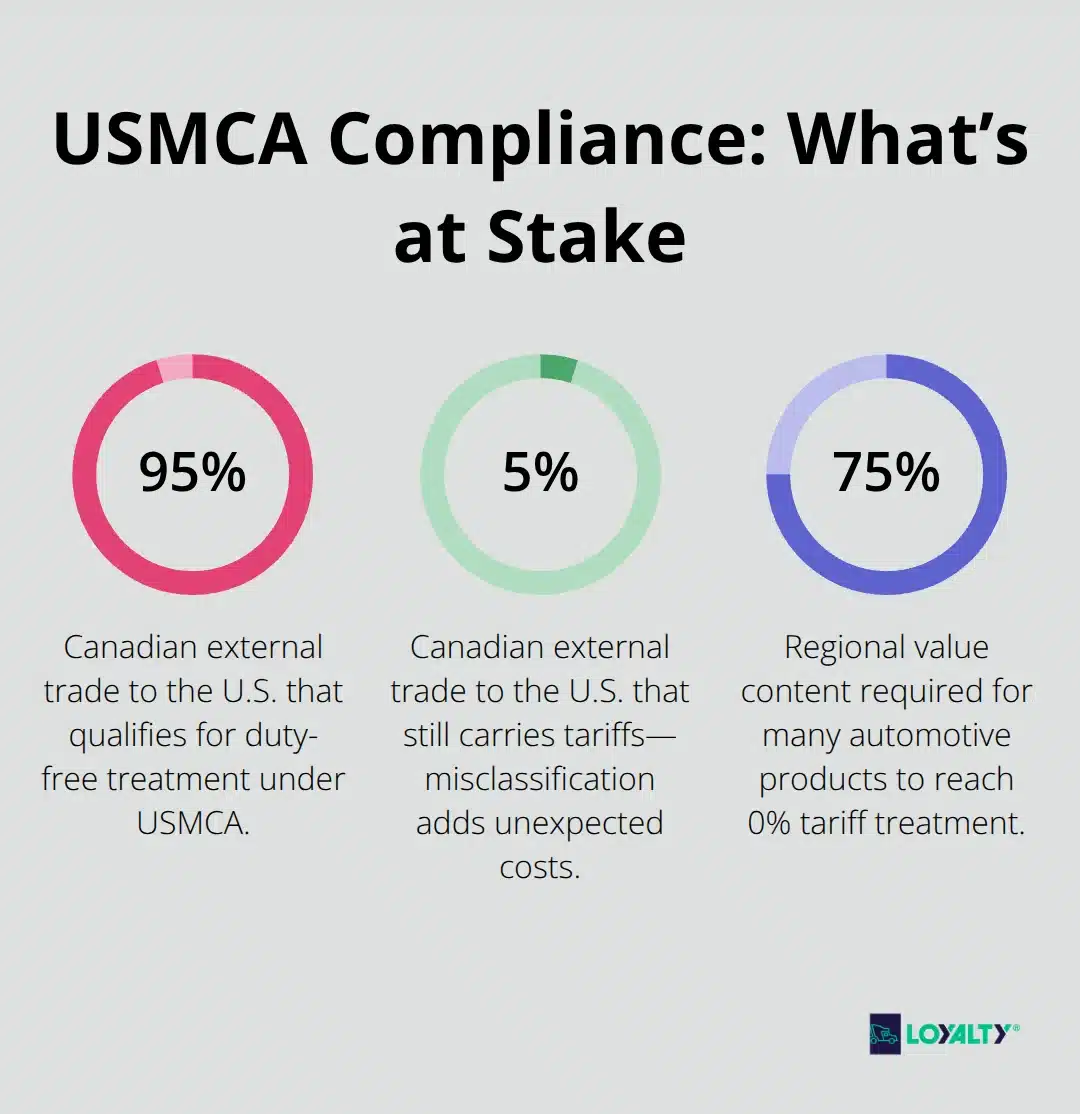
The USMCA entered force on July 1, 2020, and it remains your primary tool to avoid tariffs on qualifying goods moving between the U.S., Canada, and Mexico. However, most logistics managers miss critical compliance details that trigger delays and unexpected costs. About 95% of Canadian external trade to the U.S. qualifies for duty-free treatment under USMCA, but the remaining 5% carries tariffs, and misclassification can cost thousands. Automotive products need roughly 75% regional value content to qualify for 0% tariff treatment, while other sectors have different thresholds.
A Certificate of Origin must include nine mandatory data elements per Annex 5-A: certifier information, exporter or producer details, importer data, a detailed goods description with Harmonized Tariff Schedule code, origin criteria met, blanket period, and signed certification. Missing even one element causes shipment reclassification, delays, and penalties. Since February 1, 2025, a 25% additional tariff applies to virtually all imports from Canada and Mexico (Canadian energy at 10%), imposed under the International Emergency Economic Powers Act. This tariff exposure is treated as permanent, making tariff-qualifying shipments non-negotiable for margin protection. A practical example: a $100 product with $20 freight from Mexico incurs $30 in tariffs on $120 landed cost, totaling $150. The same item under USMCA 0% treatment drops to roughly $120 landed cost. For 10,000 units monthly, that difference translates to approximately $3.6 million annually in tariff costs versus near-zero duty exposure.
Verify Codes Before Shipment
Verify tariff codes before shipment using the U.S. HTS Search, Canada Tariff Finder, and SNICE Mexico to prevent post-shipment disputes. Hidden border costs, storage, demurrage, expedited brokerage, and reclassification fees, often exceed $500 to $2,000 per shipment, compounding tariff exposure. Audit your bill of materials to identify which components qualify for USMCA treatment and which inputs carry the highest tariff burden, this step alone determines whether your landed cost remains competitive. Manufacturing operations that use the IMMEX program for temporary imports stack a second layer of duty deferral on top of USMCA qualification, sharpening landed-cost math further.
Documentation That Clears Customs Faster
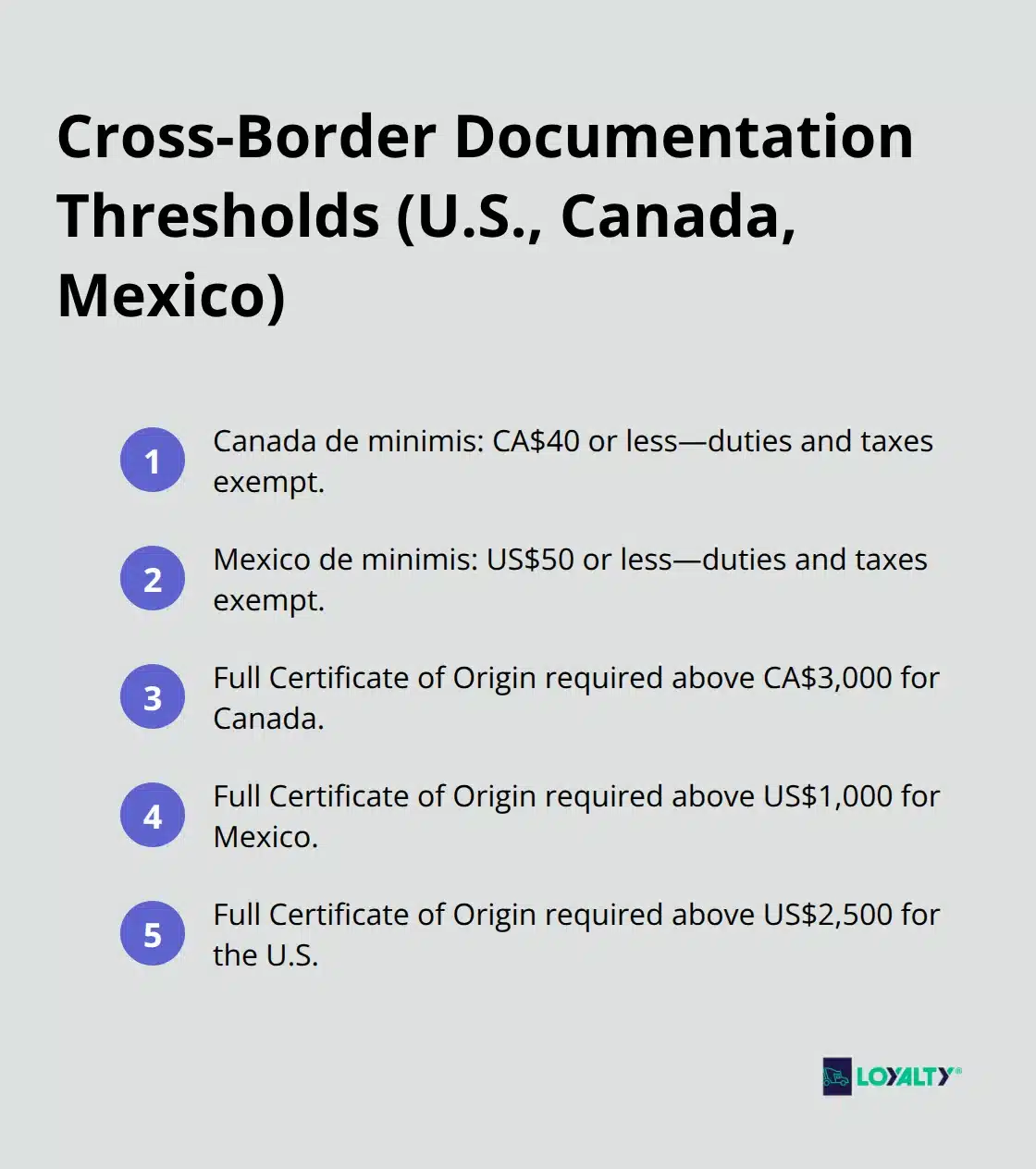
Shipments to Canada require a Canada Customs Invoice, Certificate of Origin, bill of lading, and Customs Coding Form B3-3 submitted by your importer or customs broker. Shipments to Mexico demand an Official Register of Importers, Mexican Import Request, Certificate of Origin, commercial invoice in Spanish, bill of lading, packing list, and shipper export declaration for shipments valued at $2,500 or more. De minimis thresholds reduce paperwork for lower-value shipments: Canada exempts shipments of CA$40 or less from duties and taxes; Mexico exempts shipments of US$50 or less. Shipments above CA$3,000 to Canada, US$1,000 to Mexico, or US$2,500 to the U.S. require a full Certificate of Origin.
CBP binding advanced rulings on USMCA importations are searchable in the CROSS database, and submissions use the eRulings Template, this tool prevents costly classification disputes before shipment. For questions, contact [email protected] for trade agreement inquiries or [email protected] for textile specifics. ACE (Automated Commercial Environment) serves as the official platform for electronic entry filing, and proper documentation submission here eliminates delays.
Standards That Vary by Country
Environmental and safety rules differ across the three countries, and shipments that meet U.S. standards may not clear Canadian or Mexican customs without additional certifications. Mexico requires product safety documentation for regulated goods, while Canada enforces stricter labeling and packaging standards for certain categories. Understanding country-specific regulations beyond basic U.S. safety compliance prevents regulatory surprises that slow clearance. In-Bond shipments routed through U.S. territory like Laredo can move goods to Canada without triggering U.S. tariffs if documentation is correct, real-time tracking ensures compliance with this routing strategy. Cross-border security standards maintained through C-TPAT certification (USA), PIP (Canada), and CSA reduce inspection rates and expedite clearance, making certification investment worthwhile for high-volume shippers. Trucks carry more than 60% of surface trade along the Northern and Southern U.S. land borders according to the Bureau of Transportation Statistics, and Laredo handled about $30.5 billion in cross-border freight during March 2025, up 12.4% from the prior year. The mechanics of freight shipping to Mexico on these routes require the same documentation discipline.
Tariff Escalation and Contract Protection
Your compliance strategy must account for tariff escalation targets: timber faces 10% tariffs and upholstered furniture 25%, with announced increases potentially reaching 30% and 50% by January 2027. Stay updated via the Department of Commerce and USTR, and include tariff adjustment clauses in supplier contracts to protect margins against policy shifts. These regulatory layers, tariffs, documentation, standards, and escalation risk, form the foundation of cross-border cost control. The next section shows how to translate compliance into concrete cost savings through strategic sourcing and transportation decisions.
Trying to coordinate USMCA documentation across three countries with a patchwork of brokers and carriers?
Loyalty Logistics coordinates trilateral cross-border freight with vetted U.S., Canadian, and Mexican customs brokers, ACE/CROSS-aware documentation, and bilingual border management on U.S.-Canada, U.S.-Mexico, and Canada-Mexico corridors.
How to Cut Cross-Border Shipping Costs Without Sacrificing Speed
Compliance alone does not drive savings. Shippers reduce per-unit costs by 15 to 20 percent through deliberate consolidation and mode selection, but only when they align sourcing decisions with tariff exposure and carrier capacity. Start by auditing your top 20 SKUs for monthly volume and tariff treatment. Shipments moving under USMCA qualification cost dramatically less than tariffed alternatives. A 10,000-unit monthly volume from a USMCA-compliant Mexican supplier avoids roughly $3.6 million in annual tariffs compared to non-qualifying sources, but consolidating that volume into fewer, larger shipments cuts per-unit transportation costs by another 8 to 12 percent. The Bureau of Transportation Statistics reported that March 2025 cross-border trucking reached $94.2 billion across U.S.-Canada and U.S.-Mexico corridors, with Laredo alone handling $30.5 billion, up 12.4 percent year-over-year.
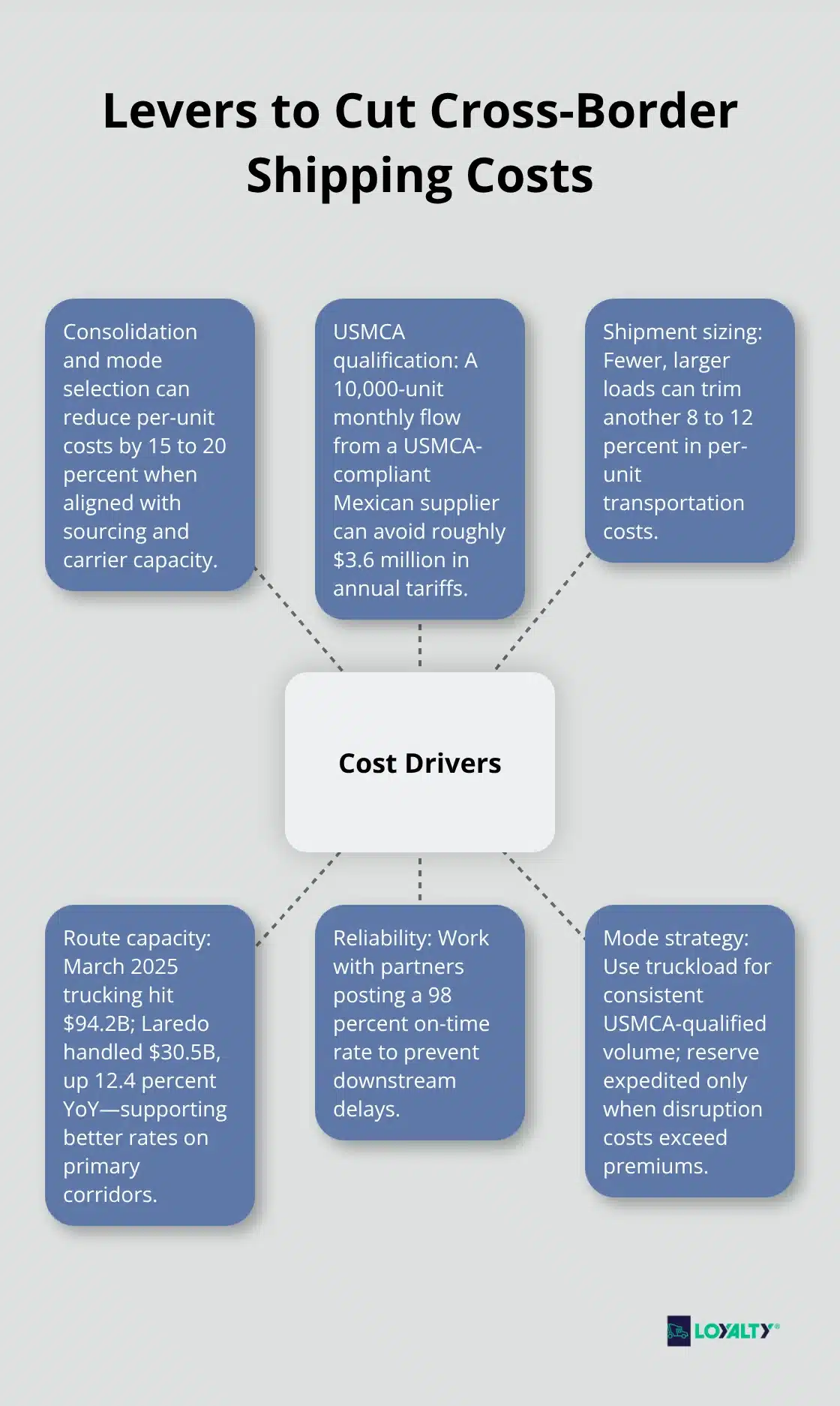
This volume concentration means carriers maintain consistent capacity on primary routes like Laredo-to-Monterrey, where consolidation discounts apply immediately.
Consolidate Volume Strategically Across Routes
Trucks dominate cross-border surface trade at over 60 percent of all freight, making road transport your most flexible option for consolidation. However, consolidation does not always mean full truckloads. Using LTL shipments across multiple tariff-exposed suppliers hedges risk by diversifying sourcing without locking into single-source dependency, even though base transportation costs rise 15 to 20 percent. The trade-off proves worthwhile when tariff policy shifts; you avoid being locked into high-cost sourcing agreements. Route optimization compounds savings. In-Bond shipments routed through Laredo can move goods to Canada without triggering U.S. tariffs if documentation is correct, sometimes justifying longer transit times if a USMCA-compliant facility reduces overall duties. Real-time tracking through ACE ensures compliance and prevents costly reclassification fees that range from $500 to $2,000 per shipment. The same playbook scales northbound on freight shipping to Canada when Canadian suppliers anchor your USMCA-qualified inputs.
Match Transportation Mode to Shipment Profile
Choosing between LTL and truckload depends on your volume consistency and tariff exposure, not just weight. Shipments from USMCA-compliant suppliers benefit from full truckloads because tariff savings already offset per-unit freight costs. Non-qualifying shipments facing the 25 percent tariff impose landed costs so high that transportation mode becomes secondary to sourcing strategy. Expedited cross-border moves justify premium pricing only when supply-chain disruption costs exceed freight premiums. Loyalty Logistics offers both LTL and truckload services with expedited options across U.S.-Canada, U.S.-Mexico, and Canada-Mexico corridors, with a 98 percent on-time rate that prevents downstream delays.
Eliminate Hidden Border Costs Through Proper Documentation
Hidden border costs erode savings faster than transportation rates. Storage, demurrage, expedited brokerage, and reclassification fees routinely exceed $2,000 per shipment when documentation fails or tariff codes require dispute resolution. Proper Certificate of Origin completion with all nine mandatory data elements prevents these fees entirely. Technology bridges the gap between cost reduction and compliance visibility. ACE entry filing platforms show real-time clearance status, and monitoring tariff escalation targets (timber at 10 percent and upholstered furniture at 25 percent, with potential January 2027 increases to 50 percent) allows contract renegotiation before price shocks hit. Sourcing diversification across multiple USMCA suppliers consolidates volume strategically while maintaining margin protection through tariff-risk sharing clauses in contracts. These cost-reduction tactics work only when your supply chain partners understand cross-border compliance requirements and can execute documentation flawlessly, a capability that separates efficient operations from costly delays.
Best Practices for Seamless Cross-Border Operations
Partner Selection Determines Your Cost Structure
Selecting the right partner fundamentally determines whether your cross-border shipments clear customs on schedule or sit in holding yards burning cash. Most logistics managers report that poor partner selection costs them 20 to 30 percent more per shipment through unnecessary delays, reclassification fees, and compliance missteps. The wrong partner treats cross-border moves like domestic freight, missing tariff optimization opportunities and failing to prepare proper Certificates of Origin with all nine mandatory data elements.
Your partner must maintain an in-house customs team that understands evolving USMCA regulations, CBP requirements, and the specific documentation demands of Canada and Mexico. They need bilingual staff coordinating with carriers and border agencies, not generic logistics coordinators reading outdated compliance guides. A licensed Mexican customs broker (agente aduanal) should be embedded in their operation for southbound moves, not outsourced to a third party who lacks visibility into your shipment details.
Access to Carrier Capacity and Pricing Power
When March 2025 cross-border trucking reached $94.2 billion according to the Bureau of Transportation Statistics, volume concentration on primary corridors like Laredo created carrier capacity advantages for shippers with established relationships. Partners with access to top cross-border freight carriers maintain consistent capacity and negotiate spot pricing that independent shippers cannot access.
Loyalty Logistics provides access to industry-leading carriers across U.S.-Canada, U.S.-Mexico, and Canada-Mexico corridors with a 98 percent on-time rate that prevents downstream supply chain disruptions. A single point of contact with dedicated customs expertise and bilingual border management eliminates coordination gaps that plague multi-vendor setups.
Build Flexibility Through Strategic Sourcing
Building a flexible supply chain means abandoning single-source dependency and instead consolidating volume strategically across multiple USMCA-compliant suppliers. This approach requires your partner to manage tariff risk through real-time visibility into which suppliers qualify for duty-free treatment and which shipments face the 25 percent tariff imposed since February 1, 2025.
Route optimization compounds this flexibility: In-Bond shipments routed through Laredo can move goods to Canada without triggering U.S. tariffs if documentation is correct, sometimes justifying longer transit times when a USMCA-compliant facility reduces overall duties. Your partner should model landed costs transparently, accounting for tariff exposure, transportation mode, and border processing time so you understand total cost before shipment commits.
Monitor Visibility Across All Checkpoints
Visibility across all checkpoints means monitoring shipment status through ACE (Automated Commercial Environment) entry filing platforms, not relying on email updates from carriers. Real-time tracking prevents the hidden border costs, storage, demurrage, expedited brokerage, and reclassification fees, that routinely exceed $2,000 per shipment when documentation fails or tariff codes require dispute resolution.
Your partner must alert you to contract renegotiation windows before price shocks hit your margins. Tariff escalation targets like timber at 10 percent and upholstered furniture at 25 percent (with potential January 2027 increases to 50 percent) demand proactive monitoring. C-TPAT certification (USA), PIP (Canada), and CSA compliance maintained by your partner reduce inspection rates and expedite clearance, saving hours at busy gateways like Laredo where $30.5 billion in March 2025 freight moved through in tight windows.
Want a trilateral cross-border partner with bilingual brokers, ACE filing, and itemized landed-cost models?
Tell us your lanes, SKUs, tariff classifications, and monthly volumes. We’ll quote U.S. Canada Mexico freight with USMCA-aware documentation, Laredo routing intelligence, and 98% on-time performance across all three corridors.
Final Thoughts
Cross-border efficiency requires three interconnected decisions: tariff optimization through USMCA qualification, cost reduction via strategic consolidation, and operational visibility through proper documentation and partner selection. Logistics managers who treat these elements separately waste thousands monthly on hidden border costs, reclassification fees, and compliance delays. The data proves the point: a $100 product from Mexico costs $150 landed under the 25% tariff but drops to $120 under USMCA treatment, for 10,000 monthly units, that gap represents $3.6 million annually.
Your action plan requires three steps over one quarter. First, audit your top 20 SKUs for USMCA eligibility and regional value content, then verify Harmonized Tariff Schedule codes across U.S., Canada, and Mexico databases. Second, standardize your Certificate of Origin documentation to include all nine mandatory data elements and implement real-time tracking through ACE entry filing. Third, consolidate volume strategically across multiple USMCA-compliant suppliers while negotiating tariff-risk sharing clauses into supplier contracts.
U.S. Canada Mexico shipping demands partners who understand tariff exposure, maintain in-house customs expertise, and provide real-time visibility across all checkpoints. We at Loyalty Logistics operate across all three countries with bilingual border management staff, licensed customs brokers, and access to industry-leading carriers that maintain a 98% on-time rate. Explore our freight transportation services to discuss your cross-border strategy and get a free quote for your next shipment.
Frequently Asked Questions
What documents are required for U.S. Canada Mexico shipping under USMCA?
Cross-border shipments under USMCA require a Certificate of Origin with nine mandatory data elements per Annex 5-A (certifier, exporter, importer, goods description with HTS code, origin criteria, blanket period, signed certification). Canada-bound shipments also need a Canada Customs Invoice, bill of lading, and Customs Coding Form B3-3. Mexico-bound shipments need an Official Register of Importers, Mexican Import Request, commercial invoice in Spanish, packing list, and shipper export declaration for shipments above $2,500.
How much does USMCA save on tariffs for cross-border shipments?
USMCA-qualified goods move duty-free across U.S., Canada, and Mexico borders. About 95% of Canadian external trade to the U.S. qualifies for duty-free treatment. Without USMCA qualification, since February 1, 2025, a 25% additional tariff applies to virtually all Canadian and Mexican imports (Canadian energy at 10%). A practical example: 10,000 units monthly of a $100 Mexico-sourced product avoid roughly $3.6 million annually in tariffs versus non-qualifying alternatives. Automotive products need 75% regional value content for 0% tariff treatment.
What’s the difference between shipping to Canada vs. Mexico from the U.S.?
Canada-bound shipments need Customs Coding Form B3-3 and trigger CA$40 de minimis exemption below the threshold. Mexico-bound shipments require an Official Register of Importers and a Spanish-language commercial invoice; de minimis exempts shipments of US$50 or less. Mexico imposes additional NOM product safety standards beyond U.S. requirements; Canada enforces stricter labeling and packaging for certain categories. Laredo handles roughly $30.5 billion monthly in U.S.-Mexico freight, making it the dominant southbound gateway with capacity advantages but congestion risk.
How long does cross-border customs clearance take in North America?
Cross-border customs clearance ranges from a few hours to several days depending on documentation quality, tariff classification accuracy, and inspection rates. Shipments with complete Certificate of Origin documentation, accurate HTS codes, and ACE pre-filing typically clear in 24-48 hours. Reclassification disputes, missing data elements, or random inspections can extend clearance by 3-10 days plus storage and demurrage fees of $500-$2,000. C-TPAT, PIP, and CSA security certifications reduce inspection rates significantly for high-volume shippers.
Ready to Coordinate U.S. Canada Mexico Shipping Without Coordination Gaps?
Trilateral USMCA freight rewards shippers who partner with carriers running bilingual customs teams, ACE filing capability, and itemized landed-cost models. Tell us your lanes, SKUs, tariff classifications, and monthly volumes and we’ll quote cross-border freight with USMCA-aware documentation and 98% on-time performance.
Related Articles
- IMMEX Program: Complete Guide for Exporters: Manufacturing duty deferral that stacks on top of USMCA qualification.
- Understanding Tariffs on Canada and Mexico: Tariff math that determines USMCA qualification value.
- How to Navigate Freight Shipping to Mexico Successfully: Mexico-specific operational playbook for southbound moves.
Loyalty Logistics: Connecting businesses with opportunities across North America.
Written by: Carlos Robayo, Marketing Director at Loyalty Logistics
With expertise in logistics marketing and international trade, Carlos specializes in connecting businesses with efficient and reliable transport solutions for the North American market.

