
The IMMEX program is one of Mexico’s most powerful tools for exporters, yet many manufacturers still underutilize it. At Loyalty Logistics, we’ve seen firsthand how companies that master this program gain significant competitive advantages on cross-border freight operations.
Whether you’re managing complex supply chains or looking to reduce costs, understanding the IMMEX program’s requirements and benefits is essential. This guide walks you through everything you need to know to operate compliantly and efficiently.
How IMMEX Works and Who Can Use It
Understanding the IMMEX Framework
IMMEX stands for Industria Manufacturera, Maquiladora y de Servicios de Exportación, a Mexican federal program that allows you to temporarily import raw materials, machinery, and components without paying duties, as long as you export the finished goods. This isn’t a loophole or tax shelter, it’s a legally sanctioned export incentive that originated from Mexico’s Maquiladora program in 1965 and evolved into its modern form. The mechanics are straightforward: you bring inputs into Mexico duty-free, manufacture your product, and export it within an 18-month window. Once your finished goods leave Mexico, the temporary import clears and duties are avoided entirely. For exporters manufacturing near the U.S. border in sectors like automotive, electronics, medical devices, and aerospace, this structure creates real cost advantages. The program works because it aligns with trade agreements like USMCA, which means your exported products benefit from reduced tariffs across North America. However, IMMEX isn’t suitable if your business plan centers on selling products inside Mexico, the program requires that you export to justify the duty exemptions.
Eligibility and Registration Requirements
To qualify, your company needs annual exports exceeding USD 500,000 or representing at least 10% of total turnover, according to the Mexican Secretariat of Economy. You’ll also need a legal entity registered in Mexico, an automated FIFO inventory system to track temporary imports, and monthly customs declarations filed by a licensed Mexican customs broker.
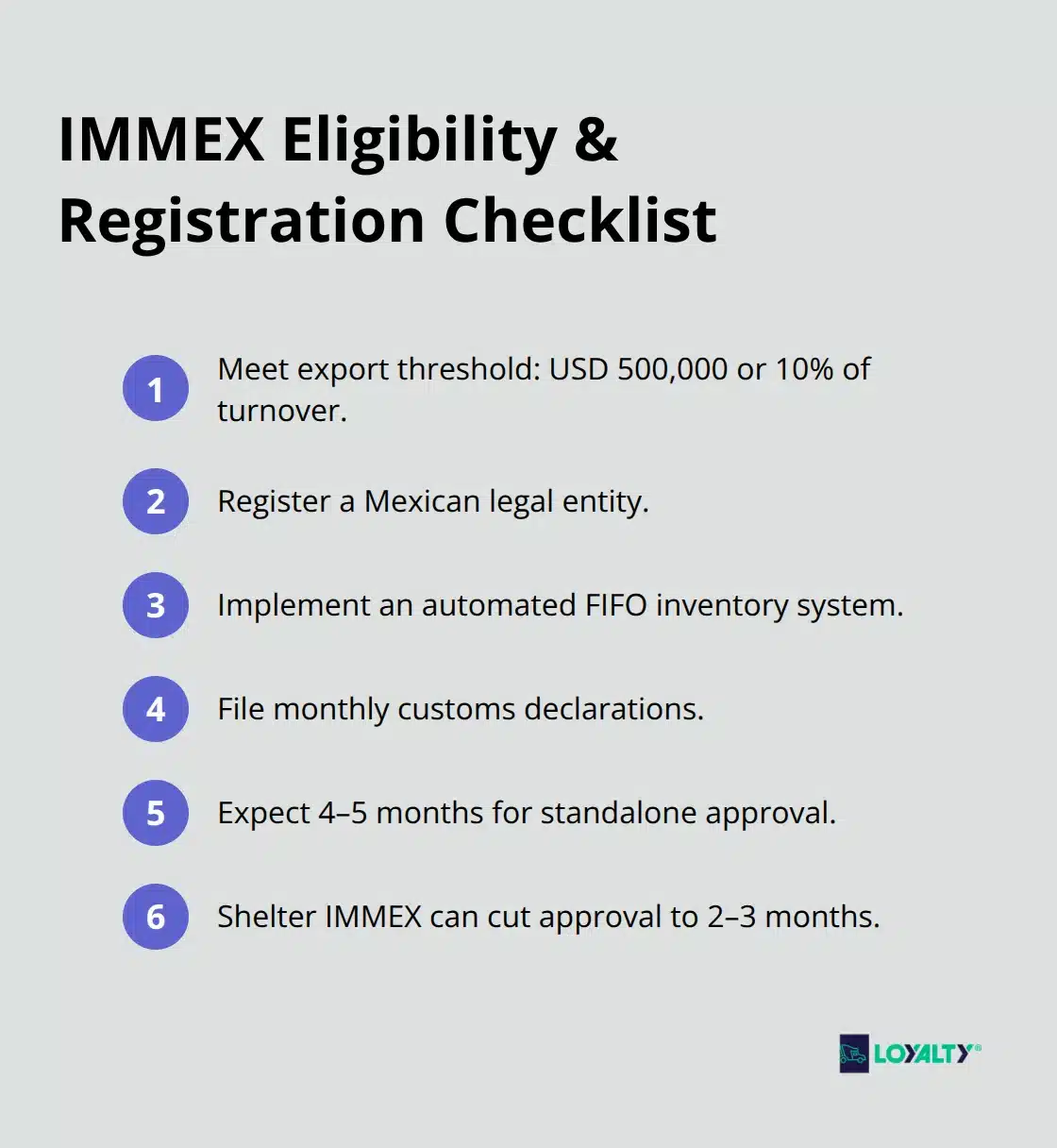
The approval process typically takes 4 to 5 months for a standalone IMMEX registration, though working through an existing shelter company can cut that to 2 or 3 months. Shelter IMMEX offers the fastest entry point for newcomers because you join an established program rather than building one from scratch. Once approved, you can import machinery and equipment that stays in Mexico for the duration of your IMMEX authorization, while raw materials and components cycle through with the 18-month deadline. Operators serving Tier 1 suppliers in industrial manufacturing sectors benefit most from this structure when production volumes justify the compliance overhead.
Managing VAT and Compliance Obligations
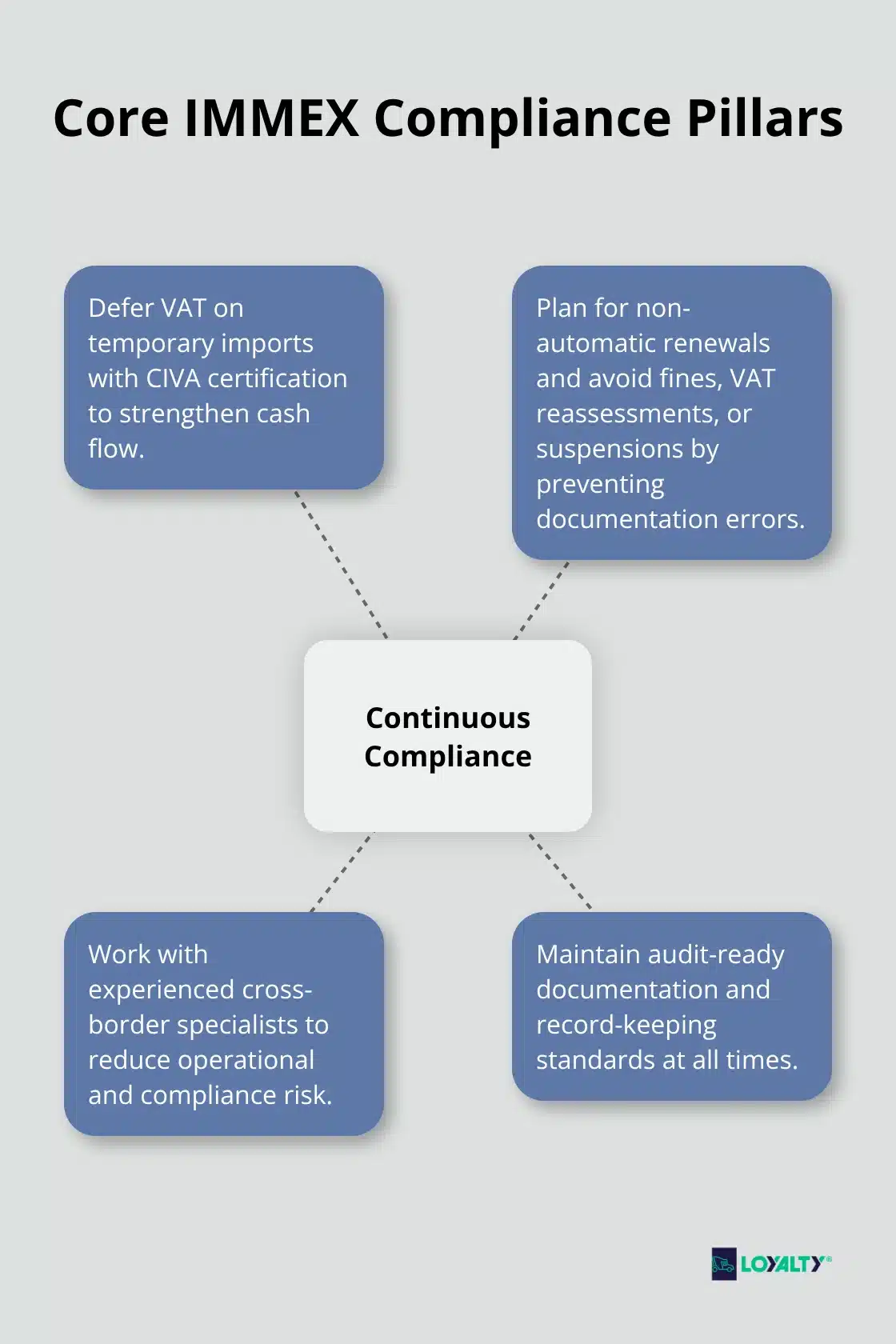
VAT on temporary imports can be deferred if you obtain CIVA certification, which improves cash flow significantly. One critical point: IMMEX privileges aren’t automatically renewed, and non-compliance, even documentation errors, can result in fines, VAT reassessment, or program suspension. This is why working with trade compliance specialists or logistics partners experienced in cross-border IMMEX operations reduces risk substantially. The next section covers the specific documentation and record-keeping standards that keep your operations compliant and audit-ready.
Looking for a cross-border freight partner who already operates inside IMMEX supply chains?
Loyalty Logistics coordinates cross-border freight with vetted Mexican customs brokers, CIVA-aware documentation, and Tier 1 manufacturing experience across U.S., Canada, and Mexico.
Staying Compliant With IMMEX Operational Standards
Monthly Reporting and Documentation Requirements
The Mexican Secretariat of Economy requires monthly customs declarations and precise inventory tracking from the moment goods enter Mexico until they ship out. This isn’t optional paperwork, authorities use digital monitoring tools to track temporary import flows, and non-compliance triggers penalties that can halt production entirely. Your FIFO inventory system must link every imported input to its corresponding export transaction, creating an audit trail that survives government inspections.
Documentation errors represent the most common violation we observe: misclassified goods, incomplete shipping records, or inventory discrepancies that don’t match monthly INEGI reports on employees involved in IMMEX operations. One electronics manufacturer lost three weeks of production because their customs broker failed to match component serial numbers to export manifests, a detail that should have taken 30 minutes to verify. Your monthly reporting obligations include submitting data to INEGI on workforce, an annual RAOCE report to the Secretariat of Economy detailing all foreign trade operations, and notifications to both SE and SAT whenever corporate structure changes occur.
Inventory Management and Storage Solutions
Bonded warehousing stores imported materials duty-free until production begins, which optimizes inventory and cash flow if you manage seasonal demand or long lead times from suppliers. Pairing IMMEX with bonded warehousing creates two layers of duty deferral that compound when import volumes are high. The 18-month deadline for exporting finished goods applies strictly to raw materials and components; machinery and equipment stay in Mexico indefinitely under your IMMEX authorization, but only if you maintain active export operations and pass compliance audits. Digital inventory control systems reduce administrative burden while maintaining the documentation standards that Mexican authorities expect during inspections.
Tax Obligations and Recent Regulatory Changes
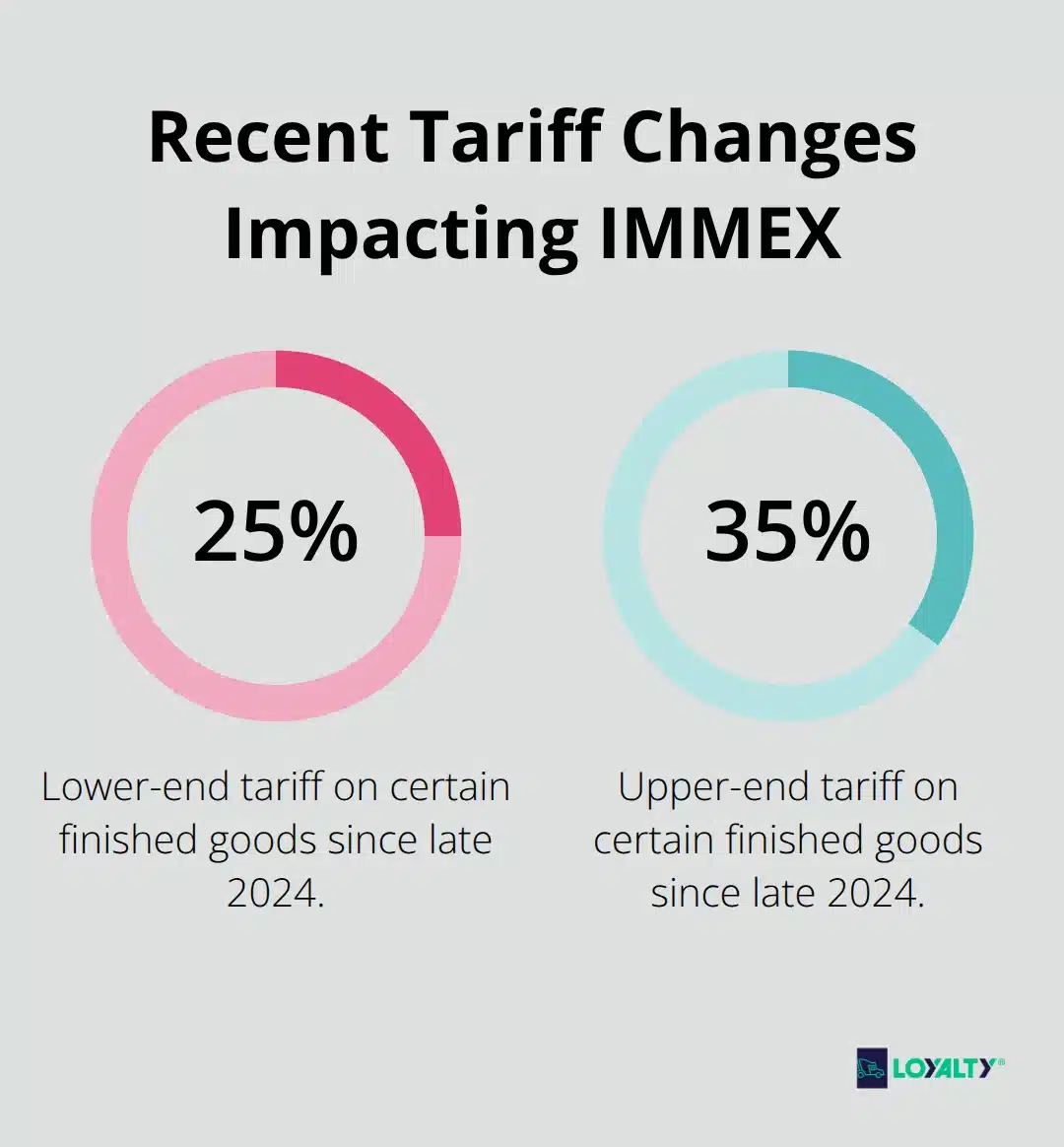
VAT on temporary imports can be deferred through CIVA certification, but this requires separate application and typically adds several months to your approval timeline. Income tax remains fully applicable on profits from IMMEX operations, the program doesn’t eliminate that obligation. Since late 2024, Mexican authorities tightened enforcement due to abuse in the apparel and 3PL sectors, with dozens of IMMEX registrations cancelled for non-compliance and new tariffs on certain finished goods ranging from 25% to 35%. Reviewing Mexico tariffs in 2026 alongside your IMMEX classifications is now table stakes.
This means your landed cost calculations need updating if you haven’t reviewed them recently. Compliance costs have risen alongside regulatory scrutiny, making it essential to partner with logistics providers who demonstrate transparent reporting and cross-border expertise. The next section addresses how to navigate these cost pressures while maintaining operational efficiency across your supply chain.
Real Costs of IMMEX Mistakes and How to Avoid Them
Inventory Tracking Failures and Production Delays
The gap between IMMEX theory and operational reality widens when you factor in inventory management failures and tariff recalculations. Exporters who operate IMMEX programs discover mid-production that their landed costs have shifted dramatically because new tariff classifications applied to finished goods, or that inventory tracking errors triggered a compliance audit costing them weeks of production delays. Since late 2024, the Mexican Secretariat of Economy cancelled dozens of IMMEX registrations for non-compliance, and many of those cancellations stemmed from preventable mistakes in how companies tracked imports, matched goods to exports, or reported transactions monthly.
The real cost isn’t just the fine or the suspension, it’s the operational disruption that follows. An automotive parts supplier lost 18 days of cross-border shipments when their FIFO inventory system failed to reconcile a batch of imported fasteners to the corresponding export manifest. That delay cascaded through their customer’s assembly line and cost them a contract worth six figures. Your inventory system must link every imported SKU to its production run and track it through export with serial numbers or batch codes that auditors can verify in minutes, not hours.
Digital Monitoring and Documentation Compliance
The compliance burden has intensified because Mexican authorities now use digital monitoring tools to flag anomalies in temporary import flows, and even documentation gaps that wouldn’t have triggered action two years ago now invite inspections. If your customs broker, manufacturer, and logistics partner fail to communicate transparently about what enters Mexico, how production uses it, and when it ships out, you’ll face reconciliation problems that compound quickly. Smart shippers connect IMMEX compliance to the broader playbook of freight shipping to Mexico so documentation, transit, and customs clearance reinforce each other rather than create gaps.
Your monthly reporting obligations demand precision. Mismatched serial numbers, incomplete shipping records, or inventory discrepancies that don’t align with INEGI reports on workforce create audit triggers that halt operations. Work with trade compliance specialists who verify that your documentation practices meet current standards and that your logistics partners maintain transparent reporting practices rather than simply processing paperwork.
Tariff Recalculation and Cost Margin Analysis
Tariff calculations have become more complex. New rules require companies to verify their product classifications under specific annexes and decrees to maintain IMMEX eligibility, and tariffs on certain finished goods now range from 25% to 35% depending on category. This means your cost advantage erodes if you haven’t recalculated landed costs recently.
Pull a sample of your current imports and have a trade compliance specialist verify the tariff classifications under current rules. Then recalculate profitability across your major product lines. If margins tighten significantly, you may need to shift production schedules to prioritize high-margin items, negotiate supplier pricing in light of higher tariffs, or evaluate whether nearshoring through IMMEX still makes economic sense compared to U.S.-based warehousing and direct distribution.
Continuous Compliance as Competitive Advantage
The companies winning with IMMEX right now treat compliance and cost management as continuous processes, not annual checkboxes. They partner with logistics providers who maintain transparent reporting practices and demonstrate hands-on cross-border expertise. They audit their tariff classifications quarterly rather than annually. They reconcile inventory monthly against export manifests rather than waiting for government inspections to reveal gaps.
Need a logistics partner who already speaks IMMEX, CIVA, and 25-35% tariff math?
Tell us your inputs, finished-goods categories, and export volumes. We’ll quote cross-border freight with vetted Mexican brokers, FIFO-aware documentation, and transparent landed-cost modeling so margins don’t erode silently.
Final Thoughts
The IMMEX program delivers measurable advantages for exporters willing to operate compliantly. You reduce upfront costs through duty exemptions on raw materials and components, improve cash flow by deferring VAT until finished goods ship, and gain access to Mexico’s skilled labor and supply chain infrastructure. For manufacturers in automotive, electronics, medical devices, and aerospace, these benefits translate directly to competitive pricing in North American markets.
However, the IMMEX program only works if you treat compliance as a core operational function, not an afterthought. If you already operate under IMMEX, audit your tariff classifications immediately and recalculate landed costs under the new regulatory environment. Verify that your inventory tracking system meets current standards and that your customs broker maintains transparent reporting practices.
Getting started requires working with partners who understand cross-border operations. We at Loyalty Logistics specialize in timely, damage-free delivery across the U.S., Canada, and Mexico, with a 98% on-time rate and more than 10,000 successful deliveries. Explore our freight transportation services to see how we support exporters navigating cross-border supply chains efficiently.
Frequently Asked Questions
What is the IMMEX program in Mexico?
IMMEX (Industria Manufacturera, Maquiladora y de Servicios de Exportación) is a Mexican federal program that lets exporters temporarily import raw materials, machinery, and components without paying duties, as long as the finished goods are exported within 18 months. It originated from the 1965 Maquiladora program and aligns with USMCA trade benefits across North America. Sectors that benefit most include automotive, electronics, medical devices, and aerospace.
Who is eligible for the IMMEX program?
To qualify for IMMEX, your company needs annual exports exceeding USD 500,000 or representing at least 10% of total turnover (per Mexican Secretariat of Economy rules), a legal entity registered in Mexico, an automated FIFO inventory system that tracks every temporary import to its export, and capacity to file monthly customs declarations through a licensed Mexican customs broker. Businesses focused on domestic Mexican sales are not eligible because the program requires export activity.
How long does IMMEX approval take?
Standalone IMMEX registration typically takes 4 to 5 months. Working through an existing shelter IMMEX program cuts approval to 2 to 3 months because you join an established structure instead of building one from scratch. CIVA certification for VAT deferral is a separate application that adds several months to the timeline. Plan registration around production launch dates to avoid duty exposure on early imports.
What are the tax benefits of the IMMEX program?
IMMEX defers customs duties on temporary imports of raw materials, components, and machinery as long as finished goods are exported within 18 months. With CIVA certification, you can also defer VAT on temporary imports, improving cash flow significantly. Income tax remains fully applicable on IMMEX operations. Tariffs on certain finished goods now range from 25% to 35% since late 2024 enforcement tightened, so verify tariff classifications under current Mexico tariff rules before assuming historical margin levels still apply.
Ready to Operate IMMEX With a Cross-Border Freight Partner Who Gets It?
IMMEX pays off when compliance, logistics, and customs broker coordination line up. Tell us your inputs, finished-goods categories, export volumes, and lanes and we’ll quote cross-border freight transportation paired with vetted Mexican brokers and audit-ready documentation so duty deferral and logistics work together transparently.
Related Articles
- Customs Broker in Mexico: The licensed agente aduanal role that files Pedimentos for every IMMEX import and export.
- Mexico Tariffs: What You Need to Know: Tariff changes since late 2024 that directly impact IMMEX landed-cost math.
- How to Navigate Freight Shipping to Mexico Successfully: Operational companion to IMMEX compliance, documentation, and Previo en Origen.
Loyalty Logistics: Connecting businesses with opportunities across North America.
Written by: Carlos Robayo, Marketing Director at Loyalty Logistics
With expertise in logistics marketing and international trade, Carlos specializes in connecting businesses with efficient and reliable transport solutions for the North American market.

