
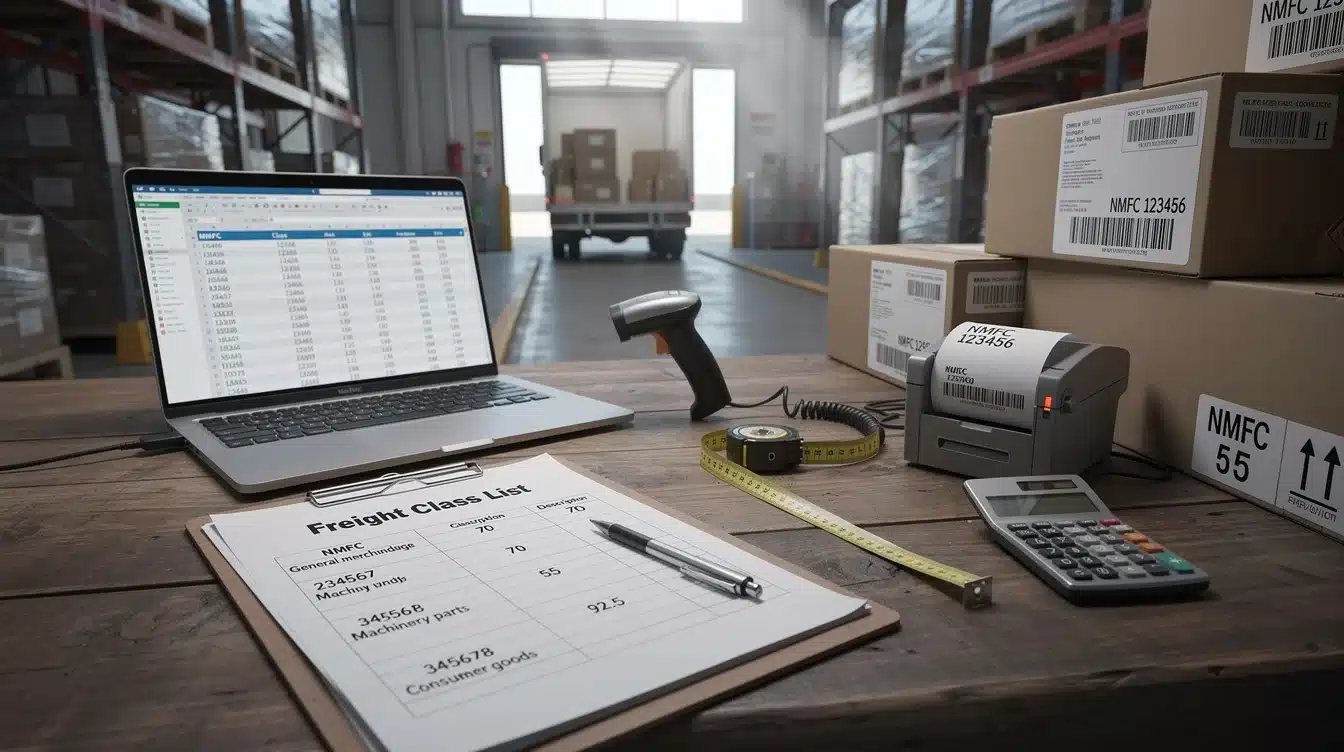
Freight class list NMFC codes determine how much you pay to ship goods across North America. Get the classification wrong, and you’re looking at unexpected surcharges, delayed shipments, and frustrated customers.
At Loyalty Logistics, we’ve seen logistics managers waste thousands annually because they misclassified a single shipment type. This guide walks you through all 18 freight classes so you can classify accurately and cut costs.
What Drives Freight Class Decisions
Freight class is not arbitrary. The National Motor Freight Traffic Association assigns one of 18 classes to every less-than-truckload shipment based on four measurable factors: density, stowability, handling, and liability. Density-measured in pounds per cubic foot-often exerts the heaviest influence on your final rate. A shipment of steel parts at 50 pounds per cubic foot lands in Class 50 and costs far less to move than the same weight in pillows at 2 pounds per cubic foot, which falls into Class 175. Stowability determines how efficiently your freight fits alongside other loads; irregular shapes, hazardous goods, or items that require special positioning push you into higher classes. Handling assesses whether your product needs extra care, climate control, or careful loading. Liability reflects the risk of theft, damage, or spoilage-high-value electronics receive different ratings than bulk cement.
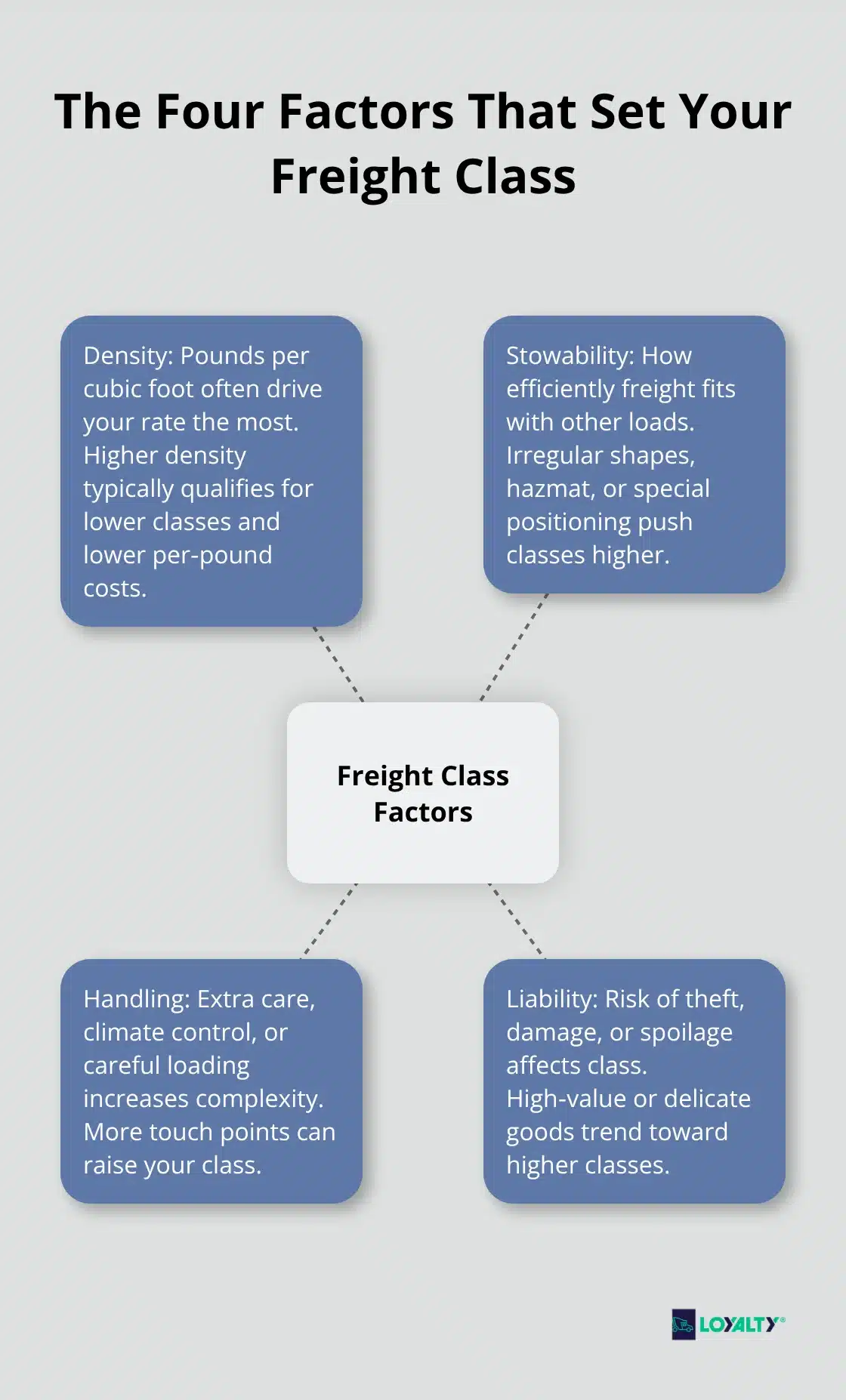
These four criteria work together, and misunderstanding even one can cost you hundreds in reclassification fees when a carrier audits your shipment at pickup.
Density Dominates Your Rate Quote
Incorrect density calculations lock you into overpaying. A refrigerator weighing 250 pounds and occupying 25 cubic feet calculates to 10 pounds per cubic foot, landing it in Class 92.5. But if you measure incorrectly and report 15 cubic feet, you inflate the density to 16.7 pounds per cubic foot, bumping it to Class 85-a lower class that saves you money on paper but invites a carrier reclassification and penalty when they reweigh and remeasure. The NMFTA publishes density ranges for common items: Class 50 handles items over 50 pounds per cubic foot, Class 55 covers 35–50 pounds per cubic foot, and Class 175 applies to lightweight items like clothing at 5–6 pounds per cubic foot. Measure length, width, and height in inches, multiply them, divide by 1,728 to convert to cubic feet, then divide the actual weight by that volume. Use a scale accurate to at least 1 pound and a measuring tape, not estimates.
Stowability and Handling Shape Real Costs
Stowability extends beyond fitting in a trailer. A pallet of books in uniform boxes stacks cleanly and takes up predictable space, but a shipment of automotive sheet metal with irregular edges creates voids and wastes cubic footage, pushing it to Class 150. Similarly, a crate of machinery that requires forklift handling and careful positioning lands in Class 85, while a case of wine in a standard box moves as Class 100. Liability matters most when you ship high-value goods or regulated items. A shipment of computers worth $15,000 falls into Class 92.5, but the same weight in smartphones-at higher theft and damage risk-climbs toward Class 100 or higher. Carriers assess liability based on industry norms and historical claims data. If your product has a history of damage claims or spoilage, expect a higher class assignment.
Protect Yourself at Pickup
Document the condition of your shipment at pickup with photos and detailed notes. This protection matters if a carrier later claims damage occurred during transit and attempts to deny your claim or shift costs to you. Accurate documentation also supports your classification decisions if disputes arise. When you move to the next section, you’ll see how these four factors translate into specific class assignments and what each class actually costs you.
Tired of NMFC reclassifications hitting your invoices weeks after pickup?
Loyalty Logistics verifies freight classifications before booking and runs LTL capacity with itemized pricing, density audits, and zero surprise reclass fees across U.S., Canada, and Mexico lanes.
What Each Freight Class Actually Costs You
Dense Cargo Commands the Lowest Rates
Class 50 through Class 85 handle your densest, most straightforward shipments and command the lowest rates in the LTL market. Class 50 applies to items exceeding 50 pounds per cubic foot-steel coils, machine castings, concrete blocks-goods so dense that carriers maximize trailer utilization and minimize handling risk. Class 55 covers bricks, cement, and hardwood flooring at 35–50 pounds per cubic foot. Class 60 includes automotive parts and accessories at 30–35 pounds per cubic foot. Class 65 adds bottled beverages and books in boxes at 22.5–30 pounds per cubic foot. Class 70 captures automobile engines and food items at 15–22.5 pounds per cubic foot. Class 77.5 addresses tires and bathroom fixtures at 13.5–15 pounds per cubic foot. Class 85 handles crated machinery and cast iron stoves at 12–13.5 pounds per cubic foot.
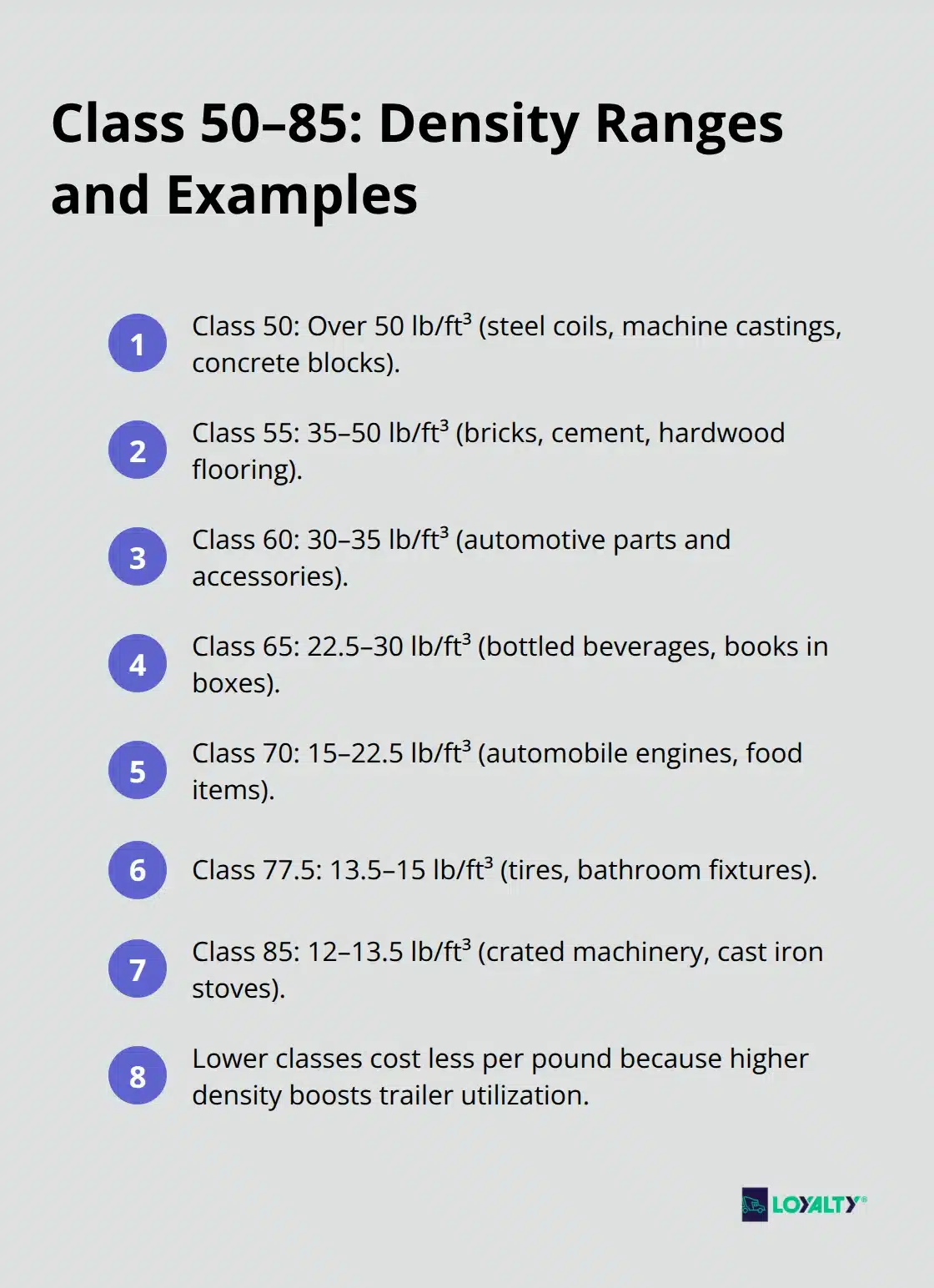
These lower classes ship for pennies per pound in the LTL market because density drives efficiency. A 10,000-pound shipment of steel at Class 50 costs roughly $800 to move 500 miles, while the same weight in Class 85 runs closer to $1,200. Modeling these jumps with a freight shipping cost estimator before booking prevents budget surprises. Misclassify dense freight upward by even one class, and you overpay by 15–25% on every shipment until you correct it. For a visual reference of all 18 classes side-by-side with this list, the freight shipping class chart guide works as a quick-lookup companion.
Mid-Range Freight Reflects Handling Complexity
Classes 92.5 to 150 represent the middle ground where most general merchandise and electronics land. Class 92.5 covers computers, monitors, and refrigerators at 10.5–12 pounds per cubic foot. Class 100 includes boat covers, wine cases, and canvas at 9–10.5 pounds per cubic foot. Class 110 applies to framed artwork, cabinets, and table saws at 8–9 pounds per cubic foot. Class 125 handles small household appliances at 7–8 pounds per cubic foot. Class 150 captures auto sheet metal parts and bookcases at 6–7 pounds per cubic foot. These classes demand higher rates because handling complexity increases. A refrigerator requires careful loading to prevent damage; artwork needs protection from crushing; appliances attract theft. Carriers price accordingly. A 5,000-pound shipment in Class 100 costs roughly 40–50% more per pound than Class 50. The premium reflects real operational costs, not arbitrary markups.
Premium Classes Protect Against Risk
Classes 175 to 500 apply to fragile, high-liability, or irregular cargo and represent the premium tier. Class 175 covers clothing and stuffed furniture at 5–6 pounds per cubic foot. Classes 200 and above apply to items with extreme fragility, high theft risk, or specialized handling needs. Glass products, electronics with volatile components, and regulated goods climb toward Class 500. A 2,000-pound shipment of fine art or hazardous materials can exceed $2,000 for 500 miles. The cost jump reflects genuine carrier risk. Misclassify downward into Class 150 when Class 200 applies, and a carrier reclassification at pickup triggers a reclass fee of $75–$150 plus the rate difference applied retroactively. That single mistake wipes out margin on five shipments.
Verify Your Classifications Now
Pull your last 50 shipments and calculate actual density using the formula from the previous section. Verify each class assignment against the NMFTA density ranges. Most logistics teams find 10–15% of their shipments misclassified. Correct those assignments before your next carrier rate negotiation. Carriers respect shippers who maintain accurate classifications and reward them with better pricing and service levels. Once you know your correct classifications, the next section shows you how to identify and fix the mistakes that cost you the most money.
Watching $75-$150 reclass fees stack up across dozens of shipments?
Tell us your shipment weights, dimensions, and freight class assumptions. We’ll quote LTL with class verification, density audits, and itemized pricing so reclassification fees stop showing up on your invoices.
Getting Your Freight Class Right
Measure Your Shipments Accurately
Start with what you ship most often and measure it properly. Pull three representative shipments from your top product categories and calculate actual density using the formula from the previous section: length times width times height in inches, divided by 1,728, then divide weight by that cubic footage result. Most logistics managers estimate dimensions and weights instead of measuring, which introduces 10–20% error into density calculations. Use a digital scale accurate to 1 pound and a measuring tape, not visual guesses. Document these measurements in a spreadsheet and cross-reference them against the NMFTA density ranges for Classes 50 through 175. You’ll likely find that 2–3 of your top SKUs are misclassified by one or two classes. Those errors compound fast: a 15% upward misclassification on 100 shipments per month adds $3,000–$5,000 annually in unnecessary freight charges.
Secure Written Confirmation From Your Carrier
Once you nail down the correct classes for your high-volume items, request written confirmation from your carrier. Carriers often use ClassIT or proprietary tools to assign classes, and getting that confirmation in writing protects you if they later attempt a reclassification at pickup. Store these confirmations in a central document linked to each product SKU so your shipping team has instant reference without guessing. This documentation becomes your defense against surprise fees and billing disputes.
Identify Where Misclassification Happens Most
Misclassification occurs most when products fall between density ranges or when stowability and handling override density calculations. A shipment of bottled beverages at 28 pounds per cubic foot sits at the high end of Class 65, but if those bottles are loosely packed in an odd-shaped crate that wastes cubic space, stowability pushes it toward Class 70. Similarly, lightweight items like pillows or foam padding often get underclassified because shippers focus only on weight and ignore the handling complexity of irregular shapes.
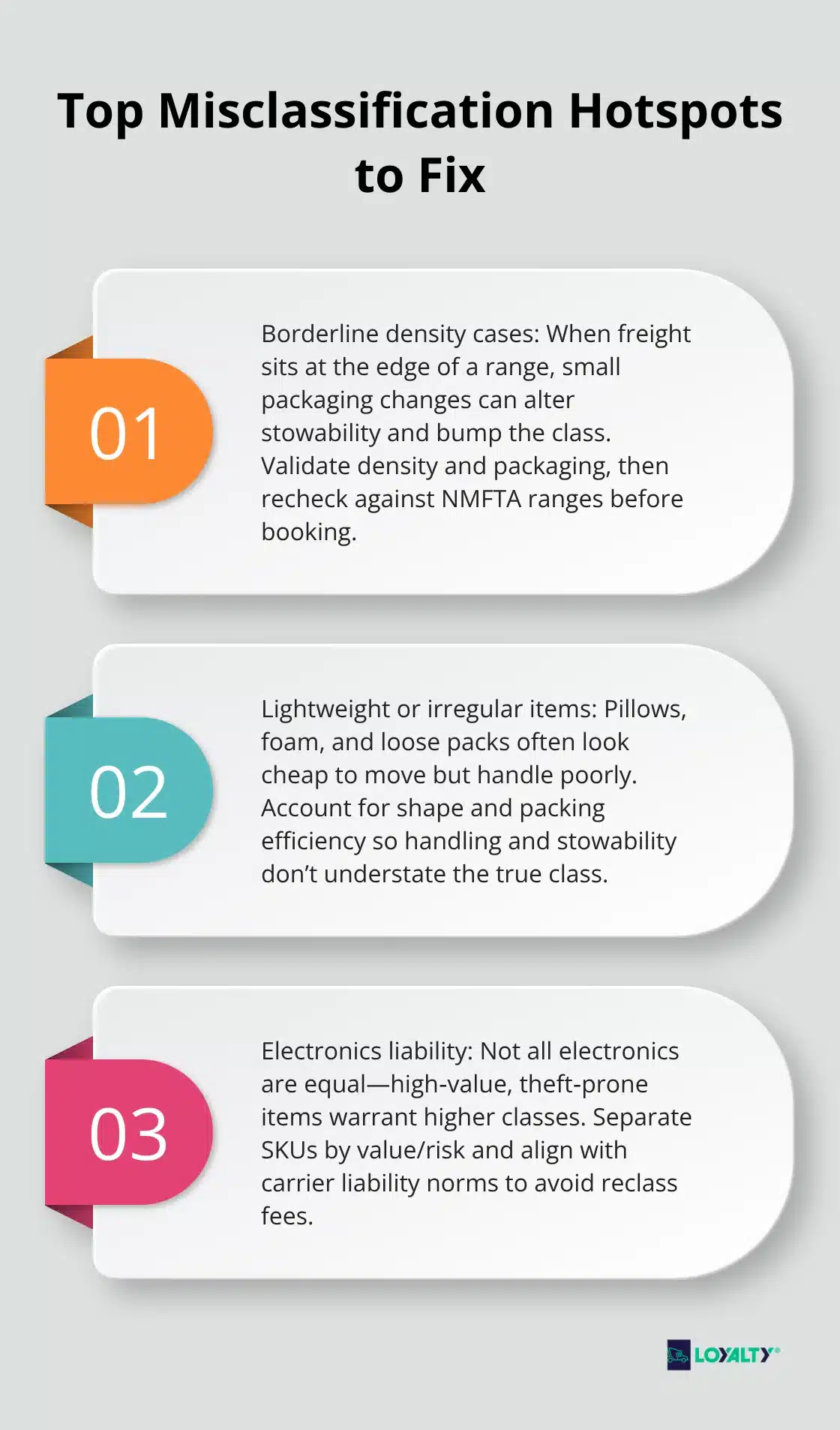
The second most common mistake is treating all electronics the same: a $500 refrigerator and a $25,000 server have vastly different liability profiles, and carriers will reclassify downward-assigned electronics to higher classes based on theft and damage risk.
Audit Your Past Shipments and Fix Your Process
Audit your BOLs from the past six months and compare the classes you assigned against what carriers actually charged you. If you see reclassification fees appearing regularly, that’s your signal that your internal classification process is broken. Fix it by assigning classification responsibility to one person or team, creating a written SOP that references NMFTA density tables, and requiring that person to verify density calculations before shipments leave your facility. Tools like ClassIT+ provide real-time NMFC data and density calculators that integrate directly into your TMS or quoting software, reducing human error and keeping classifications current as NMFC rules change. The NMFTA rolled out Phase 1 density-based updates on July 19, 2025, affecting a large share of shipments, so using outdated reference materials guarantees future reclassifications.
Prioritize Accuracy for Cross-Border Shipments
If you handle cross-border shipments to Canada or Mexico, accuracy becomes even more important because customs brokers and carriers will flag misclassified freight before pickup, causing delays and forcing expensive corrections on tight timelines. Correct classifications speed clearance and protect your margins on international lanes where reclassification costs hit harder.
Final Thoughts
Freight class accuracy determines your bottom line immediately and compounds across your annual volume. We at Loyalty Logistics have watched logistics managers recover thousands in annual savings simply by auditing their top 50 shipments and correcting misclassifications. A single Class 50 shipment misclassified as Class 85 costs you 40–50% more per pound, and that error multiplied across 100 monthly shipments bleeds $3,000–$5,000 annually in preventable overcharges.
The freight class list NMFC system standardizes pricing and reduces disputes, but only if you apply it correctly. Density calculations, stowability assessments, handling requirements, and liability profiles determine your class assignment-measure accurately, document your decision, and request written confirmation from your carrier. That three-step process eliminates most reclassification surprises and billing disputes before they hit your freight bills.
The NMFTA’s July 2025 density-based updates rendered old reference materials obsolete, so relying on 2024 classifications guarantees future reclassifications. Use ClassIT+ or integrated density calculators in your TMS to stay current, audit your past six months of BOLs to identify reclassification patterns, and fix your internal process before those errors repeat. Explore our freight transportation services to see how our LTL solutions and class verification process eliminate reclass fees from your invoices.
Frequently Asked Questions
What is the NMFC freight class list?
The NMFC freight class list is the National Motor Freight Classification system that assigns one of 18 classes (Class 50 through Class 500) to every LTL shipment based on four factors: density, stowability, handling, and liability. The National Motor Freight Traffic Association maintains the system to standardize pricing across carriers, brokers, and warehouses. Class 50 covers the densest goods like steel and concrete (50+ pounds per cubic foot); Class 500 covers the lightest, bulkiest, or most fragile items.
How do you find the right NMFC freight class for a shipment?
Calculate density first: measure length, width, and height in inches, multiply them together, divide by 1,728 to convert to cubic feet, then divide the total weight by that cubic footage. Cross-reference the resulting density against NMFTA density ranges. Density tells most of the story, but stowability (how the shipment fits in a trailer), handling (special equipment needs), and liability (theft, damage, spoilage risk) can push the class higher than density alone suggests. Always verify with your carrier in writing before booking.
What happens if you misclassify your NMFC freight?
Carriers perform spot audits at pickup and reweigh or remeasure shipments. Misclassification triggers reclassification fees of $75 to $150 per shipment plus retroactive rate adjustments to the correct class. A 15% upward misclassification on 100 shipments per month adds $3,000 to $5,000 annually in unnecessary freight charges. Misclassify downward (paying for a lower class than the shipment actually warrants), and the carrier reclassifies upward and charges you the difference plus the reclass fee.
Are NMFC freight classes the same across all carriers?
The NMFC class system is standardized so the same shipment receives the same class number regardless of carrier. However, carriers price each class differently based on their network density, equipment, and lane utilization. Two carriers might quote different rates for the same Class 100 shipment on the same lane. The NMFTA also updated density-based pricing rules on July 19, 2025, so using outdated reference materials guarantees future reclassifications regardless of which carrier you use.
Ready to Stop Paying NMFC Reclassification Fees?
The NMFC freight class list rewards shippers who measure accurately and document classifications. Tell us your top SKUs, weights, dimensions, and freight class assumptions and we’ll verify the math, quote LTL capacity with class confirmation in writing, and flag classification errors before carrier audits hit your invoices.
Related Articles
- What Are Freight Classes?: Definitional sibling that pairs with this list-and-density-based reference.
- Freight Shipping Class Chart Guide: Visual chart companion for quick class lookups across the 18 NMFC classes.
- Freight Shipping Cost Estimator: Quick Estimates Without Guesswork: Tool-level companion that models class jumps before you book.
Loyalty Logistics: Connecting businesses with opportunities across North America.
Written by: Carlos Robayo, Marketing Director at Loyalty Logistics
With expertise in logistics marketing and international trade, Carlos specializes in connecting businesses with efficient and reliable transport solutions for the North American market.

