

Freight shipping costs are unpredictable when you’re working with incomplete information. Most logistics managers waste hours gathering quotes, only to face surprise fees at checkout.
A freight shipping cost estimator removes the guesswork by showing you real pricing upfront. At Loyalty Logistics, we’ve seen companies cut their estimation time by 60% and avoid costly budget overruns simply by using the right tools.
How Freight Shipping Cost Estimators Calculate Your Real Costs
The Three Core Pricing Components
Freight cost estimators work by layering three core pricing components that directly affect what you pay. Weight and dimensional pricing forms the foundation-carriers charge based on whichever is greater: actual weight or dimensional weight, which you calculate by dividing the cubic feet of your shipment by 166 (the standard divisor for LTL freight). A pallet measuring 48x40x60 inches occupies 80 cubic feet, yielding a dimensional weight of 482 pounds even if the actual weight is only 200 pounds. You pay based on the 482-pound figure, so compact, well-fitting packaging directly cuts your costs.
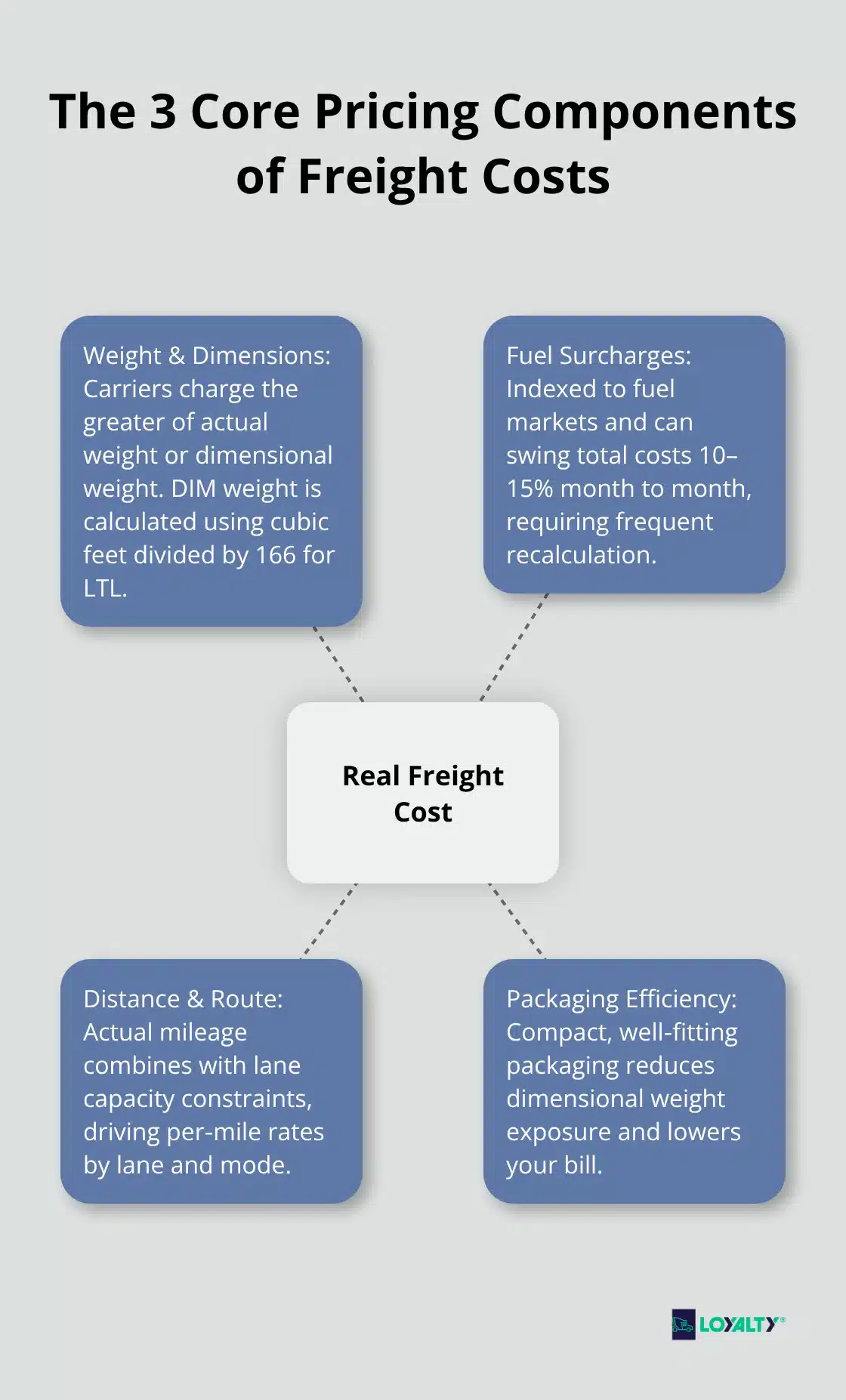
Fuel surcharges represent the second component and fluctuate with crude oil prices, swinging your final bill by 10-15% month to month. According to the Bureau of Transportation Statistics, combination trucks consume 5.5-6.5 miles per gallon on average, making fuel a volatile line item that estimators must recalculate regularly. The third lever is distance and route selection, which combines actual mileage with carrier capacity constraints on specific lanes. A 500-mile LTL shipment might cost $1.40-$2.40 per mile depending on weight and origin-destination pair, while FTL dry van rates for the same distance typically run $2.50-$3.00 per mile.
Why Real-Time Data Matters
Congestion on major interstates directly impacts transit time and fuel consumption, so estimators that pull real-time traffic data and interstate speed information deliver more accurate quotes than static calculators. The best estimators force you to input exact specifications upfront: gross weight, dimensions, freight class, origin zip code, destination zip code, and any special handling like liftgate service or hazmat compliance. Generic estimates without these details will always miss by 15-30% because they cannot account for your specific cost drivers.
Hidden Costs That Change Your Quote
Residential deliveries cost 20-40% more than commercial addresses due to liftgate requirements and dock access limitations. Freight class, which reflects density and handling difficulty, remains stable across weight variations but dramatically affects pricing-a lightweight but bulky item in class 400 costs far more per pound than dense freight in class 50. Most estimators source rates from multiple carriers and show you a range rather than a single price, which is honest because lane demand, current capacity utilization, and seasonal factors shift quotes daily.
Seasonal Surcharges and Carrier Variations
Peak shipping seasons from August through November typically add 10-20% surcharges, so timing your shipments outside these windows can save thousands annually. Price gaps of 25-40% for identical shipments are common across carriers because each carrier optimizes differently for their networks and current utilization levels. Comparing quotes across three or more carriers before you book is non-negotiable-this comparison reveals which carrier offers the best value for your specific lane, whether you need flatbed trucking or standard dry van service. Working through the best freight brokerage services simplifies the multi-carrier comparison and reveals price gaps you would otherwise miss, setting the stage for smarter carrier selection and long-term cost management.
Tired of estimates that miss invoices by 20%?
Loyalty Logistics quotes itemized rates with weight, dimensions, freight class, fuel surcharges, and accessorials broken out so your estimate matches what you pay. Tell us the lane and load.
Why Accurate Estimates Protect Your Margins
Inaccurate freight estimates drain profitability faster than most logistics managers realize. When you quote a customer at $2,800 based on incomplete shipment data, then discover at pickup that dimensional weight pushes the actual cost to $3,600, you absorb that $800 gap or damage the customer relationship with a price increase request. This scenario plays out monthly with companies that skip the detailed specification step. The real cost of a bad estimate isn’t just the immediate loss-it’s the cascading effect on pricing strategy and competitive positioning. If you systematically underestimate costs, your margins compress, and you’re forced to raise prices across the board, making you less competitive on new bids. Accurate estimators prevent this spiral because they force you to input exact weight, dimensions, freight class, and special handling upfront, eliminating the gap between quote and invoice.
Lock in Rates Before Market Swings Hit
Fuel surcharges and seasonal demand create a moving target for pricing. The Bureau of Transportation Statistics shows that truck fuel consumption averages 5.5 to 6.5 miles per gallon, and when crude oil prices spike 15-20% in a single quarter, your cost structure shifts immediately. A precise estimate lets you lock in rates with carriers before prices climb, protecting your margins for the contract period.
Without an accurate estimate, you either quote so conservatively that you lose deals, or you price aggressively and hope fuel stays flat. Peak seasons from August through November typically impose 10-20% surcharges, so knowing your exact costs three months in advance lets you build those surcharges into customer pricing rather than absorbing them. Companies that run estimates monthly rather than per-shipment miss this window entirely and end up absorbing cost increases mid-contract.
Build Forecasts That Actually Reflect Reality
Supply chain planning depends on predictable shipping costs. When estimates are off by 20-30%, your annual logistics budget swings by tens of thousands of dollars, making it impossible to forecast inventory levels, warehouse capacity, or production timelines accurately. A precise estimator tied to real carrier data and current fuel prices gives you a solid baseline for rolling 12-month projections. Understanding regional variations like trucking costs in Canada versus the U.S. lets you build forecasts that account for cross-border lane differences. You can model scenarios-what happens if you shift 30% of shipments to intermodal, or consolidate LTL into full truckload on this lane-and see the actual cost impact before you commit resources. This foresight transforms shipping from a reactive expense into a strategic lever for improving cash flow and profitability.
Why Incomplete Data Costs You More Than You Think
Estimators that accept vague inputs produce vague outputs. When you fail to specify freight class, origin-destination pair, or special handling requirements, the calculator defaults to conservative assumptions that inflate your quote by 15-30%. You then either lose the bid to a competitor with better data, or you win at a margin that evaporates once actual pickup details emerge. Carriers charge different rates for residential versus commercial deliveries (residential costs 20-40% more due to liftgate and dock access limitations), so skipping this detail alone can swing your estimate by hundreds of dollars. The best estimators force specificity upfront by requiring accurate measurements and weights of your cargo and pulling real-time carrier data, ensuring your quote matches what you’ll actually pay.
The next section explores the mistakes that derail even experienced logistics teams, and how to spot them before they hit your bottom line.
Watching estimates miss by 20-30% on every shipment?
Tell us your lanes, weights, dimensions, and freight class. We’ll quote with itemized fuel surcharges, accessorial charges, and lane-specific carrier rates so the invoice matches the estimate.
Common Mistakes That Lead to Inaccurate Freight Estimates
Dimensional Weight Miscalculation Destroys Your Quotes
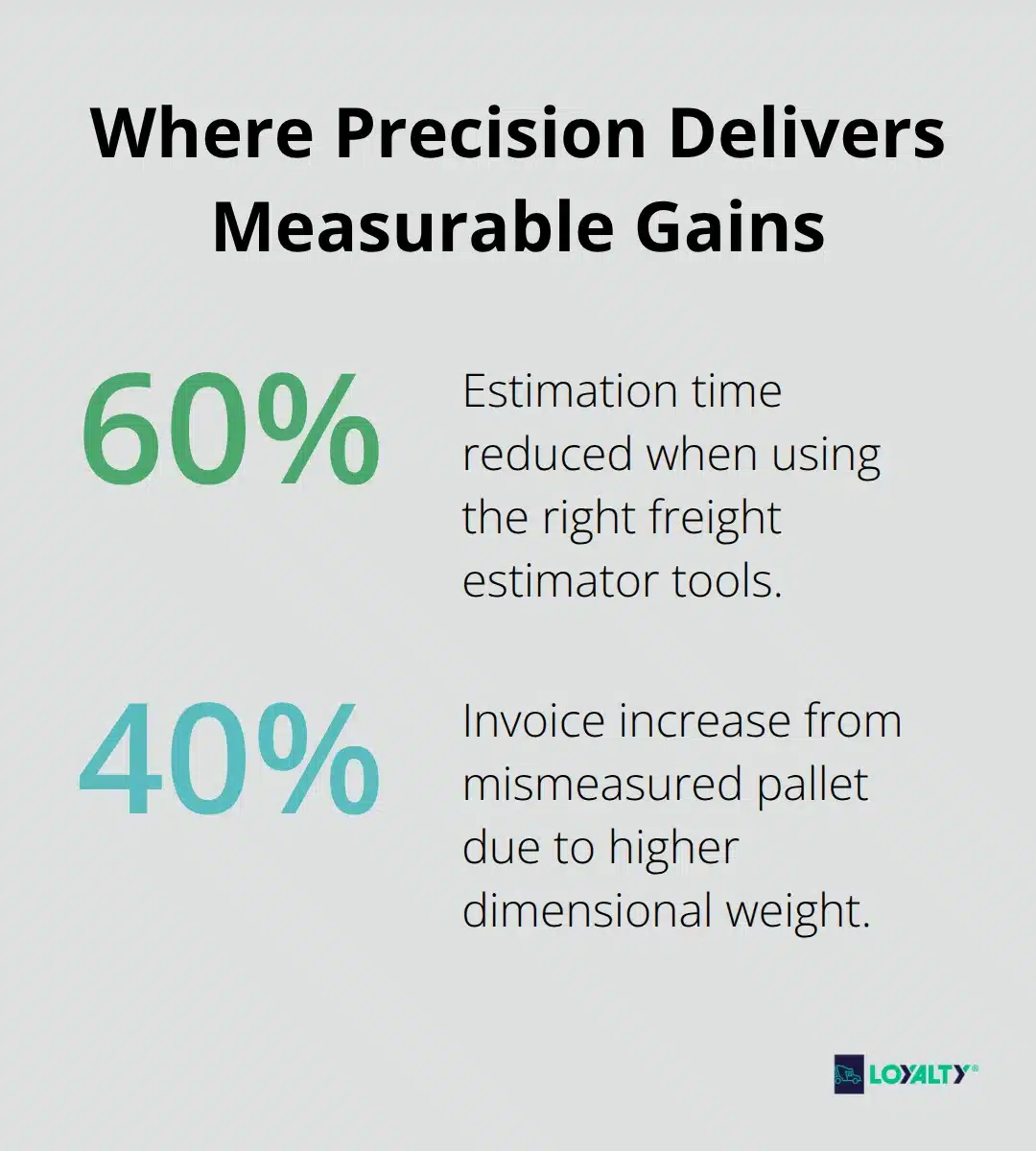
Dimensional weight miscalculation tanks more freight quotes than any other single error. Most logistics managers measure shipments correctly but then fail to account for how carriers actually charge. A 48x40x60 inch pallet containing light packaging material weighs 150 pounds but occupies 80 cubic feet, which translates to a dimensional weight of 482 pounds using the standard 166 cubic foot divisor. You pay for 482 pounds, not 150. The mistake happens because people eyeball shipments or use rough measurements instead of pulling out a tape measure and calculator before requesting quotes. A customer provides estimated dimensions, gets quoted at $1,200, then discovers on pickup day that actual measurements push dimensional weight 40% higher, resulting in a $1,680 invoice. The solution is ruthless specificity: measure length, width, and height to the nearest inch, weigh on a calibrated scale, and plug exact numbers into your estimator.
Oversized or oddly shaped items need special attention because carriers charge premium rates for freight that doesn’t stack efficiently. Most estimators won’t flag this unless you provide precise specifications upfront. Compact, well-fitting packaging cuts your costs directly, so invest time in accurate measurements before you request any quote.
Seasonal Rate Swings Catch Companies Off Guard
Seasonal rate swings catch companies off guard because they treat freight pricing as static rather than dynamic. The Bureau of Transportation Statistics data shows truck fuel consumption ranges from 5.5 to 6.5 miles per gallon depending on load and route conditions, and when crude oil prices spike, fuel surcharges follow within weeks. Peak seasons from August through November add 10-20% surcharges across the industry, yet companies quote customers in July without building that buffer into their pricing structure. Three months later, when actual pickup occurs in October, the cost basis has shifted dramatically.
The fix requires running estimates at least quarterly and adjusting your customer pricing accordingly. If you bid a contract in June for fulfillment starting in September, your estimate must reflect anticipated September rates, not June rates. This forward-looking approach protects your margins and prevents the surprise invoices that erode profitability.
Specialized Handling Requirements Vanish From Quotes
Specialized handling requirements vanish from quotes entirely when estimators lack complete information. Residential deliveries cost 20-40% more than commercial addresses because carriers charge liftgate fees, require dock workers, and navigate access restrictions. Hazmat shipments incur compliance costs, oversized freight needs permits and escorts on cross-border lanes, and reefer units consume fuel at higher rates than dry vans. Many logistics managers skip these details thinking they’ll handle them later, then watch their margins collapse when invoices arrive.
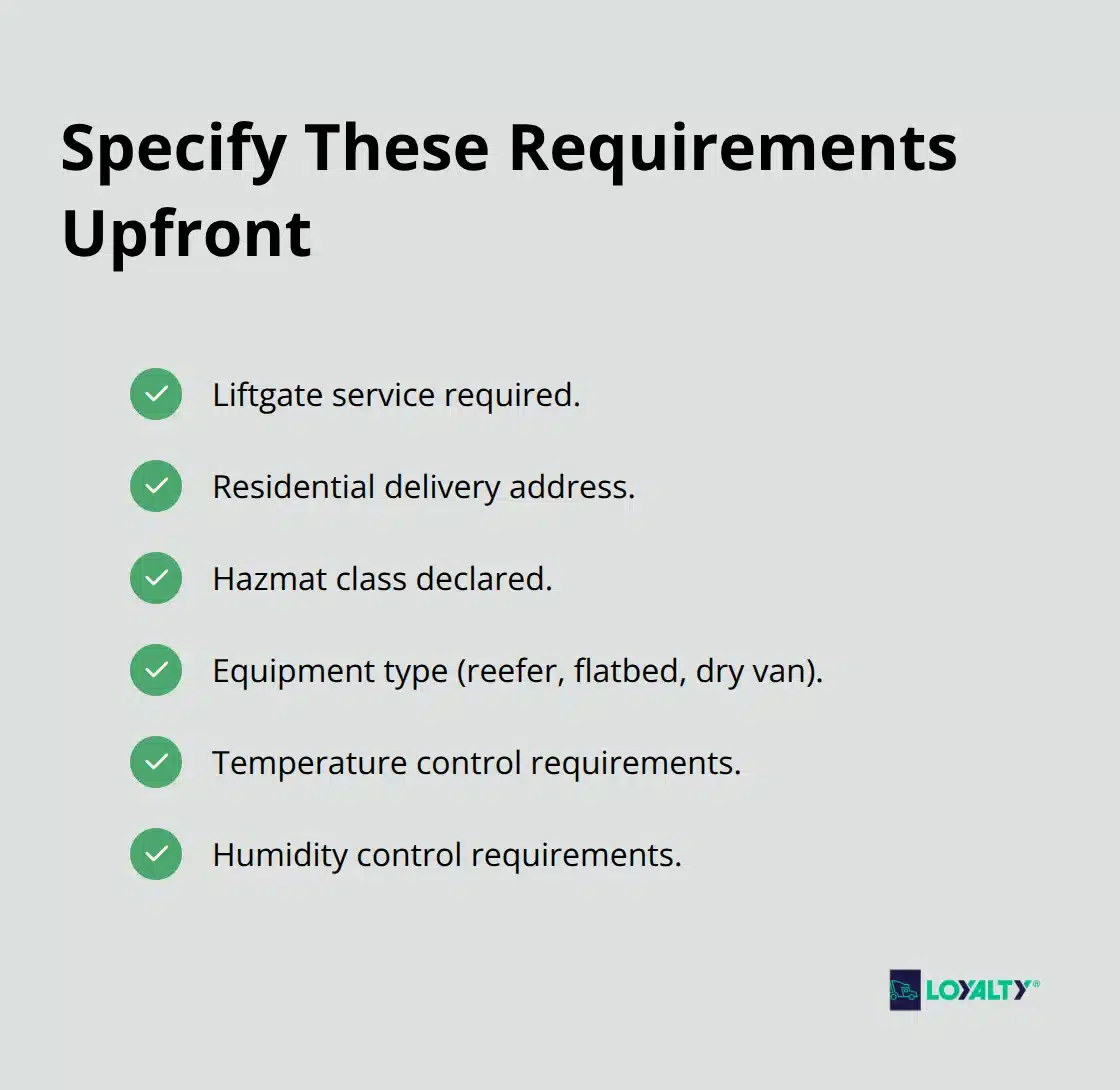
The best practice is to list every special requirement upfront: liftgate, residential delivery, hazmat class, equipment type, and any temperature or humidity controls. This forces the estimator to capture the true cost before you commit to customer pricing, protecting your margins and your reputation. Reefer shipments, flatbed loads, and hazmat freight all carry distinct cost premiums that estimators must account for from the start.
Final Thoughts
Accurate freight cost estimation separates profitable logistics operations from those that bleed money on surprise invoices and margin compression. The three core pricing components-weight and dimensional calculations, fuel surcharges, and distance-based rates-form the foundation of every quote you receive, and skipping any of these details causes your estimates to miss by 15-30%. When you run detailed estimates upfront, account for seasonal surcharges three months in advance, and specify every special handling requirement before requesting carrier quotes, you protect your margins and your customer relationships.
Choosing the right freight shipping cost estimator tool means prioritizing platforms that force specificity rather than accept vague inputs. The best estimators pull real-time carrier data, account for current fuel prices, and require exact weight, dimensions, freight class, and origin-destination information before generating quotes-this upfront rigor eliminates the gap between estimate and invoice. Comparing quotes across three or more carriers remains non-negotiable because price gaps of 25-40% for identical shipments are common across the industry, and a tool that shows you multiple carrier options gives you the transparency needed to make smarter carrier selections.
We at Loyalty Logistics understand that transparent pricing and reliable execution transform how you manage freight costs. Explore our freight transportation services to see how accurate estimates and consistent performance eliminate the guesswork that plagues most shipping operations and protect your bottom line.
Frequently Asked Questions
What is a freight shipping cost estimator?
A freight shipping cost estimator is a tool that calculates expected freight rates based on weight, dimensions, freight class, origin and destination zip codes, fuel surcharges, and special handling requirements. The best estimators pull real-time carrier rates and lane-specific data so the quote you see closely matches what carriers actually invoice. Generic estimators without these inputs typically miss by 15-30%.
What are the main components of freight shipping costs?
Freight shipping costs break into three core components: weight and dimensional pricing (whichever is greater between actual weight and dimensional weight calculated as cubic feet divided by 166 for LTL), fuel surcharges (10-15% monthly swings tied to crude oil prices), and distance and route selection (LTL ranges $1.40-$2.40 per mile, FTL dry van $2.50-$3.00 per mile for 500-mile shipments). Special handling like liftgate, hazmat, residential delivery, or reefer adds 20-40% premiums on top.
How accurate are freight shipping cost estimators?
Accuracy depends entirely on the inputs you provide. Estimators that force you to specify exact weight, dimensions, freight class, origin-destination zip codes, and special handling typically deliver quotes within 5-10% of the final invoice. Estimators that accept vague inputs default to conservative assumptions and miss by 15-30%, which leads to either lost bids or compressed margins. Real-time carrier data and current fuel surcharge formulas are the difference between a useful estimate and a guess.
How do you reduce freight shipping costs?
Reduce freight shipping costs by optimizing packaging to lower dimensional weight, comparing quotes across three or more carriers (price gaps of 25-40% are common on identical shipments), shipping outside peak seasons (August-November typically add 10-20% surcharges), consolidating LTL into FTL where volume justifies, locking in rates before fuel surcharge spikes, and using brokers or 3PLs that aggregate volume and negotiate better carrier rates than you can access alone.
Ready to Stop Losing Money on Bad Freight Estimates?
Freight shipping cost estimators only work when the inputs are precise. Tell us your origin and destination zip codes, exact weight and dimensions, freight class, and any special handling and we’ll quote with itemized fuel surcharges, accessorial charges, and lane-specific carrier rates so your estimate matches what you actually pay.
Related Articles
- Mexico Tariffs: What You Need to Know: Tariff costs that estimators must account for on U.S.-Mexico shipments.
- Understanding Tariffs on Canada and Mexico: USMCA-focused breakdown of tariffs that affect cross-border landed cost.
- Freight Shipping to Canada: Complete Guide: Cross-border freight playbook for U.S. shippers moving freight into Canada.
Loyalty Logistics: Connecting businesses with opportunities across North America.
Written by: Carlos Robayo, Marketing Director at Loyalty Logistics
With expertise in logistics marketing and international trade, Carlos specializes in connecting businesses with efficient and reliable transport solutions for the North American market.

