
Trucking costs in Canada have climbed significantly over the past three years, with fuel, labor, and compliance expenses squeezing margins across the industry. We at Loyalty Logistics work with logistics managers and supply chain directors who face these pressures daily.
This guide breaks down where your money actually goes and shows you concrete ways to cut costs without sacrificing service quality.
What Actually Drives Trucking Costs in Canada
Fuel Prices Hit Hard
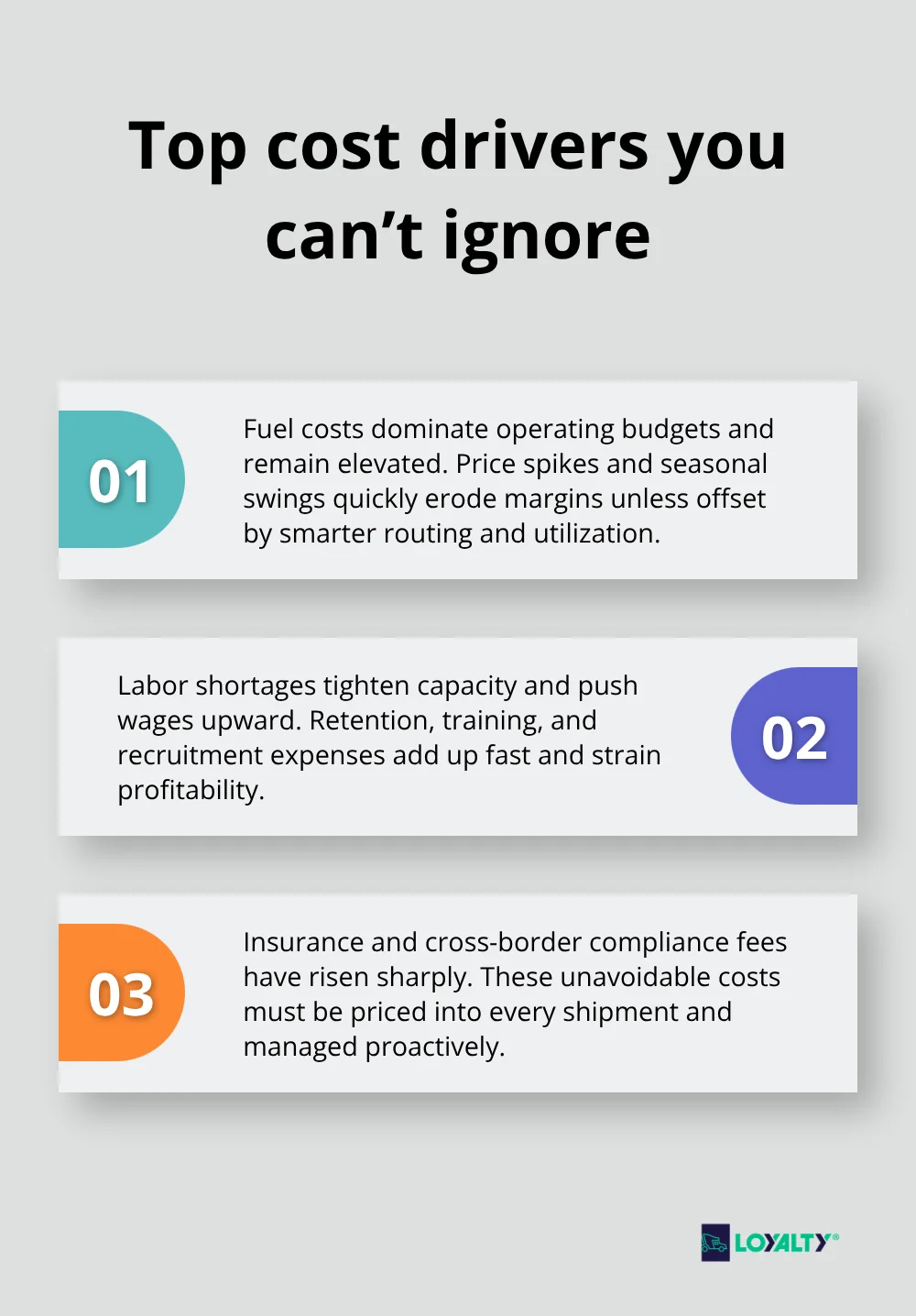
Fuel prices dominate your trucking budget, and right now they sit at levels not seen since 2022. Diesel in the Greater Toronto Area exceeded $2.39 per litre in March 2026, with some operators reporting costs above $2.40 per litre. One fleet owner watched fuel costs per truck jump from approximately $1,600 to $2,300 per fill-a roughly $700 increase. Fuel typically accounts for 20 to 35 percent of total operating costs, and geopolitical tensions in the Middle East keep global oil prices elevated. Seasonal fluctuations add another layer: winter months see higher fuel consumption due to idling and less efficient engines, while summer demand pushes prices up further.
Your ability to absorb these swings depends entirely on your fleet size and contract flexibility. Smaller operators and owner-operators have almost no cushion when fuel spikes, which is why many are calling for temporary diesel tax relief rather than waiting for market stabilization.
Labor Shortages and Wage Pressure
Driver wages and labor shortages compound the problem significantly. Canada’s capacity remains structurally tighter than the U.S. due to earlier fleet contraction and ongoing driver shortages, which means you compete harder for talent. Wages have risen steadily, and retention costs-including benefits, training, and recruitment-eat into margins quickly. The tighter labor market forces you to invest more in compensation just to maintain your current workforce, let alone expand operations.
Maintenance and Equipment Costs
Vehicle maintenance and replacement costs climb too, especially when you run older equipment to manage cash flow. Preventive maintenance programs reduce emergency breakdowns, but they require upfront investment that pressures short-term budgets. Older trucks break down more frequently, which means higher repair bills and lost revenue when vehicles sit idle instead of moving freight.
Cross-Border Compliance Expenses
Insurance and compliance expenses have jumped significantly, particularly for cross-border operations. U.S. Customs and Border Protection increased the annual commercial truck transponder cost from $402.61 USD to $752.91 USD in October 2024, and the AQI program will see five fee increases between January 2024 and October 2027. On October 1, 2026, the AQI transponder fee alone rose to $870.60 USD. These regulatory costs cannot be avoided, and they affect every cross-border shipment your operation touches.
The Ontario Trucking Association emphasizes that these increases cannot be absorbed by the industry and should be phased in gradually to prevent destabilizing supply chains. The cumulative impact of fuel, labor, maintenance, and compliance costs means your next move must address these pressures head-on. Understanding where costs originate is the first step; the real opportunity lies in the strategies you can implement to control them.
Watching Canadian diesel wipe out your margin on every full truckload?
Loyalty Logistics runs dedicated truckload capacity across Canada, the U.S., and Mexico with transparent fuel surcharge formulas and locked-in rate structures that keep your cost per mile predictable.
How to Cut Trucking Costs Without Cutting Corners
Route Optimization Reduces Fuel Waste
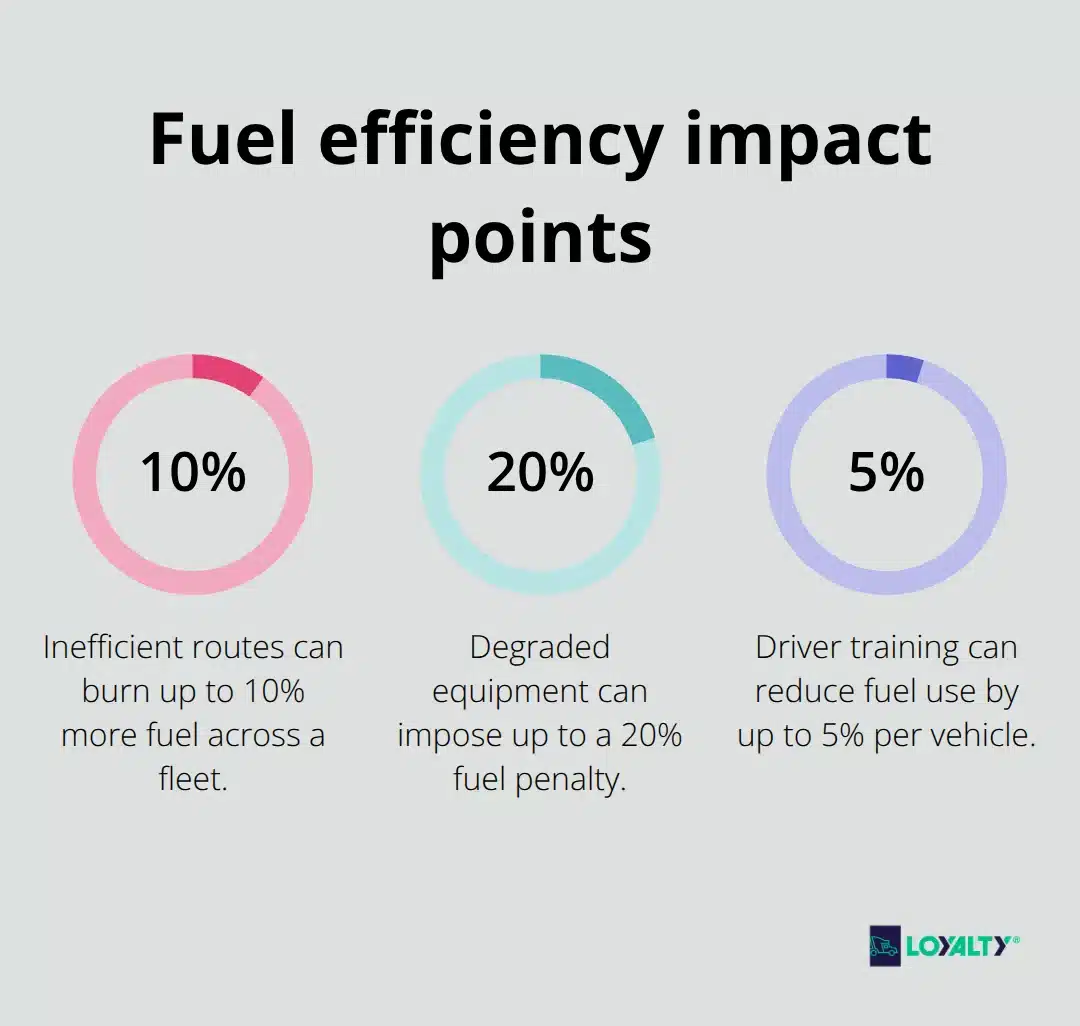
You cannot control fuel prices or regulatory fees, but you control how efficiently you operate. The operators winning right now optimize every mile and every maintenance dollar. Route optimization sits at the top of this list because fuel waste compounds across thousands of kilometers per month. Mapping your routes with precision-accounting for traffic patterns, road conditions, and weight distribution-directly reduces fuel consumption. A fleet running inefficient routes might burn 5 to 10 percent more fuel than necessary, which translates to thousands of dollars monthly when diesel sits above $2.40 per litre. The Canadian Trucking Alliance emphasizes that small operational improvements accumulate fast when multiplied across your fleet.
Load Planning and Trailer Utilization
Load planning pairs with route optimization to maximize efficiency. You consolidate shipments and maximize trailer utilization, which means fewer trips to move the same volume. If your trucks run half-empty, you pay full fuel and labor costs for partial productivity. This approach directly attacks one of your largest controllable expenses and forces every kilometer to work harder for your bottom line.
Preventive Maintenance Prevents Costly Breakdowns
Preventive maintenance programs sound expensive upfront, but they prevent the catastrophic breakdowns that sideline trucks during peak seasons. One fleet owner reported fuel costs jumping $700 per fill when equipment fails and forces inefficient emergency repairs. You schedule maintenance on engines, transmissions, and fuel systems to keep consumption predictable and prevent the 15 to 20 percent fuel penalty that degraded equipment incurs. Driver training on fuel-efficient practices-smooth acceleration, steady speeds, proper tire pressure-reduces consumption by 3 to 5 percent per vehicle.
That margin matters when operating costs squeeze so hard.
Insurance and Compliance Strategy
Insurance and compliance costs demand a different approach because you cannot negotiate away regulatory fees like the AQI transponder charges rising to $870.60 USD in October 2026. However, you can negotiate fleet insurance rates aggressively by demonstrating safety records, investing in driver training programs, and maintaining equipment to specification. Carriers with strong safety metrics pay significantly less in insurance premiums than those with frequent claims. Some operators reduce exposure by shifting to third-party logistics providers who absorb compliance complexity and leverage larger networks to negotiate better rates across multiple carriers.
The System Approach to Cost Control
The real cost reduction comes from treating your operation as a system, not isolated line items. Rising fuel costs force you to choose between absorbing losses, raising rates, or operating smarter. The operators who choose smarter are the ones still running profitably in 2026. Your next challenge involves understanding how regional variations affect these strategies-because what works in Ontario may not work in Alberta, and cross-border operations introduce entirely different cost dynamics that demand specialized attention.
Paying AQI transponder fees, winter fuel premiums, and insurance hikes all at once?
Tell us your lanes, equipment mix, and typical volumes. We’ll quote itemized rates with fuel surcharge caps, cross-border compliance built in, and no surprises at the border.
Regional Cost Variations Across Canada
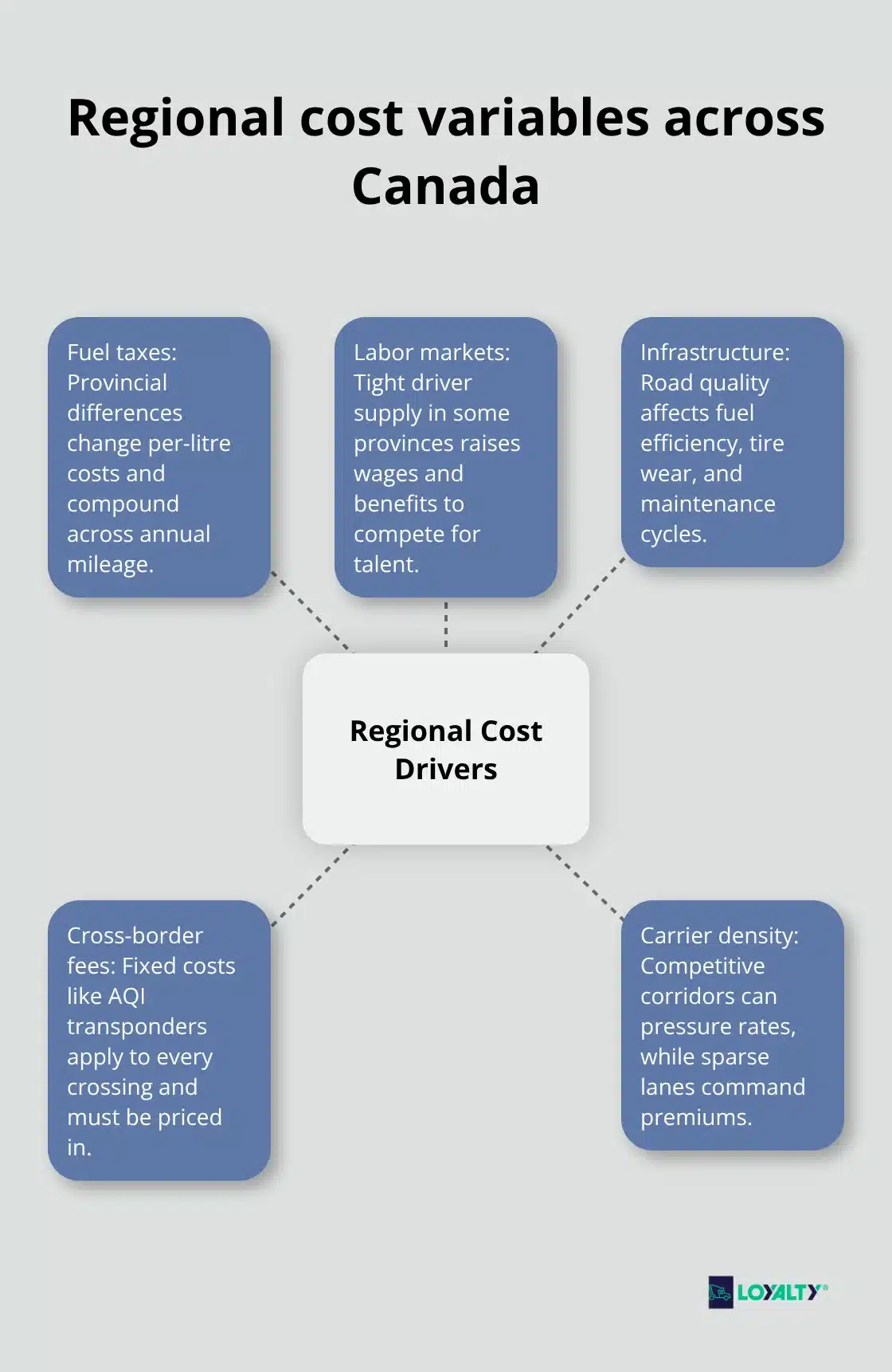
Trucking costs in Canada shift dramatically depending on where your operations run, and these variations demand region-specific strategies. Whether you’re shipping freight to Canada from U.S. origins or operating entirely within Canadian lanes, regional cost patterns define what your fleet can absorb. Diesel prices tell the clearest story: Greater Toronto Area operators paid above $2.40 per litre in March 2026, but Alberta and Saskatchewan typically run 10 to 15 cents lower per litre due to proximity to refineries and lower provincial fuel taxes. That difference compounds fast across a fleet. A carrier running 50 trucks at 100,000 kilometers annually saves roughly $15,000 to $30,000 per truck simply from lower fuel costs in lower-tax provinces. However, labor costs and equipment availability flip this advantage on its head in western regions. Driver wages in Alberta and British Columbia run 8 to 12 percent higher than Ontario due to tighter labor markets and higher cost of living, which erases fuel savings immediately.
Fuel Tax Differences Create Regional Advantages
Provincial fuel taxes vary significantly across Canada, and these differences directly impact your bottom line. Ontario’s fuel tax structure sits higher than Alberta’s, which means operators in the prairies enjoy a natural cost advantage on fuel. However, this advantage only matters if you can sustain operations in those regions without sacrificing other efficiencies. A carrier cannot simply relocate to chase cheaper fuel because labor recruitment, equipment maintenance, and infrastructure quality create competing cost pressures that offset the savings.
Labor Markets Determine True Operating Costs
ACT Research reports that Canada-wide capacity remains structurally tighter than the U.S., with earlier fleet contraction and driver shortages hitting western provinces hardest. This means recruiting and retaining drivers costs more in growth markets like Alberta, even though fuel sits cheaper. Your decision to operate in specific regions cannot rely on fuel prices alone because wage pressure, maintenance costs, and infrastructure quality create competing pressures that shift the total cost picture. Western provinces demand higher compensation packages to attract talent, which neutralizes the fuel tax advantage that initially attracted operators to those markets.
Infrastructure Quality Affects Fuel Consumption and Maintenance
Infrastructure quality matters more than most operators realize because road conditions directly impact fuel consumption, maintenance frequency, and delivery speed. Ontario’s 400-series highways and well-maintained provincial routes support efficient operations, but northern routes through Manitoba and Saskatchewan force slower speeds, increase tire wear, and reduce fuel efficiency by 5 to 8 percent. Poor road conditions also accelerate maintenance cycles, which means higher repair costs and more frequent equipment downtime. Operators in regions with superior infrastructure enjoy lower fuel consumption and longer equipment life, which compounds into significant savings over time.
Cross-Border Operations and Regional Carrier Density
Cross-border operations, including shipping freight from Canada into the U.S., introduce the largest regional cost variable because U.S. Customs and Border Protection fees hit every crossing regardless of location. However, southern Ontario and British Columbia corridors see higher competition among carriers, which can pressure rates downward, while prairie crossings face fewer alternatives and command premium pricing. The AQI transponder fee now sits at $870.60 USD annually as of October 2026, and this cost applies uniformly across all border crossings. The ability to negotiate freight rates around this fixed cost depends entirely on regional carrier density and shipper volume. Southern Ontario operators benefit from carrier density and infrastructure investment, but they face higher fuel costs and wage pressure. Alberta operators enjoy fuel advantages but must budget aggressively for labor and accept higher cross-border shipping costs due to limited carrier options on prairie lanes, where Canada and Mexico tariff rules further shape landed cost calculations.
Final Thoughts
Trucking costs in Canada shift constantly because fuel, labor, compliance, and regional factors move faster than most operators can adjust. The operators managing costs effectively right now treat their operations as interconnected systems rather than isolated expenses. You cannot control diesel prices or regulatory fees, but you control route efficiency, maintenance discipline, load planning, and carrier partnerships that directly impact your bottom line.
Audit your current operations against the regional cost drivers that affect your specific lanes and implement preventive maintenance programs that reduce fuel consumption by 3 to 5 percent per vehicle. That margin compounds across your fleet and protects profitability when diesel stays elevated. If you run cross-border operations, the AQI transponder fee at $870.60 USD annually is non-negotiable, so your strategy must focus on maximizing utilization and negotiating freight rates that account for this fixed cost.
Many logistics managers discover that partnering with an experienced logistics service provider that operates across multiple regions and carrier networks produces better rates and compliance handling than managing everything internally. We at Loyalty Logistics specialize in timely, damage-free delivery across Canada, the U.S., and Mexico with a 98% on-time rate and more than 10,000 successful deliveries. Explore our freight transportation services to discuss how we can help you reduce costs while maintaining service quality across your routes.
Frequently Asked Questions
What are the main drivers of trucking costs in Canada?
The main drivers of trucking costs in Canada are fuel (20 to 35 percent of total operating costs), driver wages and retention in a structurally tight labor market, vehicle maintenance and equipment replacement, and cross-border compliance fees like the AQI transponder ($870.60 USD annually as of October 2026). Regional variations in fuel taxes, labor rates, and infrastructure quality further shift the cost picture across provinces.
How much does diesel cost trucking operators in Canada in 2026?
Diesel in the Greater Toronto Area exceeded $2.39 per litre in March 2026, with some operators reporting costs above $2.40 per litre. Alberta and Saskatchewan typically run 10 to 15 cents lower per litre due to proximity to refineries and lower provincial fuel taxes. One fleet owner reported fuel costs per truck jumping from roughly $1,600 to $2,300 per fill, a $700 increase.
Why do trucking costs vary by Canadian region?
Trucking costs vary by Canadian region because provincial fuel taxes, driver wage rates, infrastructure quality, and carrier density all differ significantly. Alberta and Saskatchewan enjoy a fuel cost advantage but face 8 to 12 percent higher driver wages than Ontario due to tighter labor markets. Northern routes through Manitoba and Saskatchewan reduce fuel efficiency by 5 to 8 percent due to road conditions. Southern Ontario and British Columbia corridors see higher carrier competition, which pressures rates downward, while prairie crossings command premium pricing.
How can Canadian trucking companies reduce operating costs?
Canadian trucking companies reduce operating costs through route optimization (5 to 10 percent fuel savings), load planning and trailer utilization, preventive maintenance programs that avoid 15 to 20 percent fuel penalties from degraded equipment, driver training on fuel-efficient practices (3 to 5 percent savings), aggressive insurance negotiations based on safety records, and partnerships with 3PLs that absorb compliance complexity and leverage network scale for better carrier rates.
Ready to Control Your Canadian Trucking Costs?
Trucking costs in Canada reward the operators who treat their fleet as a system rather than isolated line items. Tell us your Canadian lanes, equipment mix, and cross-border volumes and we’ll quote itemized rates with fuel surcharge caps, AQI fees factored in, and region-specific carrier coverage so nothing surprises you at the border or on the invoice.
Related Articles
- Freight Shipping Cost Estimator: Quick Estimates Without Guesswork: Complementary tool for benchmarking freight rates before you commit.
- Mexico Tariffs: What You Need to Know: Tariff framework for the other side of North American cross-border trucking.
- Mastering Cross-Border Shipping in North America: Broader playbook for shippers moving freight across U.S., Canada, and Mexico corridors.
Loyalty Logistics: Connecting businesses with opportunities across North America.
Written by: Carlos Robayo, Marketing Director at Loyalty Logistics
With expertise in logistics marketing and international trade, Carlos specializes in connecting businesses with efficient and reliable transport solutions for the North American market.

