

Pharmaceutical shipments demand absolute precision. A single temperature deviation can render medications ineffective or dangerous, which is why selecting the right pharma cold chain logistics company matters more than most supply chain decisions.
At Loyalty Logistics, we’ve seen firsthand how poor cold chain management creates cascading problems-missed deliveries, regulatory fines, and ultimately, patient harm. This guide walks you through what separates reliable providers from the rest.
What Separates Reliable Cold Chain Providers from the Rest
Temperature control in pharma logistics isn’t about hitting a range-it’s about hitting a specific number, repeatedly, across every mile. The Global Pharmaceutical Cold Chain Logistics market reached US$22.75 billion in 2025 and is projected to grow to US$44.1 billion by 2033 according to DataM Intelligence, which reflects how seriously the industry takes this. Reliable providers maintain five distinct temperature bands: controlled ambient between 15 to 25 degrees Celsius, refrigerated between 2 to 8 degrees Celsius, frozen below minus 20 degrees Celsius, deep frozen between minus 60 to minus 80 degrees Celsius, and cryogenic at minus 150 degrees Celsius and below.
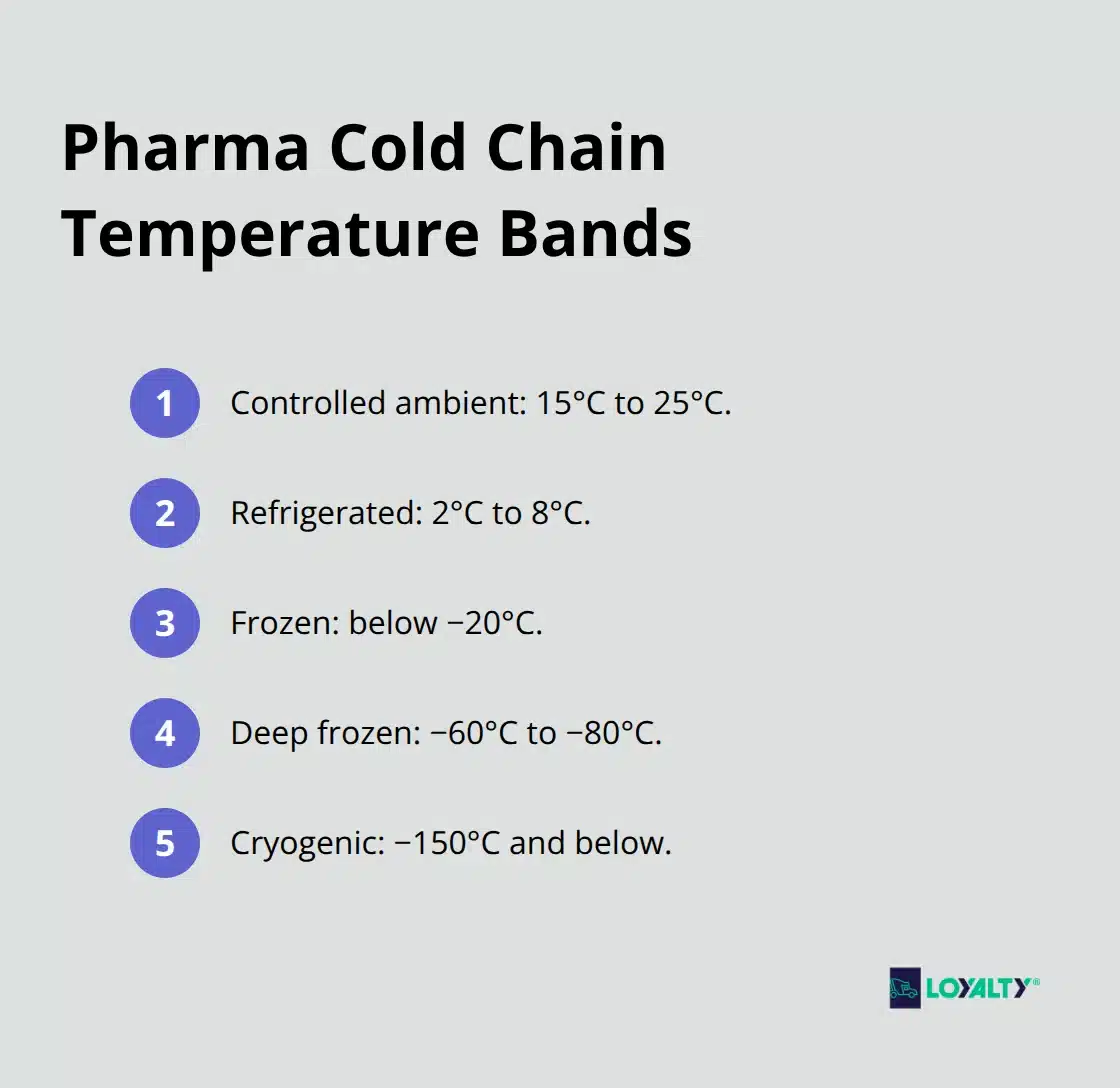
Most conventional drugs sit in the ambient range, but vaccines and biologics demand the refrigerated band with zero tolerance for deviation. When a shipment arrives one degree warmer than required, the entire batch fails. This isn’t theoretical-it’s why WHO data showed up to 50 percent of vaccines were wasted globally due to temperature control failures before COVID. The difference between a reliable provider and an unreliable one comes down to three operational realities: validated packaging systems that match your specific product and transit time, real-time temperature monitoring at every handoff point, and documented procedures that staff actually follow.
Validated Packaging Systems Stop Temperature Failures at the Source
Most logistics managers assume passive cooling solutions like dry ice or gel packs just work. They don’t. A reliable provider validates every packaging configuration under the exact ambient conditions your shipment will face during transit. If you’re shipping to a hot climate, they test in heat. If your product requires minus 80 degrees for a 48-hour journey, they simulate that scenario and document the results. Sensitech’s TempTale GEO X, launched in February 2024, represents the current standard for monitoring-it tracks temperature, humidity, pressure, light, and tilt simultaneously throughout transit. This continuous data stream reveals whether your packaging actually maintains temperature or just hopes it does. A provider that cannot show you validated packaging reports for your specific product and route cuts corners that will cost you later.
Live Monitoring Catches Deviations Before Destination
Portal-based shipment visibility isn’t a luxury-it’s the difference between catching a temperature deviation at hour 12 of a 72-hour transit versus discovering it at destination. Reliable providers offer live monitoring with downloadable post-delivery data that creates audit-ready records for FDA and EU inspections. When a deviation occurs, you need to know immediately so you can reroute, arrange emergency replacement, or notify customers. World Courier research shows that 59 percent of logistics decision-makers expect steady cold chain growth in the next 1 to 2 years, which means competition intensifies and providers race to differentiate on visibility. This transparency separates providers who manage shipments from those who simply move boxes.
Staff Training and Documented Procedures Make the Difference
Temperature control fails when staff don’t understand why precision matters. Reliable providers train personnel on specific temperature thresholds, emergency procedures, and documentation requirements-not as a checkbox exercise, but as hands-on practice that sticks. Documented procedures that staff actually follow (not just file away) prevent the human errors that trigger excursions. Regular audits aligned with FDA and EU regulations verify compliance and identify gaps before inspectors do. This combination of training, documentation, and accountability separates providers who talk about reliability from those who deliver it consistently.
Your choice of cold chain partner determines whether your temperature-sensitive products reach patients intact or arrive as expensive waste. The next section walks you through how to evaluate providers against these standards and identify which ones actually have the infrastructure and commitment to back up their claims.
Shipping vaccines, biologics, or other temperature-sensitive pharma?
Loyalty Logistics runs validated packaging, live monitoring, and dedicated temperature-controlled equipment specifically for pharmaceutical shipments across the U.S., Canada, and Mexico.
Real Obstacles in Pharma Cold Chain Logistics
Temperature swings during transit create direct product loss and regulatory violations. When a shipment crosses climate zones or sits on a tarmac in unexpected heat, passive cooling systems often fail because providers validated them for theoretical conditions, not real-world chaos. A single temperature deviation can ruin an entire shipment of vaccines or biologics, yet many providers apply the same packaging configuration to all routes. This one-size-fits-all approach causes preventable failures.
Temperature Fluctuations Across Routes Demand Specific Validation
The infectious disease diagnostics market will reach USD 31.5 billion by 2028, growing at about 8% annually according to GlobalData, which means exponentially more temperature-sensitive products move across borders. Reliable providers test packaging under the exact ambient conditions of each route, document results, and adjust accordingly. If your shipment crosses multiple climate zones, request evidence that your packaging has been tested for those specific transitions.
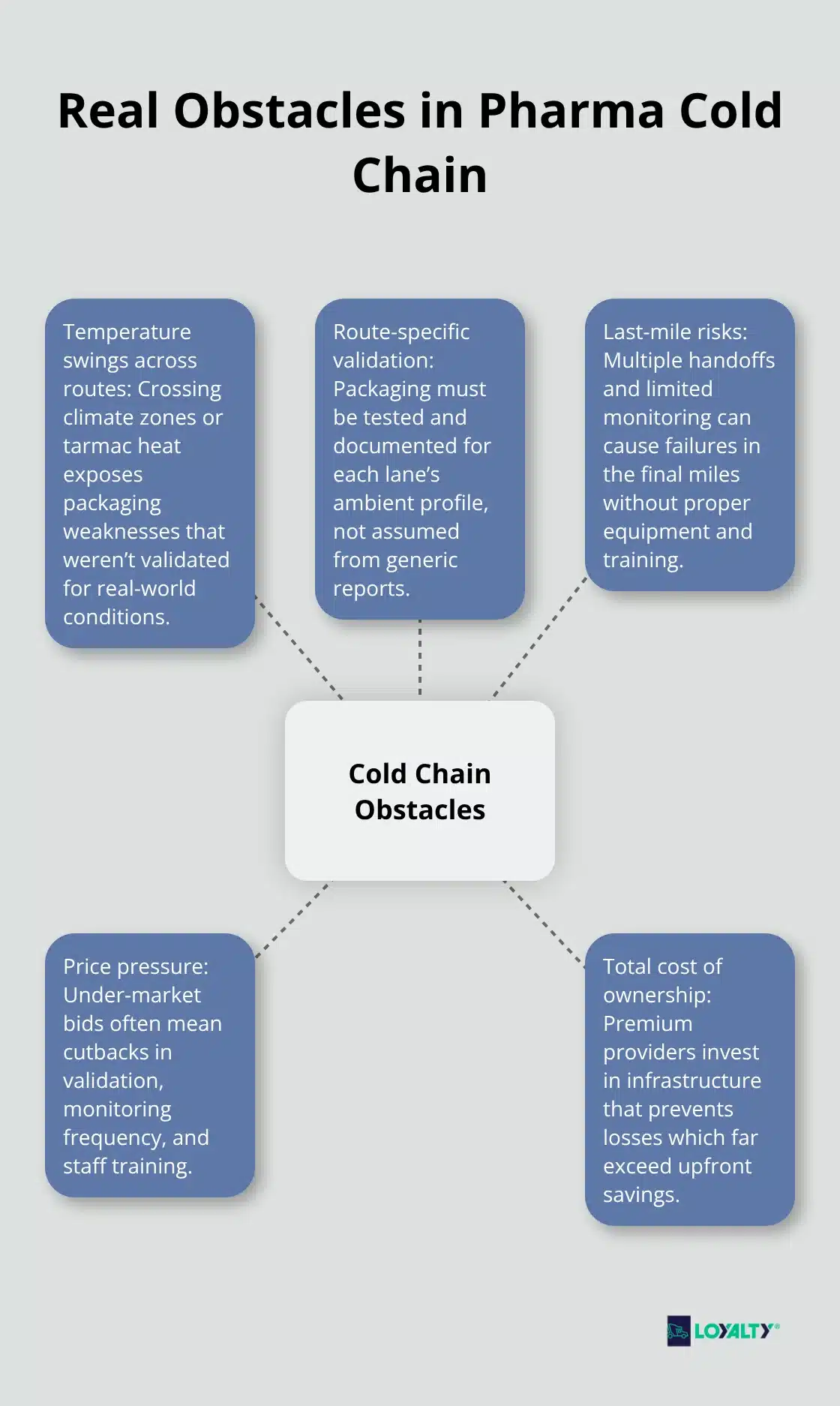
Providers who skip this step and rely on generic validation reports cut corners that manifest as failures in the field.
Last-Mile Delivery Creates Hidden Temperature Risks
Final distribution to hospitals, clinics, and pharmacies introduces longer dwell times at loading docks, multiple handoffs, and less sophisticated temperature monitoring than trunk routes. A shipment that maintained perfect temperature control for 2,000 miles can fail in the final 20 miles if the last-mile carrier lacks proper refrigerated transport equipment or training. Many cost-cutting providers invest in premium trunk line logistics but partner with budget carriers for final delivery, creating a weak link that ruins the entire chain. This fragmented approach exposes your products to avoidable risk.
Price Competition Drives Dangerous Corners
The pharmaceutical cold chain logistics market will grow from US$22.75 billion in 2025 to US$44.1 billion by 2033, yet margins remain tight because customers constantly demand price reductions. Providers squeezed on price cut corners on validation, monitoring frequency, and staff training-the exact areas where failures originate. A provider quoting 15% below market rates isn’t more efficient; they operate a higher-risk model that will eventually cause regulatory headaches and product loss that dwarf the savings. Temperature excursions trigger FDA investigations, require batch destruction, damage customer relationships, and expose companies to liability.
Total Cost of Ownership Reveals True Value
Handling last-mile delivery effectively requires providers with dedicated temperature-controlled fleets, not contracted third parties. Providers who openly discuss their temperature validation processes, show real monitoring data from comparable shipments, and maintain dedicated final-mile infrastructure command premium rates for good reason. Those who compete purely on price bet you won’t notice the failure until it costs far more than the initial savings. Evaluating total cost of ownership-not just freight rates-separates providers worth partnering with from those who will eventually create expensive problems.
The choice between competing providers hinges on how they handle the operational realities that separate reliable cold chain logistics from risky shortcuts. The next section walks you through how to assess providers against these standards and identify which ones have the infrastructure and commitment to back up their claims.
Worried a single temperature excursion could cost more than you saved on freight?
Tell us your product, route, and temperature bands. We’ll quote based on validated packaging and live monitoring instead of bundled rates that hide where corners get cut.
How to Evaluate and Select the Right Cold Chain Provider
Start with what a provider has actually delivered, not what they claim to deliver. ISO 9001:2015 certification demonstrates formal quality processes, but certification alone means nothing without a track record of executing those processes consistently. Request references from companies shipping comparable products on comparable routes within the past 12 months, then contact those references directly and ask specific questions: Did temperature deviations occur? How quickly did the provider identify and resolve problems? Did the provider’s documentation hold up during regulatory audits? A provider with 10 years of pharma cold chain experience but no verifiable references on your specific product category or route presents higher risk than a newer provider with documented successes on exactly what you need. Certifications matter only when paired with evidence that the provider maintains them operationally. Ask to review audit reports from the past 24 months, not just certification dates. The difference between a provider worth trusting and one that cuts corners often comes down to what they’re willing to show you about their actual operations. If a provider hesitates to share validation reports, monitoring data from comparable shipments, or audit results, that reluctance signals they have something to hide.
Track Record and Certifications Reveal Operational Reality
Verifiable references matter far more than marketing claims. Contact previous customers and ask whether the provider maintained temperature control consistently, identified deviations quickly, and resolved problems without product loss. A provider willing to share detailed audit reports demonstrates confidence in their operations. Providers that refuse to disclose validation testing results or monitoring data operate with something to hide. ISO certifications provide a baseline, but they don’t guarantee consistent execution in the field. Ask whether the provider maintains backup power systems at all facilities, how long those systems operate during outages, and whether they’ve experienced power failures that affected shipments. A provider that can answer these questions with specific data has invested in reliability. One that offers vague responses relies on luck rather than infrastructure.
Monitoring Systems and Infrastructure Capabilities Determine Real Performance
Real-time monitoring systems vary dramatically in capability and cost. Sensitech’s TempTale GEO X represents current industry standard functionality, but cheaper alternatives often track only temperature at limited intervals rather than continuous monitoring of temperature, humidity, pressure, and light simultaneously. Request specifications on monitoring frequency, data resolution, and whether the system provides live alerts or only post-shipment reports. A provider offering hourly temperature readings instead of continuous data creates blind spots where deviations occur undetected. Dedicated temperature-controlled warehouses with backup power systems matter far more than cloud-based tracking promises. Ask how many temperature-controlled facilities the provider operates directly versus contracts through third parties, what backup power capacity exists, and how long facilities operate during power loss. Providers squeezing costs often use contracted warehouse space without guaranteed backup power, creating risk during the exact scenarios when your products need protection most. For last-mile delivery, verify whether the provider operates dedicated temperature-controlled vehicles or relies on subcontractors. The Global Pharmaceutical Cold Chain Logistics market will reach US$44.1 billion by 2033 according to DataM Intelligence, yet many providers still hand off final delivery to budget carriers with basic refrigeration rather than pharmaceutical-grade equipment. Evaluating the quality of available refrigerated trucking companies helps you filter subcontractor partners before your shipments depend on them. Ask to see the specific vehicles that will handle your shipments and their maintenance records.
Service Agreements and Pricing Models Expose Hidden Risks
Providers quoting rates significantly below market typically achieve those numbers through lower validation standards, reduced monitoring frequency, or reliance on cheaper subcontractors for critical functions. Request itemized pricing that separates packaging validation costs, monitoring fees, and infrastructure charges rather than accepting bundled quotes. A provider charging separately for temperature validation testing signals they conduct actual testing rather than applying generic protocols. Pricing that remains constant regardless of ambient conditions, route complexity, or product sensitivity suggests the provider uses standardized solutions regardless of your specific needs. Transparent service agreements specify temperature maintenance guarantees, response times for deviations, liability limits, and what happens if a temperature excursion occurs. Read the fine print carefully: some providers limit liability to the freight cost rather than product value, leaving you absorbing massive losses if they fail. Service level agreements should define specific temperature ranges, acceptable deviation duration, and automatic compensation triggers if those standards aren’t met. Providers unwilling to commit to specific performance guarantees in writing operate on the assumption they’ll rarely face consequences for failures. When selecting a cold chain provider, ensure they back performance with documented infrastructure and transparent pricing because cutting corners on cold chain logistics eventually costs far more than premium rates.
Final Thoughts
Selecting a pharma cold chain logistics company requires evaluating three non-negotiable criteria: validated packaging systems tested under your specific route conditions, real-time monitoring infrastructure that catches deviations before destination, and documented staff procedures that prevent human error. Providers meeting these standards command premium rates because they invest in the infrastructure and processes that prevent costly failures. Those competing purely on price operate models where corners get cut on validation, monitoring frequency, or final-mile capabilities-the exact areas where temperature excursions originate.
The connection between reliable cold chain logistics and patient outcomes runs direct and measurable. WHO data showed up to 50 percent of vaccines faced waste globally due to temperature control failures before COVID, yet only 14 percent of planned COVID vaccines reached poorer countries in 2021 due to supply chain challenges.
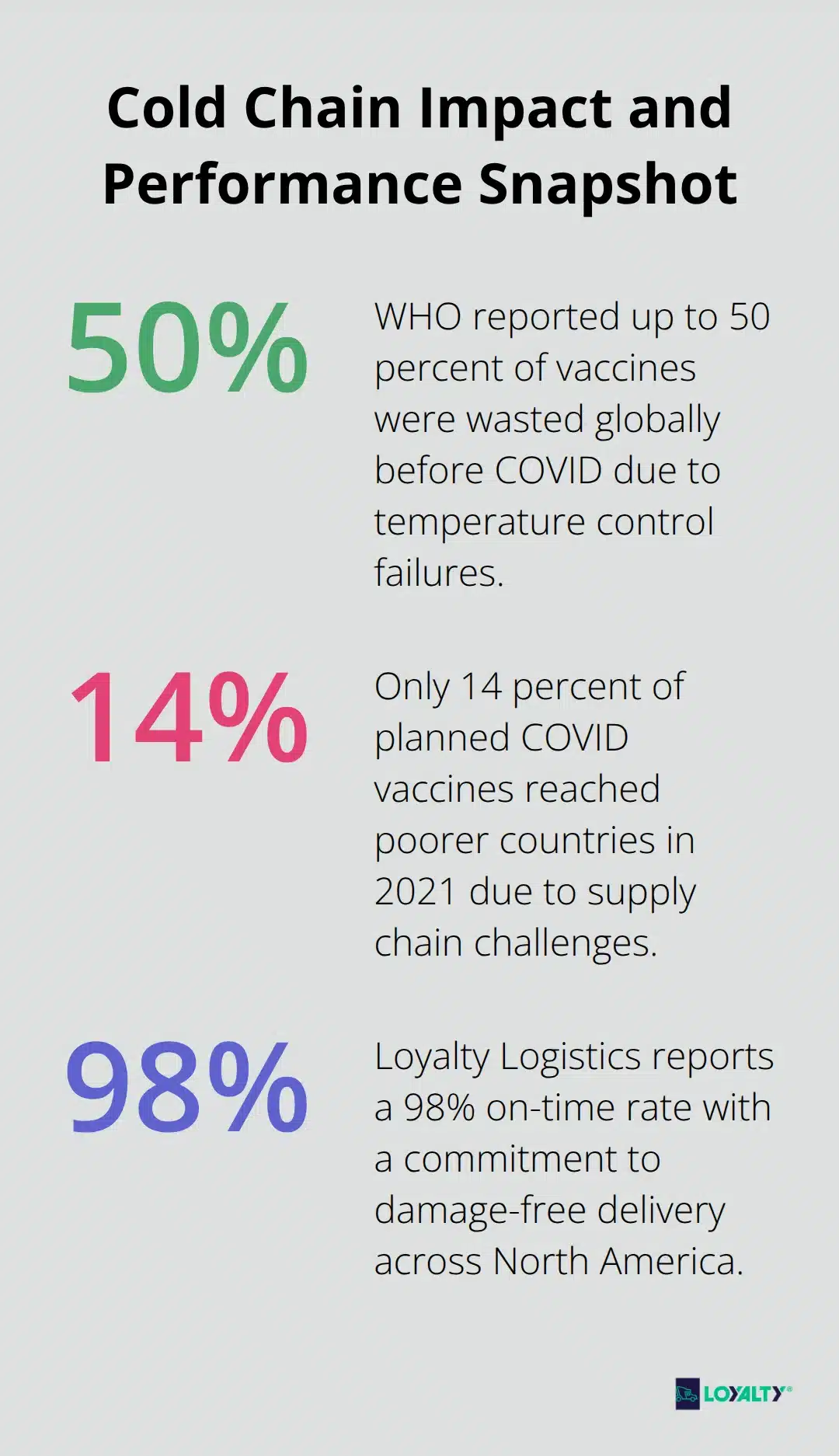
These statistics represent patients who never received protection because logistics failed them, which is why selecting the right pharma cold chain logistics companies matters more than most supply chain decisions.
We at Loyalty Logistics understand that pharma cold chain logistics demands absolute precision across every mile. Our advanced logistics capabilities and refrigerated transport solutions operate across the U.S., Canada, and Mexico with a 98% on-time rate and commitment to damage-free delivery. Explore our freight transportation services to discuss how our cold chain capabilities support your supply chain without cutting corners on the standards that matter most.
Frequently Asked Questions
What is pharma cold chain logistics?
Pharma cold chain logistics is the set of processes, equipment, and systems that keep pharmaceutical products within specific temperature ranges from manufacturing through final delivery. It covers validated packaging, temperature-controlled warehouses and vehicles, real-time temperature monitoring, documented handling procedures, and audit trails aligned with FDA and EU regulations. The goal is to deliver vaccines, biologics, and other temperature-sensitive drugs to patients without excursions that ruin product integrity.
What temperature bands do pharma cold chain logistics companies maintain?
Reliable providers maintain five distinct bands: controlled ambient (15 to 25 degrees Celsius), refrigerated (2 to 8 degrees Celsius), frozen (below minus 20 degrees Celsius), deep frozen (minus 60 to minus 80 degrees Celsius), and cryogenic (minus 150 degrees Celsius and below). Most conventional drugs sit in the ambient range, while vaccines and biologics typically require the refrigerated band with zero tolerance for deviation.
How do you evaluate a pharma cold chain logistics provider?
Evaluate a pharma cold chain logistics provider on four dimensions: track record with verifiable references on comparable products and routes, validated packaging reports for your specific transit conditions, real-time monitoring capabilities (not just post-shipment reports), and transparent service agreements that specify temperature guarantees and liability. Ask to see audit reports from the past 24 months and backup power specs at every facility they use.
Why does last-mile delivery matter in pharma cold chain logistics?
Last-mile delivery matters because it is the weakest point in most cold chains. A shipment that maintained perfect temperature for 2,000 miles can fail in the final 20 miles if the last-mile carrier lacks pharmaceutical-grade refrigerated equipment, trained staff, or coordinated dock appointments. Many providers excel on trunk routes but hand off final delivery to budget subcontractors, which is exactly where excursions typically happen.
Ready for a Pharma Cold Chain Partner That Doesn’t Cut Corners?
Pharma cold chain logistics pays off when packaging, monitoring, and last-mile infrastructure all hold up under real-world conditions. Tell us about your products, temperature bands, and routes and we’ll build a plan around validated equipment and transparent pricing instead of bundled rates that hide where corners get cut.
Related Articles
- How to Choose a Perishable Freight Forwarder: Complementary angle on evaluating providers that handle temperature-sensitive freight.
- How to Choose the Best Reefer LTL Carriers: What to look for when pharma shipments need reefer LTL capacity.
- Reefer Truck Guide: Keep Food Fresh in Transit: Reefer fundamentals that also apply to pharmaceutical loads.
Loyalty Logistics: Connecting businesses with opportunities across North America.
Written by: Carlos Robayo, Marketing Director at Loyalty Logistics
With expertise in logistics marketing and international trade, Carlos specializes in connecting businesses with efficient and reliable transport solutions for the North American market.

