
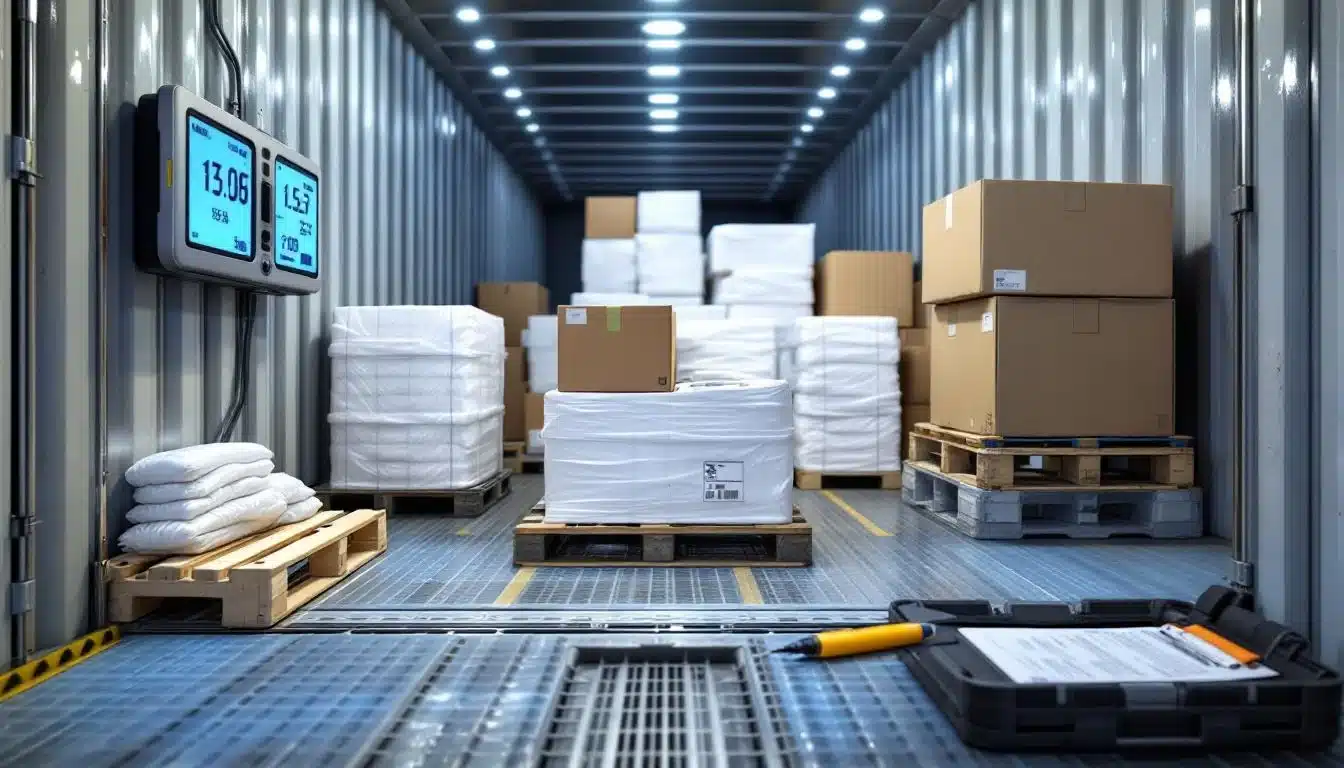
A single temperature deviation can ruin an entire shipment of pharmaceuticals, food, or biologics. At Loyalty Logistics, we know that cold chain failures cost businesses millions annually-and damage customer trust irreparably.
Product integrity isn’t just about keeping things cold. It’s about systematic monitoring, proper equipment, trained staff, and the right partners working together to prevent costly losses.
Why Product Integrity Matters in Cold Chain Logistics
Temperature excursions destroy value faster than almost any other supply chain failure. A two-hour deviation above the required range can compromise an entire pharmaceutical shipment worth hundreds of thousands of dollars. Cold chain integrity isn’t optional-it’s the foundation of your business. The global cold chain logistics market reached USD 293.58 billion in 2023 and is projected to grow to USD 862.33 billion by 2032, according to Fortune Business Insights. This explosive growth reflects reality: more companies ship temperature-sensitive products than ever before, and the cost of failure has never been higher. Reliable refrigerated transport services have become non-negotiable rather than optional in this market.
Temperature Excursions Carry Hidden Costs
Failed cold chain shipments carry expenses that extend far beyond immediate product loss. When a pharmaceutical shipment arrives outside acceptable temperature ranges, retailers and distributors reject it entirely, leaving you unable to recover the sale. Food products that exceed temperature thresholds become liability risks; you cannot resell them, and disposal costs compound the damage. Even food supply chain basics like temperature staging and documentation prevent these liability claims when executed consistently.
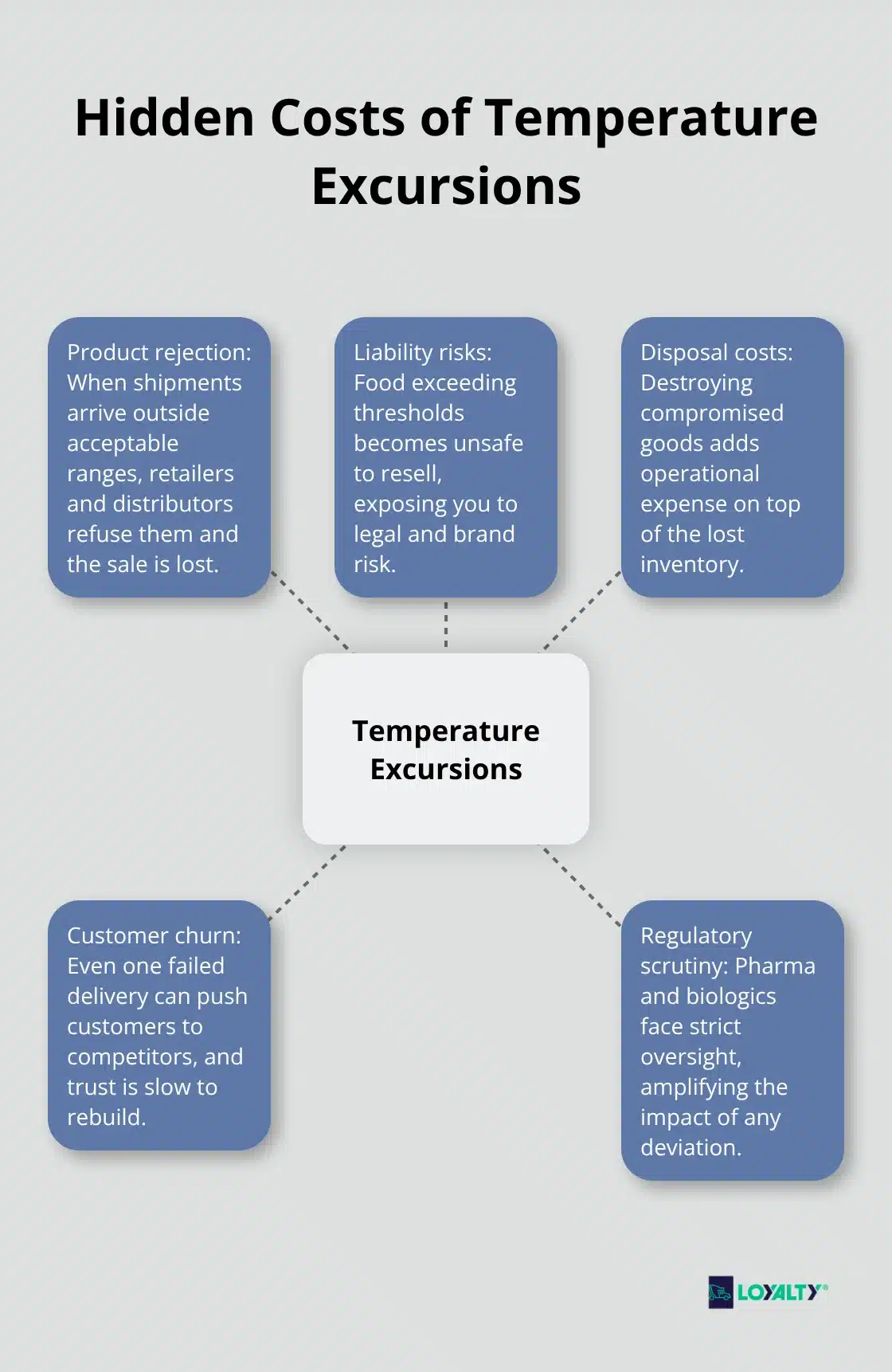
Customers who experience even one failed delivery often switch to competitors, and rebuilding that trust takes years. The pharmaceutical and biologics sector faces particularly strict scrutiny-vaccines, mRNA therapies, and cell-therapy products demand precision temperature control throughout their entire journey, which is why selecting pharma cold chain logistics companies with proven track records becomes critical.
Data loggers and real-time monitoring systems require upfront investment, but they prevent catastrophic losses that far exceed monitoring costs. Companies that skip proper temperature monitoring or use inexpensive, uncalibrated sensors risk equipment failures and power outages that happen regularly. Without robust systems in place, you receive no warning until the damage occurs.
Regulatory Bodies Enforce Strict Standards
Regulatory bodies like the FDA and EMA enforce strict temperature requirements for pharmaceuticals, biologics, and food products, with non-compliance triggering product rejections, recalls, and legal penalties. Compliance with FDA, EMA, and HACCP frameworks isn’t bureaucratic overhead-it’s a competitive advantage. Regulators require documented temperature records, calibrated monitoring equipment, and clear corrective action protocols.
Companies that maintain these standards gain approval from major retailers and pharmaceutical distributors faster, while non-compliant operations face audits, fines, and exclusion from contracts. Temperature mapping of your storage facilities and regular validation of your packaging materials demonstrate that you understand your cold chain from origin to destination. This documentation becomes essential when customers audit your operations or when regulators investigate a quality issue.
International Expansion Demands Regulatory Alignment
Asia Pacific is the fastest-growing cold chain region globally, driven partly by government investments in cold chain infrastructure and stricter enforcement of temperature standards. If you operate internationally or plan to expand, regulatory alignment isn’t optional-it’s the price of entry. The stakes increase when you cross borders; each region imposes its own requirements, and a single misstep can block access to entire markets.
These regulatory and cost pressures make temperature control and monitoring non-negotiable. The next section examines the critical checkpoints where failures most often occur and how to prevent them.
Shipping pharma, biologics, or vaccines that cannot tolerate excursions?
Loyalty Logistics runs validated pharmaceutical cold chain operations with continuous temperature logging, FDA-aware documentation, and dedicated reefer capacity across the U.S., Canada, and Mexico.
Critical Checkpoints in Cold Chain Management
Real-Time Monitoring Catches Problems Before Cargo Arrives
Data loggers and wireless sensors must transmit continuous temperature readings throughout transit, not just record them for post-delivery analysis. Many companies deploy sensors but fail to set appropriate alert thresholds or assign staff to respond when deviations occur. A two-degree Celsius excursion lasting two hours might trigger no alert in a poorly configured system, yet still compromise product efficacy. When you catch a temperature spike at hour one, corrective action prevents total loss. Wireless sensors that communicate in real-time to a centralized dashboard enable your team to reroute shipments, adjust vehicle climate controls, or contact the carrier before damage becomes irreversible.
Data loggers work well for historical validation and regulatory audits, but they reveal problems only after the shipment arrives. The pharmaceutical industry has learned this lesson repeatedly: vaccines and biologics require sensors that alert your operations team within minutes of any deviation, not days later during quality review.
Calibration and Equipment Traceability Matter More Than Cost
Inexpensive, uncalibrated data loggers can misread temperatures by several degrees, creating false confidence that conditions remained safe when they actually did not. CFR regulations require traceable calibration certificates for all monitoring equipment, yet many companies cut corners and purchase non-certified sensors to save money upfront. That gamble fails when a regulatory audit reveals your equipment lacks proper traceability or when a customer rejects a shipment based on monitoring data they cannot verify.
Packaging and Insulation Must Match Your Specific Shipping Lanes
Packaging and insulation materials must match the specific transit duration and ambient conditions of your shipping lanes, not generic industry standards. Temperature mapping of your storage facilities identifies hotspots where cooling is uneven, revealing which corners of your warehouse drift outside acceptable ranges. TAHUHU’s automated cold chain facility in Hong Kong demonstrates what precision looks like: their goods-to-person systems and temperature-controlled loading docks eliminate the temperature spikes that occur when doors open or products sit exposed during manual handling.
Equipment Maintenance Prevents Catastrophic Failures
Equipment maintenance schedules should be driven by failure history and ambient conditions, not calendar intervals. A refrigerated truck operating in Phoenix faces different stress than one in Seattle, yet many companies apply identical maintenance cycles regardless of regional climate. Preventive maintenance reduces the risk of power failures that devastate shipments, but reactive maintenance waiting for equipment to break is far more costly.
Backup power systems and redundant cooling capacity are not luxuries in pharmaceutical and biologics transport; they are operational necessities. When your primary refrigeration unit fails mid-transit, a backup system keeps temperatures stable long enough for the driver to reach a service center or transfer cargo to another vehicle. Companies that operate without redundancy accept the certainty that eventually, a single equipment failure will destroy an entire high-value shipment.
Humidity Control Protects Against Moisture Damage
Humidity control requires equal attention to temperature control, particularly for products sensitive to moisture like powders, desiccant-sensitive components, and freeze-dried biologics. Inadequate humidity management causes mold growth, freezer burn, and dehydration that temperature monitoring alone cannot prevent. Your packaging must include appropriate desiccants and moisture barriers matched to your specific products and transit times, validated through testing that mirrors real-world conditions, not laboratory ideals. These interconnected systems-monitoring, calibration, packaging, maintenance, and humidity control-form the foundation of reliable cold chain operations. The next section examines how best practices across your entire organization strengthen this foundation and reduce the risk of costly failures.
Watching cold chain failures destroy 6-figure shipments?
Tell us your products, temperature bands, and lanes. We’ll quote validated reefer capacity with continuous logging, calibrated sensors, and backup power so excursions stop costing you product.
How to Build a Cold Chain Operation That Actually Works
Set Up Real-Time Monitoring That Your Team Actually Uses
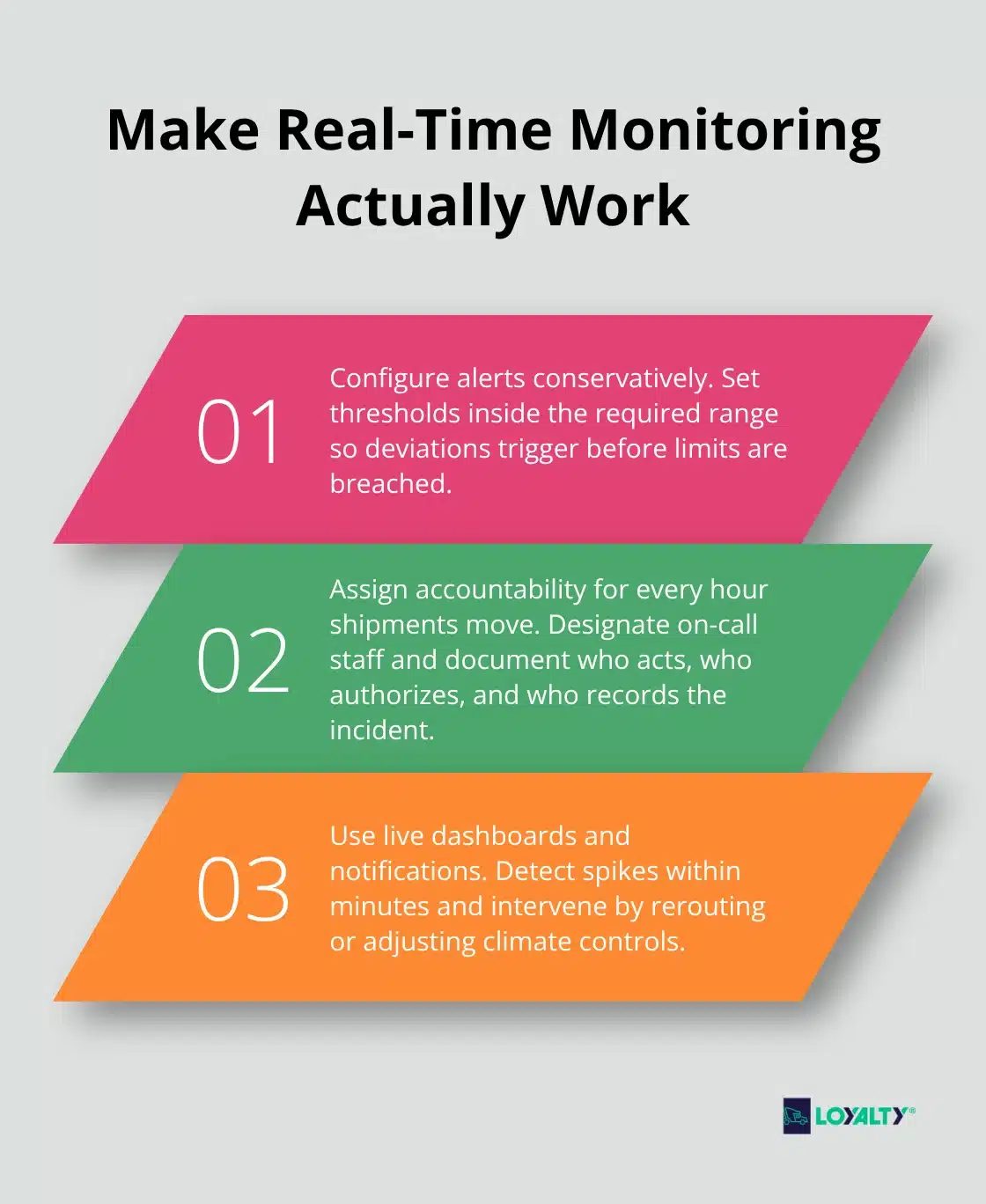
Real-time monitoring systems fail when your team ignores alerts or lacks clear protocols for responding to temperature deviations. Companies invest in sophisticated sensor networks, then lose shipments because no one checked the dashboard during night shifts or weekend operations. Your monitoring infrastructure only protects products if someone acts on the data within minutes of a deviation. Set alert thresholds conservatively-if your pharmaceutical shipment must stay between 2 and 8 degrees Celsius, trigger alerts at 3 and 7 degrees, not at the absolute limits. Assign specific staff members to monitor alerts during every hour your shipments move, and establish a corrective action protocol that names who contacts the carrier, who authorizes rerouting, and who documents the incident.
Wireless sensors that send SMS or push notifications to your team’s phones work better than dashboard-only systems because alerts reach people even when they are away from their desks. Data loggers provide essential regulatory documentation after shipment arrival, but they cannot prevent damage in progress. Combine both technologies: wireless sensors catch problems in real time, and data loggers create the audit trail regulators require. Test your alert system monthly by deliberately triggering a false deviation and timing how long it takes your team to respond. If response time exceeds 30 minutes, your process is too slow.
Train Staff on Failure Modes Specific to Your Operation
Staff training on cold chain protocols must address the specific failure modes that occur in your operation, not generic industry best practices. Train drivers on the consequences of leaving refrigerated truck doors open during loading-even five minutes of exposure at 25 degrees Celsius significantly reduces remaining shelf life for temperature-sensitive products. Train warehouse staff on the proper placement of products within coolers and freezers, ensuring air circulation reaches all items equally and preventing hotspots where some products exceed acceptable ranges.
Train your quality team to recognize when a temperature excursion might be recoverable versus when product must be rejected and disposed of, using decision trees based on product type, duration of excursion, and magnitude of temperature deviation. This targeted approach prevents costly mistakes where staff either reject salvageable product or approve compromised shipments that fail at customer sites.
Select Partners Based on Concrete Cold Chain Capabilities
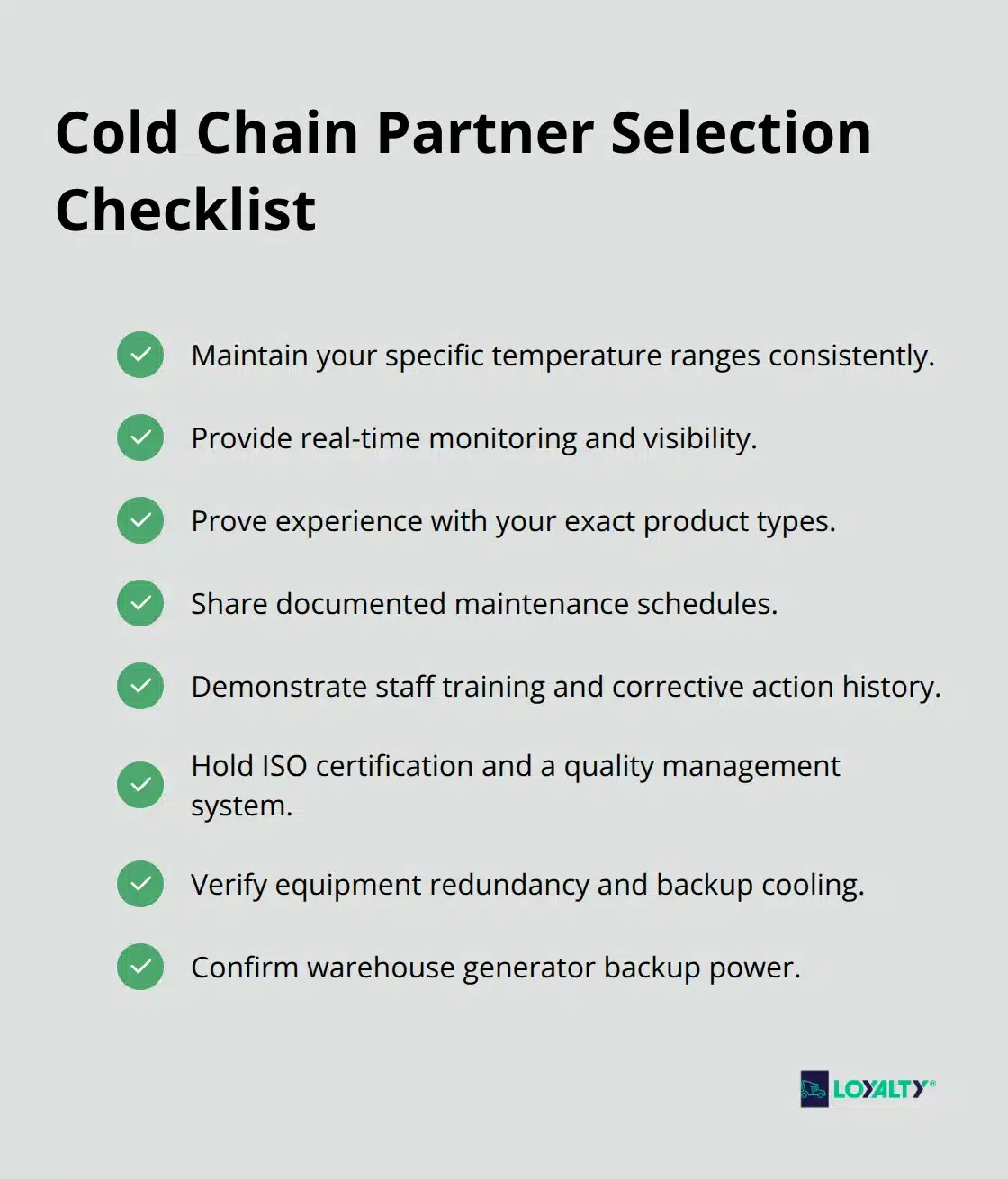
Partner selection determines whether your cold chain works reliably or fails unpredictably. Evaluate potential partners on three concrete criteria: their ability to maintain the specific temperature ranges your products require, their investment in monitoring technology that provides real-time visibility, and their track record with products identical to yours.
Ask prospective partners for references from companies shipping the same product types you do, not generic references that tell you little about their cold chain capabilities.
Request documented evidence of their equipment maintenance schedules, staff training programs, and corrective action history when temperature deviations occur. Vendors with ISO certification and quality management systems demonstrate that they follow repeatable processes, not ad-hoc approaches that vary by driver or season. Verify their equipment redundancy-ask specifically whether their refrigerated transport partner has backup cooling systems and whether their warehouses have generator backup power. A partner that cannot guarantee backup systems for your high-value shipments is not a reliable choice, regardless of their price.
Final Thoughts
Cold chain logistics success requires three interconnected elements that work together: real-time monitoring that catches problems before they destroy shipments, staff trained to respond immediately when deviations occur, and partners equipped with the technology and redundancy to prevent failures. Temperature control alone proves insufficient-you need calibrated sensors, backup power systems, humidity management, and documented processes that regulators can verify during audits. Companies that treat cold chain as a cost center rather than a competitive advantage accept preventable losses year after year, while those that invest in proper monitoring, maintenance, and partner selection recover that investment within months through reduced rejections and avoided recalls.
Technology strengthens product protection by providing visibility where none existed before. Wireless sensors alert your team to temperature spikes within minutes, not days, and real-time dashboards show exactly where your shipments are and whether conditions remain acceptable. Data loggers create the audit trail that regulators require and that customers demand, while automated warehouses with temperature-controlled loading docks eliminate the exposure that occurs during manual handling.
Your next step is to audit your current cold chain operation against the standards outlined in this article and identify which monitoring systems you operate, whether your staff has clear protocols for responding to alerts, and whether your partners can document their equipment maintenance and backup systems. We at Loyalty Logistics understand that cold chain reliability determines whether your business grows or stalls, and our refrigerated and reefer trucks combined with advanced logistics help you maintain product integrity across the U.S., Canada, and Mexico. Explore our freight transportation services to strengthen your cold chain operations and reduce the risk of costly failures.
Frequently Asked Questions
Why is product integrity critical in cold chain logistics?
Product integrity is critical because a single temperature deviation can compromise an entire pharmaceutical shipment worth hundreds of thousands of dollars. Failed cold chain shipments create cascading costs beyond product loss: rejection by retailers and distributors, disposal expenses for liability-risk goods, regulatory penalties from FDA, EMA, and HACCP non-compliance, and lost customer trust that takes years to rebuild. The global cold chain logistics market reached USD 293.58 billion in 2023, reflecting how much value depends on temperature control.
What temperature monitoring systems do cold chain operations need?
Cold chain operations need both wireless sensors that transmit continuous real-time data to a centralized dashboard and data loggers that create regulatory audit trails. Wireless sensors with SMS or push notifications alert teams within minutes of deviations, enabling corrective action before damage becomes irreversible. Data loggers verify historical conditions for FDA and customer audits. All monitoring equipment must carry traceable calibration certificates per CFR regulations; uncalibrated sensors create false confidence that conditions remained safe when they did not.
How can you prevent cold chain failures during transit?
Prevent cold chain failures by setting conservative alert thresholds (trigger at 3°C and 7°C if your range is 2-8°C, not at the absolute limits), assigning specific staff to monitor alerts every hour shipments move, training drivers on door-open exposure consequences, maintaining backup cooling systems and generator power, and managing humidity alongside temperature for moisture-sensitive products. Test alert response time monthly; if it exceeds 30 minutes, the process is too slow.
What certifications matter for cold chain logistics partners?
Critical certifications include FDA registration for U.S.-bound shipments, EMA compliance for European markets, HACCP for food products, ISO certification for quality management systems, and traceable calibration certificates for all monitoring equipment per CFR regulations. Partners with these certifications demonstrate repeatable processes rather than ad-hoc approaches. Verify partner certifications independently rather than accepting claims at face value, especially when shipping high-value pharmaceuticals or biologics.
Ready to Protect Your Cold Chain From Costly Failures?
Cold chain logistics rewards operations that pair calibrated monitoring with carrier discipline. Tell us your products, temperature bands, and lanes and we’ll quote refrigerated and reefer capacity with continuous logging, FDA-aware documentation, and backup systems engineered to prevent the excursions that destroy 6-figure shipments.
Related Articles
- Pharma Cold Chain Logistics Companies: Sibling guide focused specifically on selecting providers for pharmaceutical cold chain.
- Reefer Truck Guide: Keep Food Fresh in Transit: Reefer fundamentals and equipment selection that anchor cold chain reliability.
- How to Choose a Perishable Freight Forwarder: Selection criteria for partners moving temperature-sensitive cargo internationally.
Loyalty Logistics: Connecting businesses with opportunities across North America.
Written by: Carlos Robayo, Marketing Director at Loyalty Logistics
With expertise in logistics marketing and international trade, Carlos specializes in connecting businesses with efficient and reliable transport solutions for the North American market.