

California’s emissions standards affect every logistics operation moving freight through the state. CARB compliance California requirements aren’t optional-they’re mandatory for fleet operators who want to avoid penalties and stay competitive.
At Loyalty Logistics, we’ve helped supply chain directors navigate these regulations without derailing their budgets. This guide walks you through the standards, the steps to achieve compliance, and the financial incentives that can offset your upgrade costs.
What CARB Actually Requires From Your Fleet
Heavy-Duty Vehicle Thresholds and Emission Standards
CARB’s Clean Truck Check program sets hard thresholds that apply to any heavy-duty vehicle over 14,000 pounds operating in California. The regulation focuses on particulate matter and nitrogen oxide emissions, with specific limits that vary based on your vehicle’s model year and engine type. Diesel trucks must have 2010 model year or newer engines as of 2023, or they need CARB-approved retrofits with documented particulate filters. Non-compliance carries serious consequences: fines reach $10,000 per vehicle per day, and CARB has collected nearly $20 million in penalties from non-compliant fleets.
Tracking Your Compliance Status
Your vehicle status appears in the TRUCRS system as Compliant, Conditional, or Non-Compliant, and enforcement agencies have full visibility into fleet data. If your trucks fail inspection, they cannot operate in California until repairs are completed and verified. This visibility means you need accurate records and proactive monitoring to avoid operational disruptions that cost your business time and revenue.
Two Paths to Submit Emissions Data
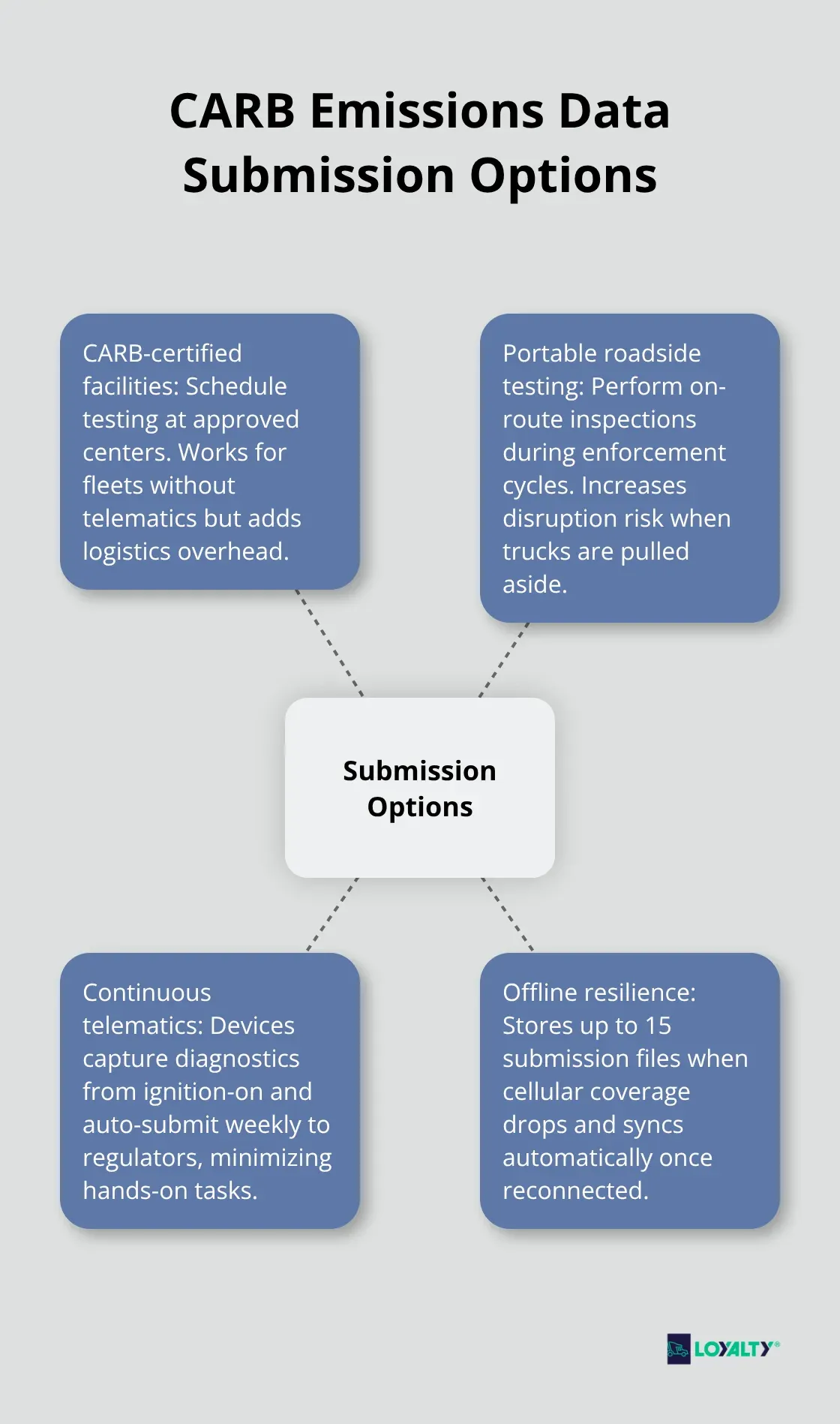
You can submit emissions data through CARB-certified testing facilities, portable roadside testing systems, or continuous telematics devices that automatically upload vehicle diagnostics to California regulators. Telematics solutions like Geotab’s CARB-compliant GO9 devices collect data continuously starting at ignition on, then submit weekly, with offline capability storing up to 15 submission files if cellular coverage drops. This automated approach eliminates the need for frequent roadside testing and reduces downtime costs that typically run $450 to $750 per day per out-of-service truck.
Reefer Units and Transport Refrigeration Requirements
For reefer units and transport refrigeration units, you register separately in the ARBER system and maintain detailed maintenance and emissions records. The key operational difference: telematics fleets stay compliant automatically through continuous monitoring, while manual testing fleets face repeated inspection cycles and higher disruption risk. This distinction shapes your compliance strategy and determines how much operational flexibility you retain throughout the year.
Getting Your Fleet Audit and Compliance Timeline Right
Conduct Your Initial Fleet Audit
Start with a complete fleet audit before making any compliance decisions. Pull your TRUCRS registration data for every heavy-duty vehicle over 14,000 pounds and verify the model year, engine type, and current compliance status. If any truck shows Conditional or Non-Compliant status, you face a hard deadline: vehicles cannot legally operate in California until repairs are completed and verified through CARB’s system. The audit takes two to four weeks depending on fleet size, but rushing this step costs more later when enforcement catches unprepared vehicles. Document every VIN, engine serial number, and DPF retrofit serial if applicable, because CARB enforcement has visibility into this data and gaps invite audits. For reefer units, run the same process through ARBER and pull maintenance records going back at least one year to confirm emissions compliance. Many fleet managers discover non-compliance during a roadside inspection, which triggers immediate service disruptions and fines up to $10,000 per vehicle per day.
Choose Between Manual Testing and Continuous Telematics
Manual testing requires you to schedule CARB-certified facilities or portable roadside testing every inspection cycle, which creates operational friction and downtime costs averaging $450 to $750 per day per out-of-service truck. Continuous telematics with CARB-compliant devices collects emissions data automatically starting at ignition on, then submits weekly with offline capability storing up to 15 submission files if coverage drops, eliminating the need for frequent inspections entirely. The telematics approach costs more upfront but prevents the repeated downtime that manual testing creates throughout the year. This choice shapes your compliance strategy and determines how much operational flexibility you retain.
Document and Track Every Compliance Action
Once you choose your path, document every compliance action in TRUCRS or ARBER, including retrofit installations, certifications, and emissions test results. Enforcement agencies review these records during audits, so incomplete documentation creates liability even if your vehicles technically meet standards. Set calendar reminders for annual TRUCRS reporting deadlines and maintain proof of compliance in every vehicle to avoid operational halts at checkpoints. With your fleet audit complete and your testing method selected, you now need to identify which vehicles require upgrades and which retrofits will bring non-compliant trucks into compliance.
What CARB Compliance Actually Costs Your Fleet
CARB compliance requires upfront investment, but the math shifts dramatically when you factor in penalty avoidance and operational efficiency. A single non-compliant truck operating in California costs you $10,000 per vehicle per day in fines, which means one week of undetected violations exceeds $70,000. Most fleet managers underestimate this risk because they assume enforcement only catches obvious violators, but CARB has collected nearly $20 million in penalties, and roadside inspections happen without warning.
Identifying Your Equipment Upgrade Costs
Your real cost calculation starts with identifying which vehicles need retrofits or replacement. A CARB-approved diesel particulate filter retrofit runs $3,000 to $8,000 per truck depending on engine type, while upgrading to a 2010 model year or newer engine costs $15,000 to $25,000. Telematics hardware like Geotab’s CARB-compliant GO9 device adds $1,200 to $2,000 per vehicle, but eliminates the $450 to $750 daily downtime cost associated with manual roadside testing.
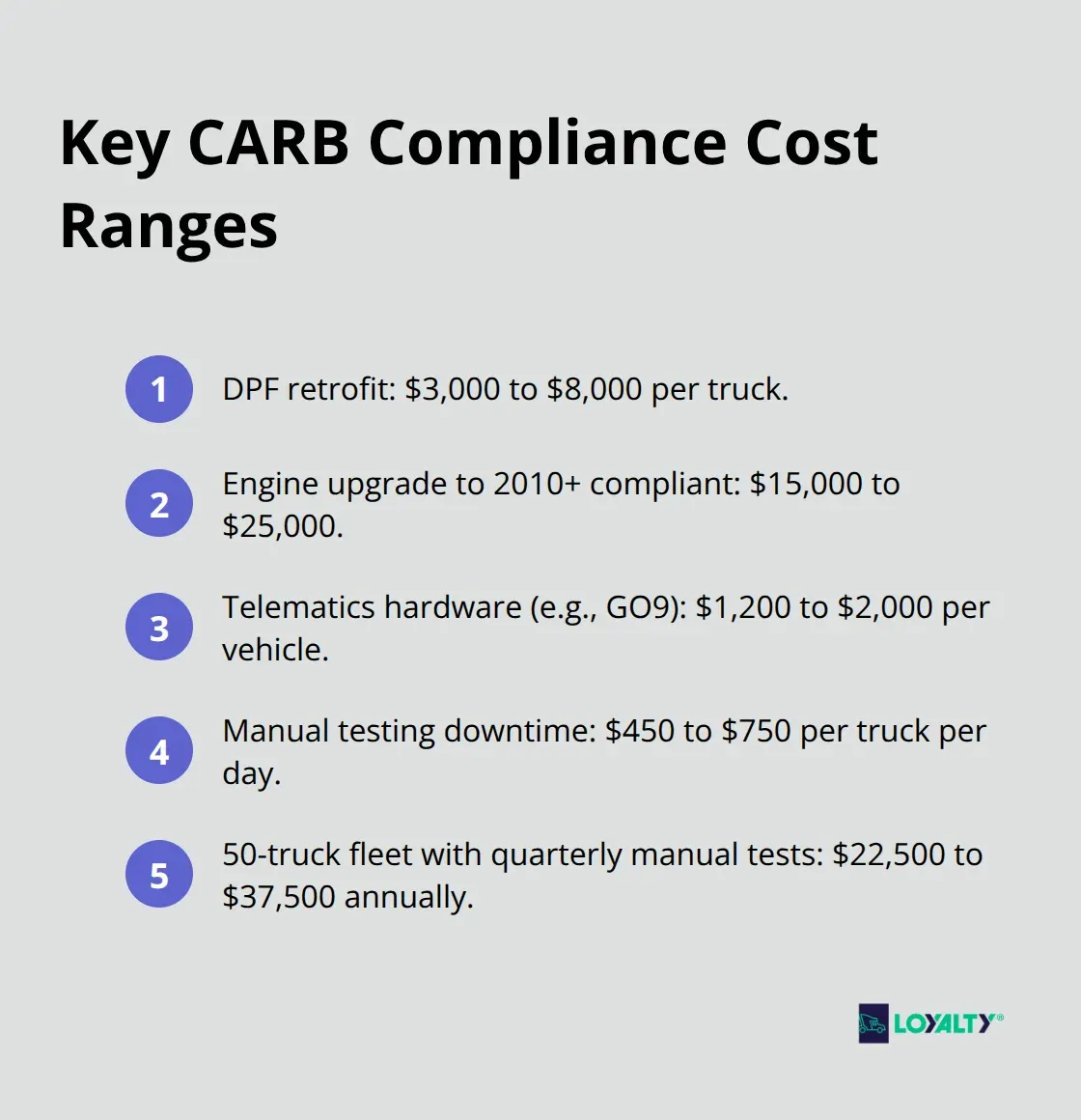
If you operate 50 trucks and conduct quarterly manual testing, you lose roughly $22,500 to $37,500 annually just in downtime, not counting technician time and inspection fees. Continuous telematics pays for itself within six months on a fleet that size.
Accessing Rebate Programs and State Funding
California’s Cap-and-Trade program and related incentive initiatives fund fleet upgrades through grants and rebates, but accessing these funds requires advance planning and specific documentation. The state prioritizes zero-emission vehicle transitions and DPF retrofits for older engines, offering up to 50% cost coverage on qualified projects. You must apply before purchasing equipment and maintain detailed records showing project completion.
Federal EPA grants complement state programs, though eligibility varies by fleet size and location. The challenge most logistics managers face is timing: rebate applications take four to eight weeks, and funding cycles align with state budget periods, not your operational schedule. Submit applications immediately after your fleet audit identifies non-compliant vehicles rather than waiting until deadline pressure forces rushed decisions. Many fleets miss funding deadlines because they treat compliance as a single event rather than an ongoing program. Document every retrofit installation with CARB-approved vendors and maintain copies of certifications, because incomplete paperwork disqualifies rebate claims even if work was completed correctly.
Calculating Long-Term Operational Savings
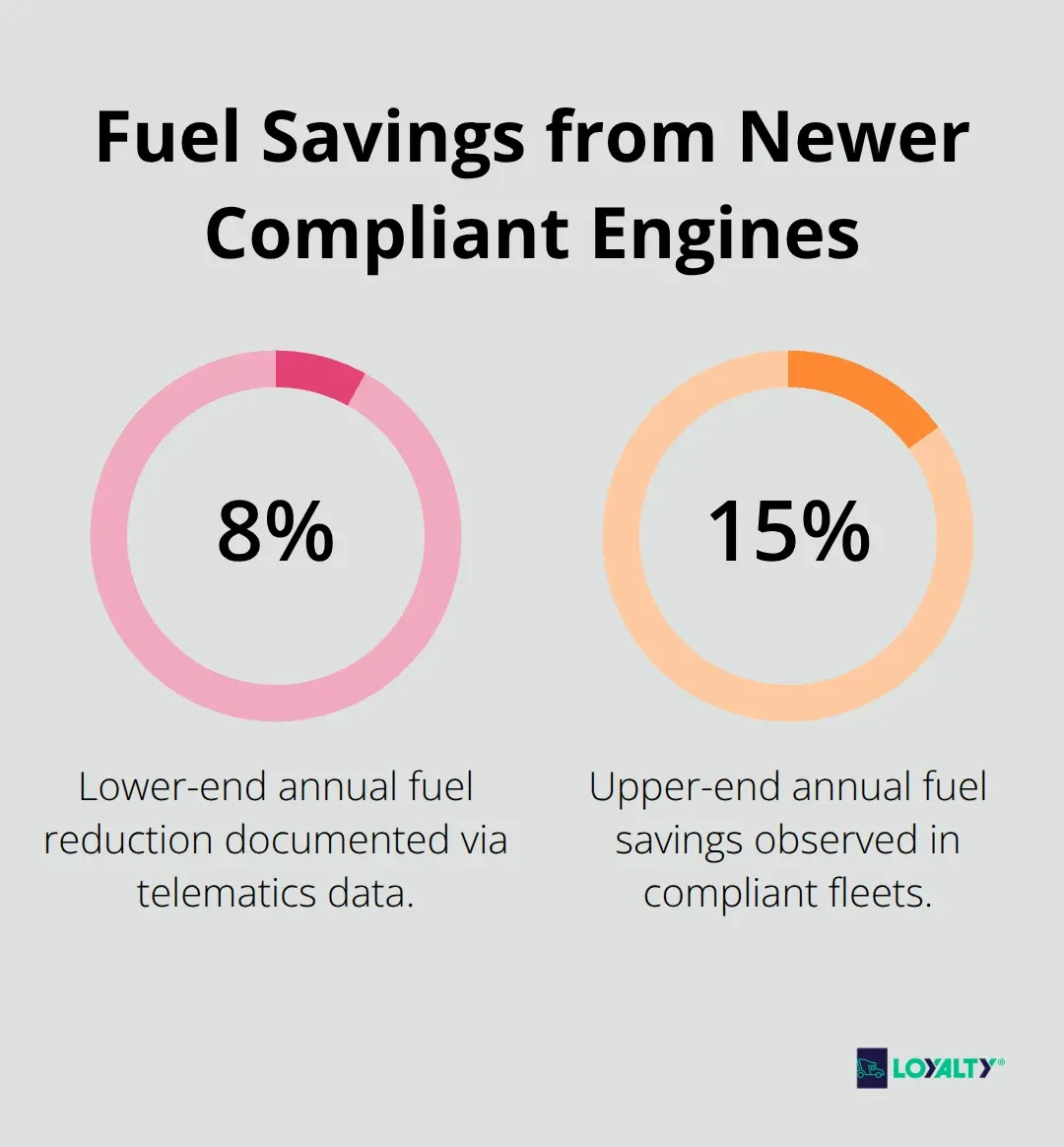
Newer compliant engines consume less fuel and require fewer repairs than aging diesel units, cutting operational costs by 8% to 15% annually according to fleet data tracked through telematics systems. A truck averaging 50,000 miles yearly at $3.50 per gallon saves $1,400 to $2,600 annually through fuel efficiency alone. Telematics monitoring of engine diagnostics catches maintenance issues before catastrophic failure, reducing unexpected downtime that disrupts customer commitments and damages reputation.
Continuous emissions monitoring through CARB-compliant devices identifies engine faults early, allowing planned maintenance windows instead of emergency roadside repairs. Your compliance investment becomes profitable within three to four years when you account for reduced downtime, fuel savings, and eliminated penalties. Fleets that delay compliance face compounding costs: each year of operation with marginal equipment increases failure risk, extends payback periods, and exposes your business to escalating regulatory pressure as California’s standards tighten.
Final Thoughts
CARB compliance in California demands immediate action on three fronts. Complete your fleet audit within two weeks and pull TRUCRS status for every heavy-duty vehicle over 14,000 pounds, then decide whether manual testing or continuous telematics fits your operational model-telematics eliminates the $450 to $750 daily downtime costs that manual testing creates. Apply for state rebate funding before purchasing equipment, since timing these applications correctly cuts your net compliance costs by 30% to 50%.
Your compliance investment recovers quickly through operational efficiency. Newer engines consume 8% to 15% less fuel annually, telematics monitoring catches maintenance issues before catastrophic failure, and continuous emissions data prevents repeated roadside inspections that disrupt service schedules. Most fleets recover their CARB compliance California investment within three to four years through fuel savings and reduced downtime alone.
At Loyalty Logistics, we work with supply chain directors across the U.S., Canada, and Mexico to navigate regulatory complexity while maintaining service levels. If you manage cross-border freight or California-heavy routes, contact us to discuss how we support logistics operations through regulatory transitions and help you build a compliance strategy that protects your business.
