
SmartWay certification from the EPA has become a real differentiator for logistics companies serious about reducing emissions and cutting fuel costs. At Loyalty Logistics, we’ve seen firsthand how carriers running freight shipping services use this credential to win contracts and improve their bottom line.
The program tracks measurable performance metrics, and certified carriers report fuel savings between 5% and 15% annually. If you’re managing freight operations, understanding what SmartWay certification involves and how it affects your supply chain decisions matters more than ever.
What SmartWay Certification Actually Means
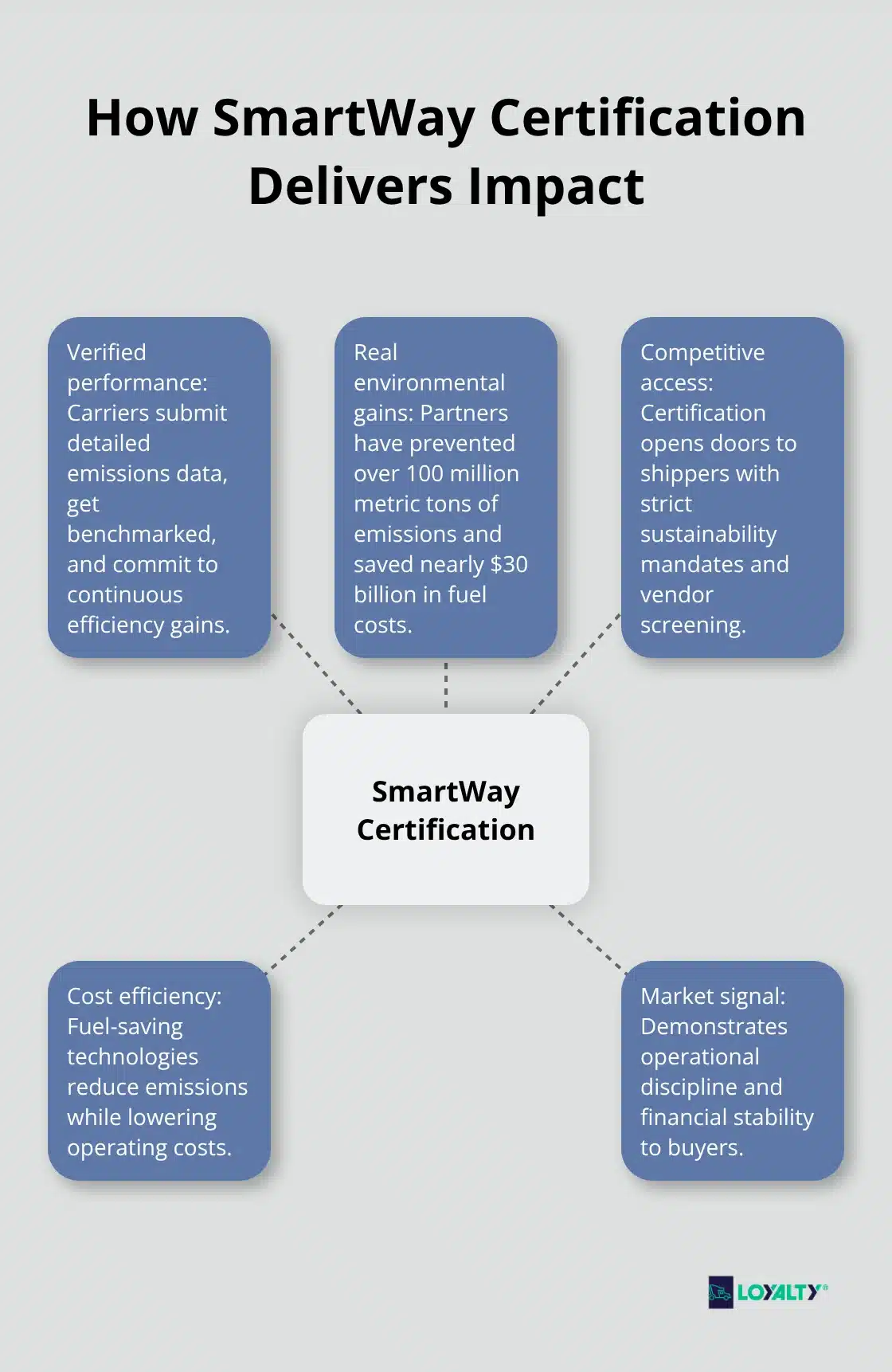
SmartWay certification from the EPA is not a participation trophy. It’s a data-backed credential that proves a carrier or logistics company has measured, benchmarked, and actively reduced its freight emissions and fuel consumption against industry standards. The program launched in 2004 and now includes over 3,000 certified carriers. When you see SmartWay certification on a carrier’s profile, it means they submitted detailed emissions data to the EPA, received ranking against their peers, and committed to ongoing efficiency improvements.
This matters because transportation accounts for more than 50% of nitrogen oxide emissions and about 20% of particulate matter emissions in the United States. SmartWay partners have prevented over 100 million metric tons of emissions since the program’s inception and saved nearly $30 billion in fuel costs collectively. For logistics managers, this translates to a simple fact: a SmartWay-certified carrier has proven it can move freight more efficiently than non-certified competitors. This proof connects directly to broader carbon neutral logistics goals that more shippers now build into their RFPs.
Two Certification Tracks
The certification comes in two distinct tracks. Carriers submit loaded and non-loaded miles data, fuel consumption by engine class, and vehicle specifications so the EPA can rank them on carbon emissions, nitrogen oxide output, particulate matter, and fuel efficiency. Logistics companies like brokers and third-party providers certify by tracking the environmental impact of their carrier base, reporting which carriers they used and the fuel efficiency of those shipments over 12 months. Neither path is automatic, both require real data collection infrastructure and annual reporting discipline.
Why Certified Carriers Win Contracts
Companies pursuing sustainability commitments increasingly screen vendors using SmartWay status. Shippers identify carriers that match their environmental goals and reduce supply chain risk simultaneously. A certified carrier signals financial stability, operational discipline, and access to efficiency technologies. Anderson Trucking Service holds SmartWay certifications for both dry van and specialized fleets and targets a 1% annual reduction in CO2 emissions using EPA tools. Their brokerage division maintains separate SmartWay certification, showing end-to-end commitment.
This approach works because sustainability and operational efficiency are not separate goals. The fuel-saving technologies that reduce emissions also cut costs. Certified carriers typically report 5% to 15% annual fuel savings, which directly improves margins and allows them to compete more aggressively on price. For shippers managing tight budgets, choosing SmartWay partners addresses two requirements at once: meeting corporate sustainability targets while controlling transportation spend.
The Real Competitive Edge
The competitive advantage is real and measurable. Shippers now expect their logistics partners to demonstrate environmental accountability, and SmartWay certification provides that proof. Carriers without this credential face increasing pressure to obtain it or risk losing contracts to competitors who have already invested in the program. The certification also opens doors to shippers with strict sustainability mandates, companies that simply will not work with non-certified providers. This shift in vendor selection criteria means that SmartWay status has moved from a nice-to-have credential to a business necessity for carriers competing in major accounts. Connecting SmartWay status to a broader green supply chain strategy is how leading shippers position themselves with customers and investors.
Sustainability mandates pushing you to verify carrier emissions data instead of taking marketing claims at face value?
Loyalty Logistics coordinates freight transportation for industrial manufacturers running ESG-reported supply chains, with carrier vetting that includes SmartWay status, CO2 grams-per-ton-mile data, and lane-level emissions reporting.
Getting SmartWay Certified: What You Actually Need to Do
Who Qualifies for SmartWay Certification
Any carrier or logistics company moving freight can apply for SmartWay certification, but the EPA sets specific eligibility requirements that separate serious operators from those unprepared for the reporting discipline involved. Carriers need at least one year of operational history and the ability to track loaded miles, non-loaded miles, fuel consumption broken down by engine class, and vehicle specifications. Logistics companies like brokers and third-party providers must demonstrate they managed freight shipments over a 12-month period and can report which carriers they used and the fuel efficiency of those movements. No minimum fleet size exists, which means even smaller operations can qualify if their data systems function properly. The real barrier is not eligibility itself but the infrastructure required to collect and verify emissions data accurately. Carriers without telematics or fuel management systems hit a wall immediately because the EPA rejects estimates or approximations. You submit actual numbers or you do not submit at all.
Data Submission Requirements and Precision
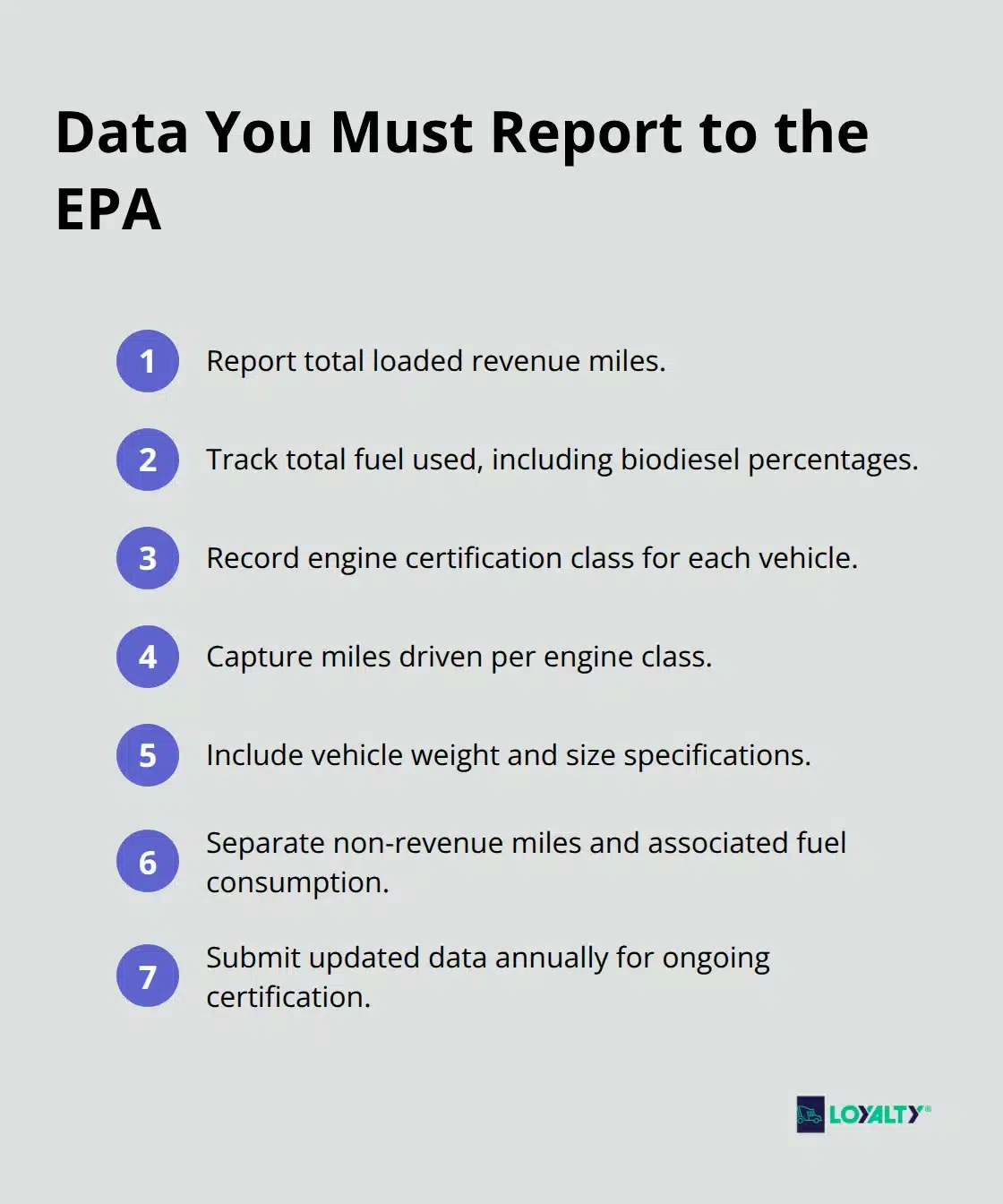
The data submission process demands precision that catches many applicants off guard. You report total loaded revenue miles, total fuel used including biodiesel percentages, engine certification classes for each vehicle, miles driven per engine class, and vehicle weight and size specifications. Non-revenue miles and associated fuel consumption must also be tracked separately so the EPA can calculate your true efficiency.
The EPA then ranks you against other SmartWay carriers on carbon emissions per ton-mile, nitrogen oxide output, particulate matter, and fuel economy. Anderson Trucking Service demonstrates the commitment this requires: they target a 1% annual reduction in CO2 grams-per-ton-mile using EPA modeling tools and maintain detailed records across both dry van and specialized divisions. Once certified, you report annually with updated data, meaning the certification process never truly ends. Carriers running modern eco-friendly logistics innovations like idle-reduction tech, low-rolling-resistance tires, and aerodynamic skirts consistently rank higher in SmartWay benchmarks.
Timeline and Financial Investment
The timeline to initial certification typically runs four to six months from application to approval, assuming your data systems function properly and your submissions are complete on the first attempt. Incomplete submissions delay approval significantly. Costs vary but expect to invest in software or consulting support to manage data collection and reporting. The EPA does not charge a certification fee, but the internal resources required to gather, verify, and submit accurate data add up quickly. Many carriers underestimate this expense and find themselves paying consultants to help organize their operational data into EPA-acceptable formats. The annual reporting requirement means ongoing costs persist year after year, not just during the initial certification phase. These financial commitments (software licenses, staff time, external consulting) represent a real investment that carriers must budget for before they apply.
Moving From Certification to Competitive Advantage
Once you hold SmartWay certification, the credential opens doors with shippers who screen vendors based on environmental performance. Your certified status appears in EPA databases and on your carrier profile, signaling to logistics managers that you have submitted to independent benchmarking and committed to measurable efficiency improvements. Shippers increasingly use this credential to narrow their carrier lists, which means certification directly influences your ability to win and retain contracts. The next step involves understanding how shippers actually evaluate SmartWay-certified carriers and what competitive advantages this credential delivers in real vendor selection scenarios.
Real-World Impact of SmartWay Certification
SmartWay-certified carriers report measurable results that logistics managers can verify independently. Anderson Trucking Service holds SmartWay certification for both dry van and specialized fleets and targets a 1% annual reduction in CO2 grams-per-ton-mile using EPA modeling tools. Across the entire SmartWay program, certified carriers have prevented over 100 million metric tons of emissions since 2004 and saved nearly $30 billion in fuel costs collectively.
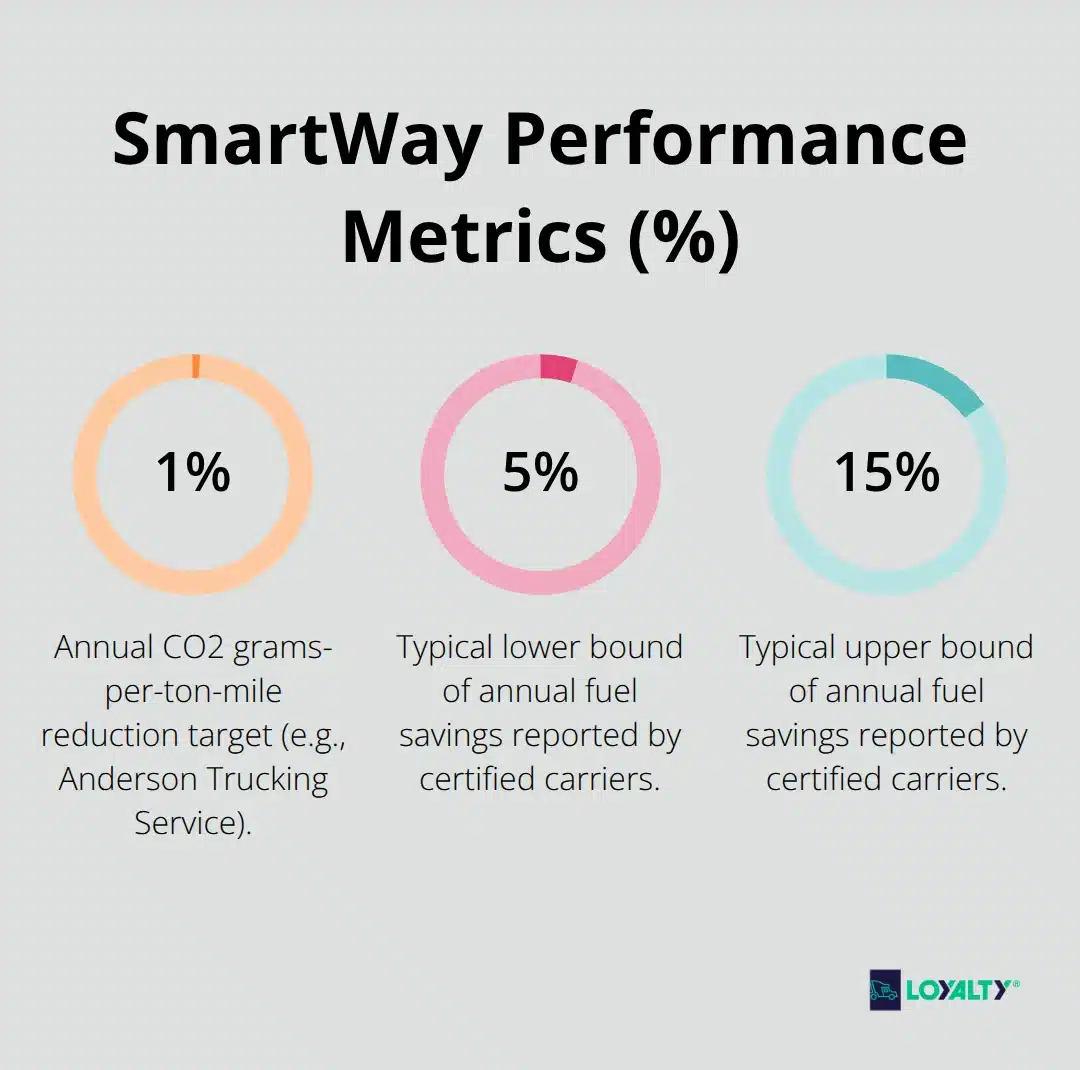
Individual carriers typically report fuel savings between 5% and 15% annually. These numbers matter because they translate directly to operational costs. A carrier that saves 10% on fuel costs gains a competitive advantage that persists year after year. The EPA’s rankings provide shippers with transparent performance data, so you can compare certified carriers against each other using standardized metrics rather than relying on vendor claims. This transparency removes guesswork from vendor selection, and pairs naturally with broader supply chain efficiency initiatives.
How Shippers Screen Carriers Using SmartWay Status
Shippers increasingly use SmartWay certification as a screening tool in vendor selection, and this practice continues to accelerate. Companies with formal sustainability commitments now require carriers to hold SmartWay certification before they qualify for contract consideration. This is not theoretical, shippers managing tight sustainability mandates simply will not work with non-certified providers. For logistics managers, this means SmartWay status has shifted from a credential that provides advantage to a baseline requirement for competing in major accounts. When you evaluate carriers, cross-reference their SmartWay status against EPA databases to confirm active certification and review their environmental performance ranking relative to other certified competitors. A carrier ranked in the top quartile of SmartWay performers gains tangible negotiating power with shippers who prioritize environmental accountability. This vetting also fits into the broader playbook of building a sustainable supply chain in the digital age.
Competitive Disadvantage Without Certification
Carriers without SmartWay certification face genuine competitive disadvantage in a market where shippers increasingly screen vendors based on environmental performance. You lose contracts to competitors who have already invested in the program. Worse, you cannot access shippers with strict sustainability mandates because your operations lack independent verification. The certification cost and reporting discipline required to obtain SmartWay status represent real investment, but the cost of remaining non-certified (losing bids, reduced market access, and pressure from shippers demanding proof of efficiency) creates a stronger financial argument for pursuing certification. Logistics companies like brokers and third-party providers face the same pressure. Your ability to place freight with shippers depends partly on whether your carrier base holds current SmartWay certification. This market shift means that postponing certification carries hidden costs that compound over time.
Need a freight partner that documents carrier SmartWay status, fuel efficiency, and CO2 data lane-by-lane?
Tell us your lanes, volumes, and ESG reporting requirements. We’ll quote freight transportation with vetted SmartWay-aware carriers and audit-ready emissions data across U.S., Canada, and Mexico.
Final Thoughts
SmartWay certification delivers measurable value that extends far beyond environmental compliance. Carriers gain access to shippers with strict sustainability mandates, improve fuel efficiency by 5% to 15% annually, and strengthen their competitive position in a market where environmental accountability matters. Logistics companies that certify their carrier base demonstrate commitment to supply chain sustainability while simultaneously controlling transportation costs.
For logistics managers considering what SmartWay certification means for your operations, the decision hinges on market reality rather than ideology. Shippers increasingly screen vendors based on SmartWay status, which means non-certified carriers face genuine competitive disadvantage. The investment required to establish data collection systems and submit accurate emissions reports represents real cost, but postponing certification carries hidden costs that compound over time through lost contracts and reduced market access.
The long-term value of SmartWay certification lies in positioning your operations for sustained growth in a supply chain environment where sustainability expectations continue to tighten. Certified carriers retain contracts longer, negotiate from stronger positions, and access shipper networks that exclude non-certified competitors. Explore our freight transportation services to see how Loyalty Logistics integrates sustainability into every shipment across U.S., Canada, and Mexico.
Frequently Asked Questions
What is SmartWay certification?
SmartWay certification is an EPA-administered program launched in 2004 that ranks carriers, brokers, and third-party logistics providers based on freight emissions and fuel efficiency. Participants submit loaded miles, non-loaded miles, fuel consumption by engine class, and vehicle specifications. The EPA then benchmarks each participant against peers on carbon emissions per ton-mile, nitrogen oxide output, particulate matter, and fuel economy. Over 3,000 carriers currently hold SmartWay certification, and the program has prevented over 100 million metric tons of emissions since inception.
How do you get SmartWay certified?
To get SmartWay certified, your company needs at least one year of operational history, telematics or fuel-management infrastructure that can track precise data, and capacity to submit annual reports to the EPA. Submit loaded revenue miles, total fuel used including biodiesel percentages, engine certification classes per vehicle, miles per engine class, and vehicle weight/size. Brokers and 3PLs report carrier base data over 12 months. The EPA rejects estimates; only actual measured numbers qualify. Annual re-reporting is required to maintain certification.
How long does SmartWay certification take?
Initial SmartWay certification typically takes 4 to 6 months from application to approval, assuming your data systems function properly and submissions are complete on the first attempt. Incomplete or inaccurate submissions extend timelines significantly. The EPA does not charge a certification fee, but expect to invest in data-collection software, consulting support, and staff time to gather and verify the operational data. Annual re-certification adds ongoing cost that must be budgeted into long-term operations.
Why is SmartWay certification important for shippers?
SmartWay certification matters for shippers because it provides EPA-verified emissions and efficiency data they can use to screen vendors transparently. Companies with formal sustainability commitments now require SmartWay certification before a carrier qualifies for contract consideration. Cross-referencing a carrier’s SmartWay status and ranking against EPA databases lets shippers compare vendors on standardized metrics rather than marketing claims. This vetting also reduces ESG reporting risk because the data is independently verified, not self-reported.
Ready to Vet Carriers With SmartWay Data Instead of Marketing Claims?
SmartWay certification cuts the guesswork out of carrier emissions reporting. Tell us your lanes, freight types, and sustainability targets and we’ll quote freight transportation with SmartWay-aware carrier vetting, lane-level CO2 data, and audit-ready emissions reporting across U.S., Canada, and Mexico.
Related Articles
- Achieving Carbon Neutral Logistics Goals in 2025: Broader sustainability frame that SmartWay certification supports.
- How to Implement a Green Supply Chain: Strategic playbook for embedding sustainability into operations.
- Eco-Friendly Logistics Innovations Transforming Supply Chains: Equipment and tech that push SmartWay rankings higher.
Loyalty Logistics: Connecting businesses with opportunities across North America.
Written by: Carlos Robayo, Marketing Director at Loyalty Logistics
With expertise in logistics marketing and international trade, Carlos specializes in connecting businesses with efficient and reliable transport solutions for the North American market.