

Heavy machinery shipping across borders demands precision, compliance knowledge, and strategic cost management. Delays in documentation, unexpected regulatory hurdles, and inflated freight rates can derail your supply chain and impact your bottom line.
At Loyalty Logistics, we’ve helped logistics managers and supply chain directors navigate these complexities. This guide covers the regulations, cost strategies, and partner selection criteria you need to move heavy equipment efficiently and affordably.
Navigating Documentation, Weight Limits, and Safety Standards Across Borders
Cross-border heavy machinery transport requires mastery of three interconnected compliance areas: documentation, dimensional restrictions, and safety certifications. Many logistics managers treat these as separate boxes to check rather than integrated systems that must align perfectly. Documentation errors alone can trigger 5–10 day border delays, while weight violations expose your company to fines ranging from $500 to $5,000 per violation depending on jurisdiction. The Federal Highway Administration and state departments of transportation enforce overweight permits strictly, and there’s no negotiating your way past them once you’re stopped.
Confirm Permit Requirements Before Departure
Start with exact permit requirements before your machinery leaves the yard. Canada requires overweight permits through provincial authorities, while the USA issues them via state DOTs-these are not interchangeable, and crossing state lines without the correct permit creates immediate liability. For USA-to-Mexico shipments, you’ll need a Temporary Importation Permit and Mexican customs documentation confirming equipment ownership and applicable duties. Canada-to-USA moves require US Customs and Border Protection compliance, including a customs bond and entry manifest. This documentation must be accurate and submitted in advance; CBP inspections flag inconsistencies that halt your shipment for hours or days.
Weight and Height Restrictions Demand Route-Specific Planning
Each jurisdiction sets different weight limits on bridges, overpasses, and highways, which means your lowest-cost route may be illegal for your specific load. A 90,000-pound excavator might travel freely on Interstate highways in one state but face severe restrictions 50 miles away. Frost laws in northern regions further complicate timing-many states restrict heavy loads during spring thaw months to protect road surfaces, forcing seasonal adjustments to your shipping window. Route analysis tools identify these constraints, but they require detailed input on axle weights and equipment dimensions.
Safety Standards and Cargo Securement Compliance
Safety standards vary across jurisdictions. Equipment destined for Mexico must meet Mexican environmental and safety standards, which differ from US requirements. Riggers must secure cargo using FMCSA-compliant methods: chains, straps, and shackles configured to prevent load shifts during sharp turns or emergency braking. According to FMCSA cargo securement data, improper securement accounts for 34% of all commercial vehicle accidents and 28% of equipment-damage incidents, making this compliance area non-negotiable.
Your carrier must perform pre-trip inspections and route risk assessments to identify hazards like low-clearance bridges or tight turns that could damage your machinery. Professional carriers coordinate with DOT authorities to pre-clear routes before departure, preventing costly detours or rejection at checkpoints. These compliance steps directly impact your ability to control costs-violations and delays compound quickly, but proper planning prevents them entirely. The next section covers how to structure your freight rates and load planning to maximize efficiency without sacrificing compliance.
How to Control Freight Costs Without Compromising Compliance
Heavy machinery shipping costs vary dramatically based on distance, equipment weight, trailer type, and service speed, with industry rates typically ranging from $2 to $5 per mile for specialized transport. That $2-to-$5 range masks significant variation: a 500-mile cross-country flatbed move for a 40,000-pound excavator costs substantially less per mile than a 200-mile move requiring permit escorts and specialized lowboy equipment. Real cost control happens before you request a quote. You must know your equipment’s exact axle weight distribution, overall dimensions including height and width, and whether your route requires oversized permits or escort services.
Eliminate Rate Padding Through Complete Load Specifications
Most logistics managers treat freight rates as fixed line items, but carriers negotiate them when you provide complete, accurate load specifications upfront. Carriers price uncertainty into their quotes-they add 15 to 25 percent padding when they’re unsure about load details or route complexity. Precise documentation eliminates that padding. Provide your carrier with equipment specs, origin and destination addresses, and any known route restrictions before negotiations begin. This shifts the conversation from guesswork to concrete planning, and carriers respond with competitive rates because they can accurately assess their costs.
Identify the Legally Compliant, Cost-Effective Route
Route efficiency directly impacts your bottom line, and this is where most logistics managers leave money on the table. Your cheapest route is often illegal, too slow, or both. A route avoiding toll highways might add 200 miles and two days to your shipment; a route using interstate highways with low-clearance bridges requires expensive escort services and permit modifications. Specialized carriers analyze axle-weight distribution against bridge ratings and seasonal frost restrictions to identify the legally compliant, fastest, and most cost-effective path. This analysis prevents expensive detours, fines, and delays that compound quickly once your shipment is in transit.
Compare Total Project Cost, Not Per-Mile Rates
General freight carriers lack heavy-machinery expertise-they quote a rate based on distance and weight, then your shipment hits unexpected restrictions and costs spike. Specialized heavy-machinery carriers maintain updated routing databases and pre-clear routes with state DOTs before departure, absorbing this complexity into their service model. The per-mile rate may appear higher, but your total cost is lower because you avoid delays, permit violations, and last-minute route changes. A carrier quoting $3 per mile with full permit and escort coordination often delivers lower total cost than a general freight option at $2.50 per mile that leaves compliance and routing decisions to you.
Controlling freight costs requires shifting your focus from per-mile rates to total project cost and from guesswork to precise load specifications. Once you’ve mastered cost management, selecting the right carrier becomes the final piece of your shipping strategy-and this decision determines whether your machinery arrives on time, undamaged, and within budget.
Selecting the Right Heavy Machinery Shipping Partner
Experience in heavy machinery shipping separates carriers that deliver on time from those that create costly surprises. A carrier with 16 years of specialized experience has navigated frost-law restrictions, bridge-clearance issues, and permit complications that a general freight operator encounters once a year, if ever. When evaluating carriers, ask specifically about their track record with your equipment type and route corridor. A carrier experienced with excavator shipments across the Canadian border knows the provincial permit variations and CBP documentation requirements that will trip up someone without that history.
Request References From Similar Shipments
Request references from companies that shipped similar loads on similar routes within the past two years, not generic testimonials. Ask those references about on-time performance, how the carrier handled route complications, and whether their actual costs matched the initial quote. Industry data from the Global Heavy Equipment Shipping Service Market shows that leading players like DHL, Kuehne + Nagel, and DB Schenker dominate through specialized expertise and established relationships with regulatory authorities, which translates directly into faster approvals and fewer delays for your shipments.
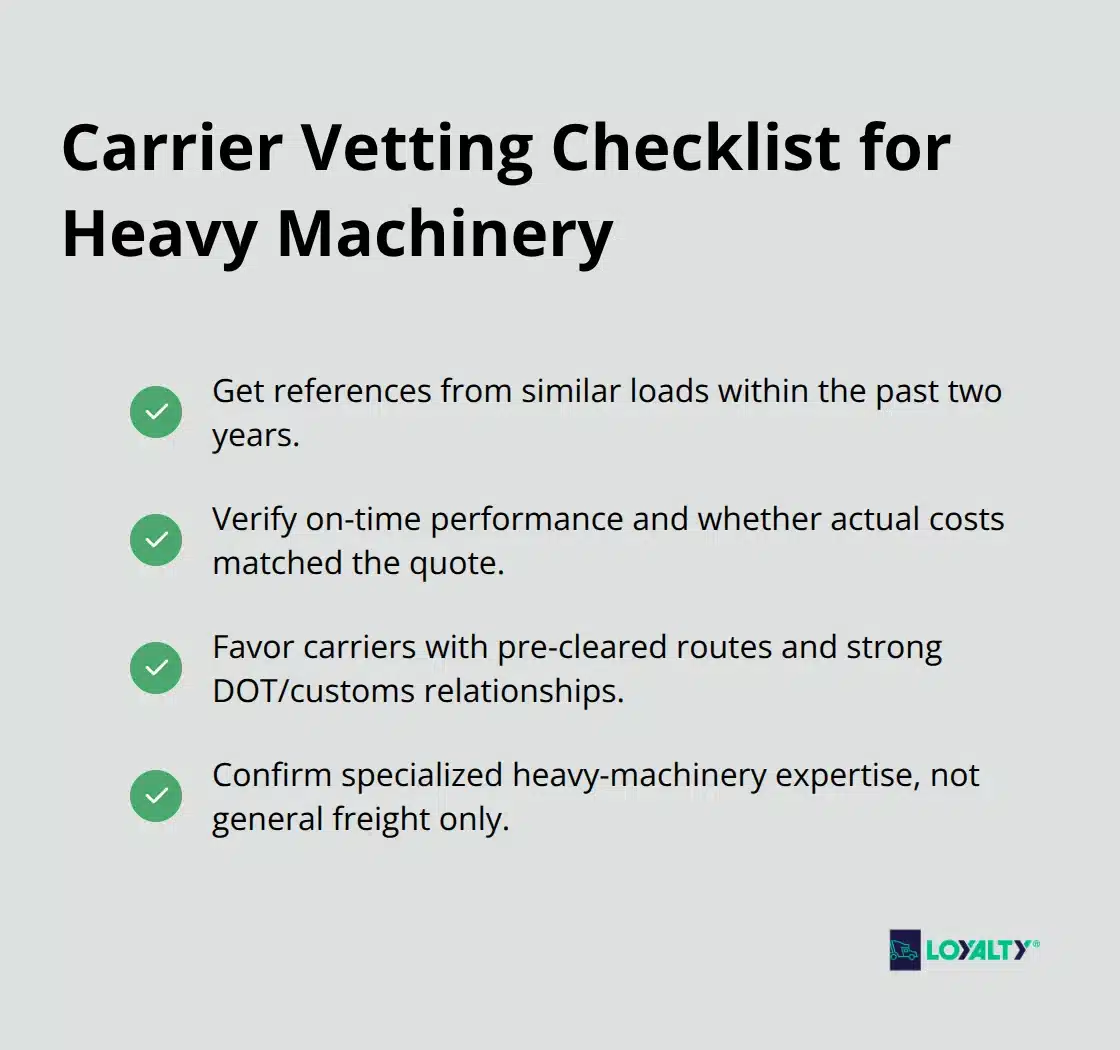
A carrier’s relationship with state DOTs and customs agencies matters more than you might expect-pre-cleared routes and established communication channels save 2 to 5 days compared to carriers that submit permits reactively.
Verify Specialized Equipment and Trailer Capabilities
Equipment capabilities and safety practices reveal whether a carrier can actually handle your machinery or will improvise solutions that damage your load. Confirm the carrier maintains specialized trailers matched to your specific needs: lowboys for oversized or extremely heavy loads, flatbeds for standard heavy equipment, step-decks for tall machinery. A carrier telling you they can haul anything on any trailer signals they lack specialization and will route your load on whatever equipment is available. Ask about their cargo securement process, including tie-down specifications and how they prevent load shifts during transit.
Assess Safety Compliance and Securement Standards
FMCSA standards require specific chain grades, spacing, and angles for securing heavy equipment, and carriers that cannot articulate their securement method operate without proper compliance. Request copies of their pre-trip inspection procedures and ask whether they perform route risk assessments that identify low-clearance bridges or tight turns before departure. Insurance coverage matters equally-confirm they carry cargo coverage appropriate to your machinery value and that their carriers are bonded and certified.
Evaluate Claims Support and Damage Resolution
Claims support separates professional operators from others; ask how they handle damage claims, what documentation they require, and their average resolution time. A carrier that hesitates to detail their processes isn’t managing risk properly, and you’ll absorb the consequences when delays or damage occur. Don’t accept vague answers about safety or claims-the carrier you select must demonstrate clear accountability through documented procedures, verifiable references, and transparent communication about how they manage the complexities of heavy machinery transport.
Final Thoughts
Heavy machinery shipping across borders succeeds when you control three variables: regulatory compliance, freight costs, and carrier selection. Documentation errors, weight violations, and improper cargo securement create delays that compound quickly, turning a two-week project into a three-week crisis. Route planning that accounts for frost laws, bridge clearances, and permit requirements prevents costly detours and fines, and when you invest upfront in compliance, your actual shipping costs drop because you eliminate the expensive surprises that derail budgets.
Cost control flows directly from precision-carriers padding quotes by 15 to 25 percent do so because they’re uncertain about your load specifications and route complexity. Providing exact axle weights, dimensions, and origin-destination details shifts negotiations toward competitive rates based on actual costs rather than guesswork. A carrier that pre-clears routes with state DOTs and maintains established relationships with customs agencies saves you 2 to 5 days compared to reactive permitting, and those days translate directly to cost savings.
Selecting the right carrier determines whether your machinery arrives on time and undamaged, so request references from similar shipments on similar routes, verify specialized trailer capabilities matched to your equipment, and assess their safety compliance and claims support processes. We at Loyalty Logistics handle the compliance details and logistics coordination so your heavy machinery shipping arrives on schedule and within budget. Contact us today to discuss your next project and see how specialized expertise reduces your delays and costs.
