
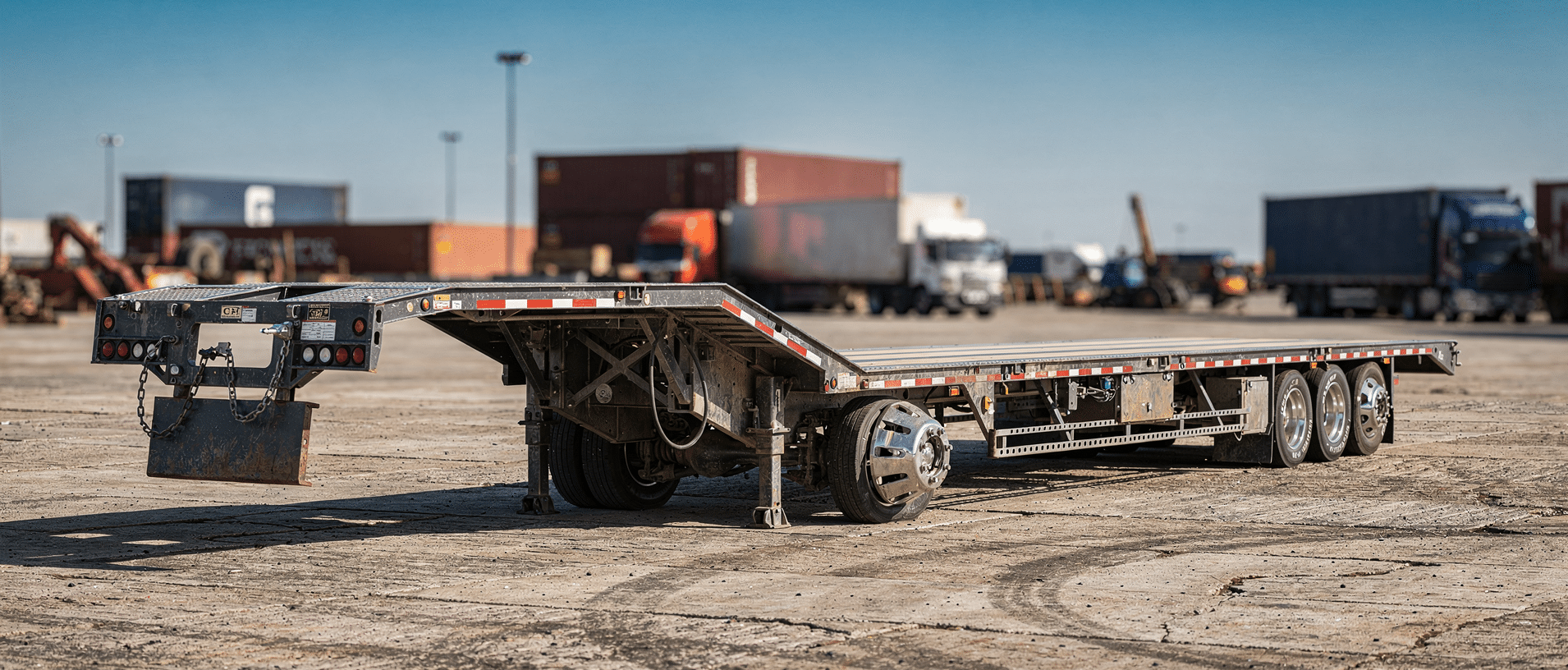
An RGN trailer — short for Removable Gooseneck — is one of the most versatile options in heavy haul trucking. At Loyalty Logistics, we often field questions about how RGN trailers differ from lowboy trailers, and which one is right for each job. In this guide, we break down the key differences to help you decide.
What Is an RGN Trailer and How Does It Work?
Definition and Key Features
RGN trailers (Removable Gooseneck trailers) stand as powerhouses in the heavy hauling industry. These versatile trailers feature a detachable front section, which allows for easy loading and unloading of oversized equipment. RGN trailers support impressive load capacities, typically up to 42,000 pounds with standard configurations. With additional axles, they can handle loads up to 150,000 pounds. The most common RGN setup includes a 29-foot well length and 8.5-foot width, providing ample space for large equipment.
Standout Features
The detachable gooseneck creates a gentle slope for drive-on loading. This design eliminates the need for cranes or forklifts in many cases, which streamlines the loading process and reduces associated costs. RGN trailers offer superior maneuverability compared to some alternatives. Their weight distribution method over the rear axle of the towing vehicle provides increased control (especially valuable when navigating tight spaces or making sharp turns).
Advantages of RGN Trailers
The versatility of RGN trailers sets them apart in the logistics world. Their ability to accommodate a wide range of cargo sizes and shapes makes them ideal for industries that require frequent heavy equipment transport. The U.S. Department of Transportation reports that RGN trailers effectively handle loads that exceed standard height restrictions. Proper cargo securing techniques become especially critical with these oversized loads to ensure damage-free delivery.
Industries Benefiting from RGN Trailers
Construction companies frequently choose RGN trailers due to their ease of loading and unloading self-propelled machinery. Agricultural operations also favor RGNs for transporting combines and other large farm equipment. In the energy sector, RGN trailers excel at moving components for wind turbines and solar panels.
The towing industry has embraced RGN trailers for their ability to transport large vehicles efficiently. Their versatility in loading and unloading (a key factor for auto transport companies handling oversized or specialty vehicles) makes them a top choice in this sector.
Now let’s shift focus to lowboy trailers, where you’ll notice some distinct differences in design and application that play a significant role in determining which trailer type best suits specific hauling needs.
Exploring Lowboy Trailers
Definition and Design
Lowboy trailers, also known as double drop trailers, are specialized hauling solutions for tall and heavy equipment. These trailers feature a dropped deck that sits 18 to 24 inches from the ground. This low profile enables the transport of taller cargo while adhering to standard height regulations.
Key Features and Capacity
A standard two-axle lowboy trailer supports loads up to 40,000 pounds. With additional axles, this capacity increases to 80,000 pounds. The most common lowboy trailer length ranges from 24 to 29.6 feet (with a 25-foot well suitable for most equipment like bulldozers and excavators).
Lowboy trailers offer superior stability due to their fixed neck design. This configuration contributes to their ability to carry heavier loads safely and securely. The U.S. Department of Transportation classifies loads exceeding 8.5 feet wide as oversize (which may require special permitting when using lowboy trailers).
Industry Applications
Oil and Gas
The oil and gas industry frequently uses lowboy trailers to transport heavy equipment such as drills and generators. The trailer’s durability and high weight capacity make it ideal for moving large drilling rigs and other essential machinery to remote locations.
Construction
In the construction sector, lowboy trailers are the preferred choice for moving bulldozers, excavators, and other heavy machinery. Their low deck height allows for the transportation of tall equipment without exceeding legal height restrictions (which is essential for navigating under bridges and overpasses).
Practical Considerations
When selecting a lowboy trailer, evaluate the specific dimensions and weight of your cargo. The American Trucking Associations recommends a thorough assessment of your transport needs against the capabilities of available options, and choosing the right lowboy trailer for your specific needs requires careful consideration of multiple factors to determine the best fit for your operations.
Regulatory compliance is critical when using lowboy trailers, especially for oversized loads. Familiarize yourself with state-specific regulations, as they vary significantly. Some states require escort vehicles for loads exceeding certain dimensions, while others have strict route restrictions.
Effective communication with transport companies ensures successful lowboy trailer operations. A reputable shipping service will provide updates throughout the entire transport process, ensuring smooth logistics and minimizing potential delays.
Need help choosing between RGN and lowboy?
Loyalty Logistics operates RGN, lowboy, step deck, and flatbed trailers with expert load planning across the U.S., Mexico, and Canada.
Explore Lowboy Trailer Services →RGN vs Lowboy: A Comprehensive Comparison for Heavy Hauling
Load Capacity and Dimensions
RGN trailers outperform lowboys in weight capacity. A standard RGN supports up to 42,000 pounds, while multi-axle configurations handle loads up to 150,000 pounds. Two-axle lowboys max out at 40,000 pounds, with multi-axle setups reaching 80,000 pounds.
RGNs offer more flexibility in length. Their 29-foot well length accommodates longer equipment, compared to lowboys’ 24 to 29.6 feet range. However, lowboys excel in height restrictions. Their low deck height (18 to 24 inches) allows for taller cargo without exceeding legal limits. For cargo with moderate height requirements that don’t need the extreme low profile of a lowboy, step deck trailers offer a versatile middle ground.
Maneuverability and Loading Efficiency
RGN trailers provide superior maneuverability, especially in confined spaces. Their weight distribution over the towing vehicle’s rear axle improves control during sharp turns (a significant advantage on construction sites or in urban areas).
RGNs streamline loading and unloading processes. The removable gooseneck design creates a gentle slope for drive-on loading of self-propelled equipment. This feature often eliminates the need for cranes or forklifts, reducing time and costs.
Lowboys, while less maneuverable, offer exceptional stability due to their fixed neck design. This makes them ideal for extremely heavy or oddly-shaped loads that require a steady platform during transport.
Cost Analysis
Initial investment and operational costs differ between these trailer types. RGNs typically come with a higher price tag due to their complex design and versatility. However, their loading and unloading efficiency can offset this cost over time, especially for businesses that frequently transport self-propelled equipment.
Lowboys, with their simpler design, often have lower upfront costs. They can improve fuel efficiency due to their lower profile, which reduces wind resistance. However, the potential need for additional loading equipment should factor into the overall cost analysis.
Maintenance expenses also vary. RGNs have more moving parts, potentially leading to higher maintenance costs. Lowboys, with their simpler design, may require less frequent servicing.
Legal and Permit Requirements
Both trailer types may require special permits for oversized or overweight loads, but the specifics can vary.
For RGNs, their higher weight capacity often means stricter regulations. The Federal Highway Administration sets specific guidelines for axle weight distribution, which impacts route planning and permit requirements.
Lowboys, while generally subject to fewer weight-related restrictions, often face challenges with height limits. The U.S. Department of Transportation considers loads exceeding 8.5 feet in width as oversized, necessitating special permits and potentially escort vehicles.
Thorough planning and knowledge of state-specific rules prove essential for smooth operations, regardless of the chosen trailer type. Understanding the common challenges of hauling oversized cargo can help you anticipate permitting issues and plan routes more effectively. For heavy haul loads crossing into Mexico or Canada, cross-border freight expertise adds another layer of regulatory complexity that your carrier must handle.
Hauling heavy equipment across North America?
Our specialized fleet and expert load planning handle RGN, lowboy, step deck, and flatbed shipments across the U.S., Mexico, and Canada.
Get a Free Quote →Final Thoughts
RGN and lowboy trailers offer distinct advantages for heavy hauling operations. RGNs support higher weight capacities and provide easier loading for self-propelled equipment, while lowboys excel in transporting tall cargo within height restrictions. The choice between RGN vs lowboy depends on specific cargo requirements, loading processes, and operational environments.
Consider the dimensions and weight of your typical loads, transport frequency, and terrain when selecting a trailer. Factor in initial investment costs, ongoing maintenance, and potential fuel efficiency. Familiarize yourself with state-specific regulations for oversized loads and permit requirements to ensure compliance, and partner with reliable heavy haul trucking companies that understand these complexities.
Related Articles
• How to Choose the Right Lowboy Trailer for Your Needs – Deep dive into lowboy specifications and selection criteria
• How to Use a Double Drop Trailer Effectively – Another specialized option for ultra-tall cargo
• Top Heavy Haul Trucking Companies for Your Freight Needs – Finding the right heavy haul partner
Not Sure Which Trailer Fits Your Load? Let Us Help.
Loyalty Logistics operates a full range of specialized trailers-RGN, lowboy, step deck, and flatbed-with expert load planning to match your exact cargo dimensions, weight, and route requirements across North America.
Loyalty Logistics: Connecting businesses with opportunities across North America.
Written by: Carlos Robayo, Marketing Director at Loyalty Logistics
With experience in logistics marketing strategy and international trade, Carlos specializes in connecting businesses with efficient and reliable transportation solutions across the North American market.