

Shipping costs can make or break your logistics budget, and freight classification plays a major role in determining those expenses. Getting your freight class wrong means paying more than necessary for every shipment.
We at Loyalty Logistics see businesses struggle with freight shipping class charts daily. The right classification saves money and prevents costly shipping delays that hurt your bottom line.
Understanding Freight Classifications and NMFC Codes
Freight classifications represent a standardized rating system that directly controls your shipping expenses. The National Motor Freight Traffic Association created the National Motor Freight Classification system with 18 distinct classes that range from Class 50 to Class 500. Class 50 applies to dense, durable items like steel rods and machinery, while Class 500 covers lightweight, high-risk products such as ping pong balls and inflated items.
The Four Classification Factors That Control Your Costs
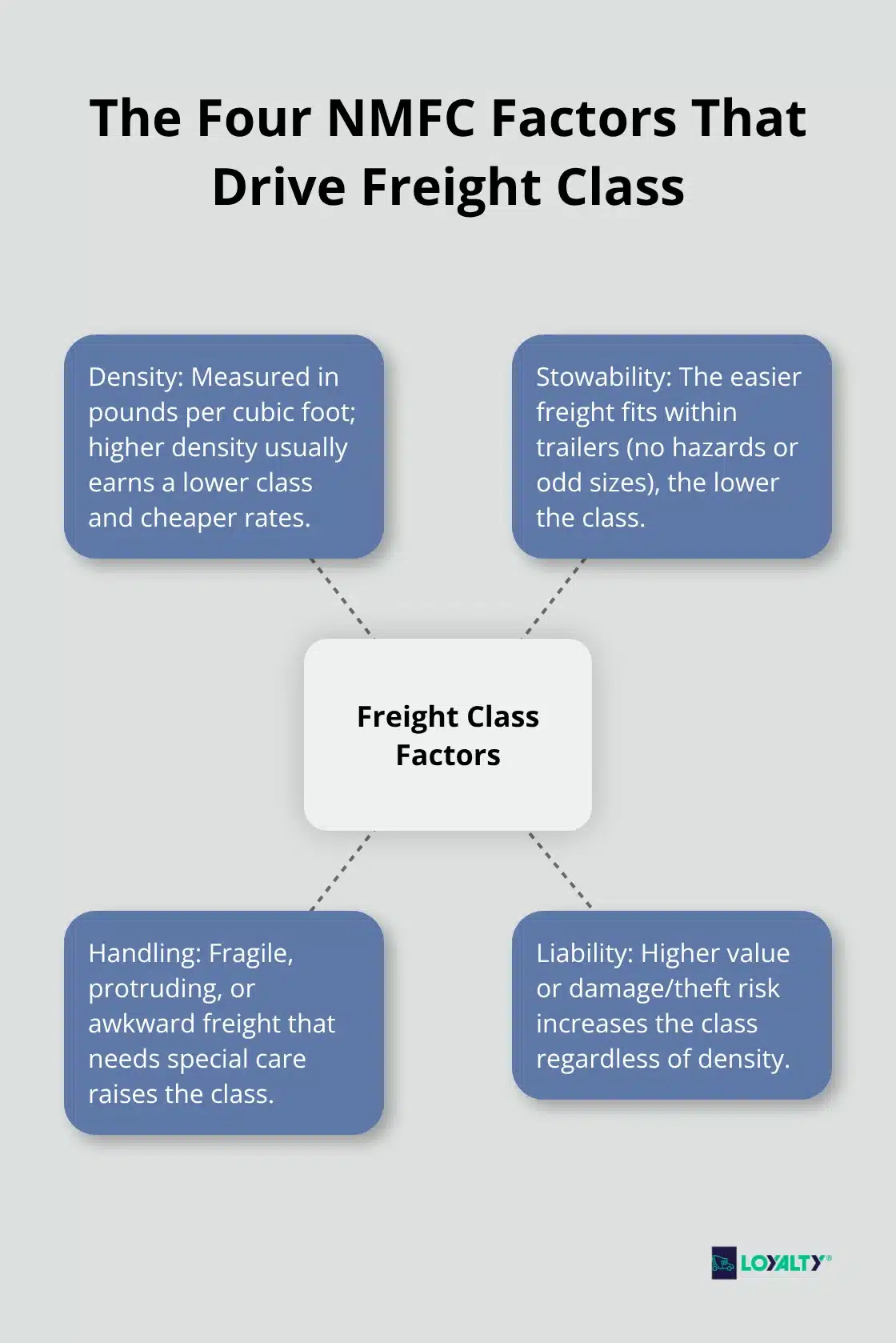
The NMFC system evaluates every shipment with four specific characteristics. Density measures pounds per cubic foot, and higher density items receive lower class numbers and cheaper rates. Stowability examines how efficiently your freight fits into transport vehicles, where odd dimensions or hazardous materials increase classification. The system assesses load and unload difficulty, with fragile or awkwardly shaped items that push costs higher. Liability considers theft and damage risk, where valuable or vulnerable goods face elevated class assignments.
How Misclassification Impacts Your Budget
Misclassification costs businesses substantially more than correct rating. Carriers regularly audit shipments and reclassify incorrectly rated freight, which adds fees up to 200% of standard charges according to industry data. Lower classifications save money but trigger expensive reclassification penalties when carriers catch errors. Higher classifications waste money through overpayment (often hundreds of dollars per shipment). The NMFTA provides ClassIT tools for precise determination, though many shippers still struggle with accurate measurement and evaluation.
Common Classification Mistakes That Cost Money
Shippers frequently omit NMFC numbers from Bills of Lading, which leads to automatic reclassification. Vague item descriptions create confusion and trigger reclass fees that could reach double the original rate. Many businesses misuse FAK (Freight All Kinds) class instead of actual freight class, which results in classification errors.
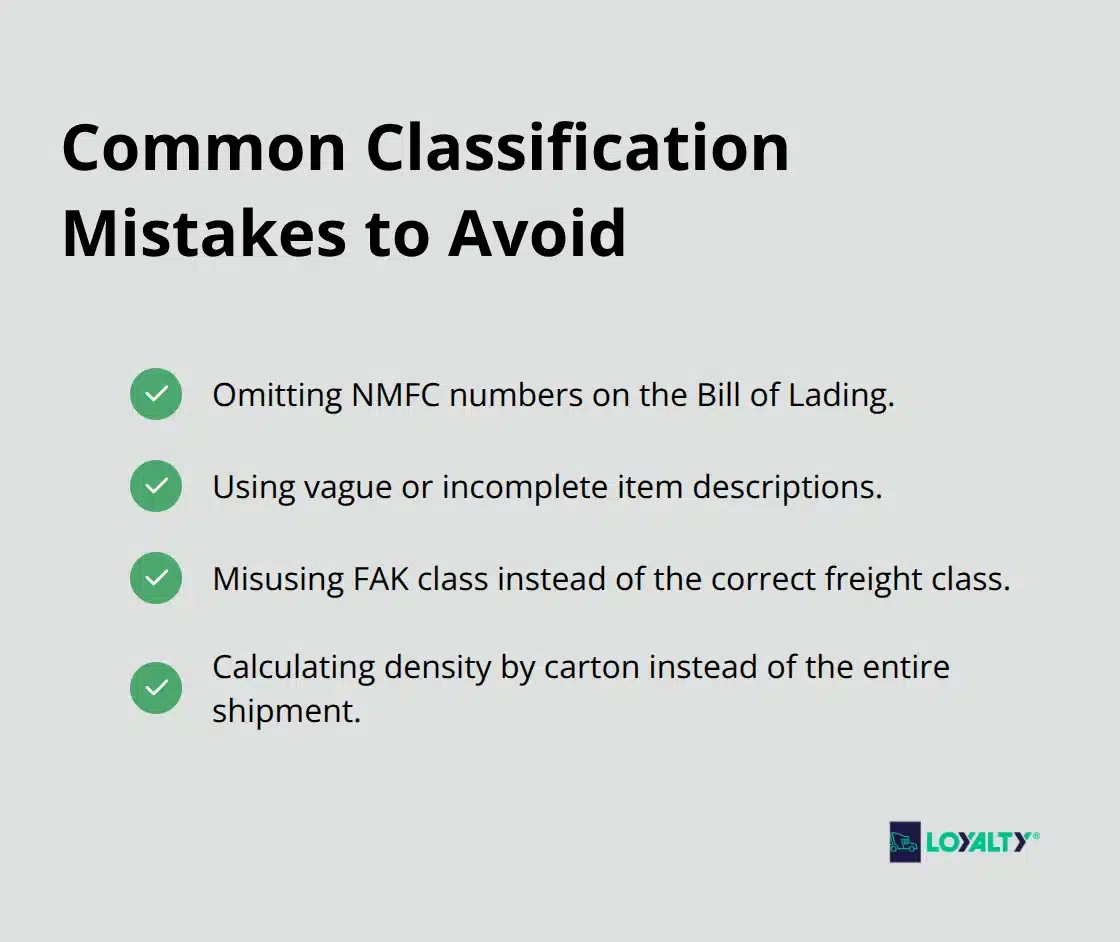
Density calculations based on individual cartons rather than entire shipments produce incorrect results and higher costs.
The next step involves learning how to accurately measure and calculate these factors to determine your exact freight class.
How to Determine Your Freight Class
Calculate Density With Precise Measurements
Accurate density calculation forms the foundation of correct freight classification. Measure your shipment at its furthest points including height, width, and depth, then multiply these dimensions to get cubic inches. Convert to cubic feet by dividing by 1,728, then divide your total weight by cubic feet to determine pounds per cubic foot. The NMFC requires you to round all measurements up to the next whole number to prevent disputes. For palletized freight, include pallet dimensions in your total cubic measurement since carriers bill for the entire space your shipment occupies. A shipment that weighs 500 pounds with dimensions of 48x40x48 inches equals 92,160 cubic inches or 53.3 cubic feet, which results in 9.4 pounds per cubic foot density.
Assess Stowability and Space Efficiency
Stowability affects classification when your freight cannot efficiently fill trailer space. Items that exceed 8 feet in any dimension, hazardous materials, or products that require temperature control automatically receive higher class ratings. Nested items that pack inside each other reduce cubic displacement and lower freight class, while knocked-down furniture ships at better rates than assembled pieces. The NMFC specifically rewards shipments that fill more than 65% of their container cube as reasonably full, which can reduce your class assignment.
Evaluate Handling Requirements and Complexity
Freight that requires special equipment, has protruding parts, or needs careful positioning faces elevated classifications. Fragile items that demand extra care during loading receive higher class assignments regardless of density. Items with unusual shapes or those that cannot stack properly increase handling complexity and push costs higher. The classification system penalizes freight that creates loading challenges or safety concerns for dock workers.
Determine Liability Risk and Value Impact
High-value freight faces increased liability charges that elevate freight class regardless of other factors. Electronics, artwork, and precision equipment typically fall into higher classes due to theft risk and damage potential (often doubling standard rates). The NMFC considers both actual value and susceptibility to loss when it assigns classifications. Items prone to concealed damage or those that require proof of delivery face additional liability considerations that increase costs substantially.
These four factors work together to determine your final freight class, but understanding the specific class ranges and their typical cargo types helps you estimate costs before you ship.
Which Freight Classes Apply to Your Products
Dense Products Save You the Most Money
Class 50 through Class 100 represents the most cost-effective options for businesses that ship heavy, durable products. Steel rods, machinery parts, and automotive components typically fall into Class 50 because their density exceeds 35 pounds per cubic foot. Bricks, tile, and concrete products commonly qualify for Class 60 with densities between 30-35 pounds per cubic foot. Class 70 includes items like lumber and plumbing fixtures that weigh 22.5-30 pounds per cubic foot. Manufacturing equipment, heavy tools, and metal fabrications often ship at Class 85 with densities from 15-22.5 pounds per cubic foot. These classifications offer the lowest rates because carriers maximize trailer capacity and minimize complexity.
Mid-Range Classes Balance Cost and Convenience
Class 150 through Class 200 covers products with moderate density that balance costs with practical requirements. Furniture components, appliances, and automotive parts frequently ship at Class 150 with densities between 9-10.5 pounds per cubic foot. Class 175 includes items like bedding, small furniture pieces, and packaged consumer goods that weigh 7.5-9 pounds per cubic foot. Clothing, textiles, and lightweight manufactured products often qualify for Class 200 at 6-7.5 pounds per cubic foot. These classes represent reasonable costs for businesses that cannot achieve the density requirements of lower classes but want to avoid the premium rates of higher classifications.
Lightweight Items Face Premium Rates
Class 250 through Class 500 applies to products that require special care or present elevated liability risks, which results in substantially higher costs. Electronics, artwork, and fragile items typically ship at Class 250 due to their value and damage susceptibility rather than density alone. Class 300 includes items like computers, medical equipment, and precision instruments that demand careful attention regardless of weight (often doubling standard rates). Class 400 covers extremely lightweight products such as ping pong balls, balloons, and inflated items that waste trailer space. Class 500 represents the highest classification for items that combine low density with high liability, often costing three times more than Class 50 shipments for equivalent weight. Many small business shippers find that understanding these classifications helps optimize their logistics costs significantly.
Final Thoughts
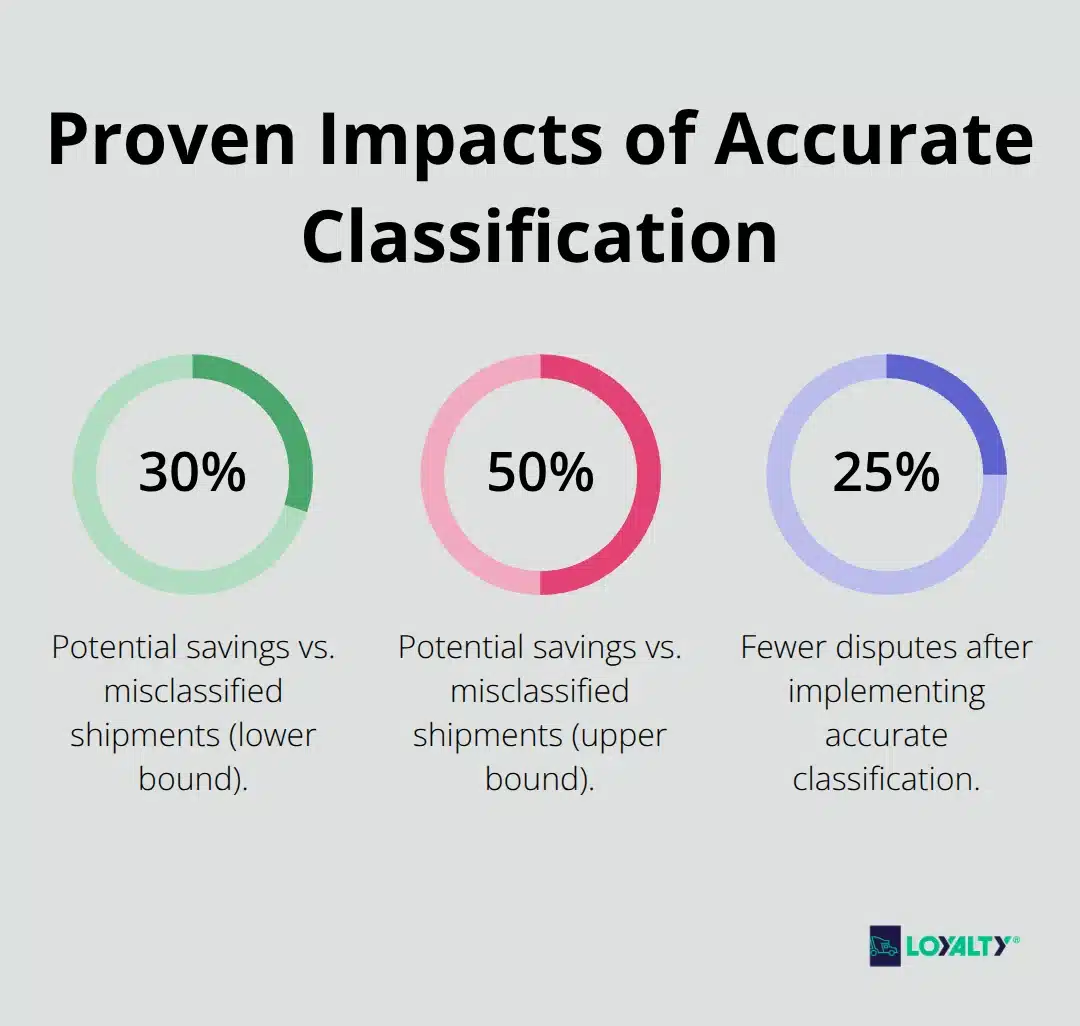
Accurate freight classification directly impacts your shipping budget with potential savings of 30-50% compared to misclassified shipments. Businesses that master the freight shipping class chart avoid reclassification fees that can double their transportation costs. They eliminate delays that disrupt customer deliveries and damage profit margins.
Experienced carriers provide classification expertise that prevents costly mistakes while they offer competitive rates through established networks. Their knowledge of NMFC codes and density calculations protects your business from audit penalties and unexpected charges. Companies that implement accurate classification systems report 25% fewer disputes and significantly better carrier relationships (often within the first quarter of implementation).
Proper freight classification streamlines your entire supply chain as it reduces transit times and minimizes damage claims. It improves delivery predictability across all your shipments. We at Loyalty Logistics combine classification expertise with advanced logistics solutions to optimize your shipping costs across the U.S., Canada, and Mexico.

