

Freight shipping to Mexico presents unique challenges that can make or break your cross-border operations. Complex documentation requirements, varying border protocols, and hidden costs often catch businesses off guard.
At Loyalty Logistics, we’ve seen companies lose thousands due to preventable mistakes in Mexico freight shipping. The right preparation and partnerships make all the difference in your success.
What Documentation Do You Need for Mexico Freight Shipping?
Essential Paperwork That Prevents Border Delays
Mexico freight shipping requires precise documentation that extends far beyond basic papers. The Commercial Invoice must contain detailed product descriptions, accurate HS codes, and exact values in both USD and Mexican pesos. Your Bill of Lading needs specific format compliance with Mexican customs requirements, while the Certificate of Origin becomes mandatory for USMCA benefits. Missing any of these documents triggers automatic delays that average 3-5 days at major border crossings like Laredo and Tijuana. The Pedimento de Importación serves as your official import declaration and requires a licensed Mexican customs broker to file it correctly.
Customs Clearance Speed Depends on Preparation Quality
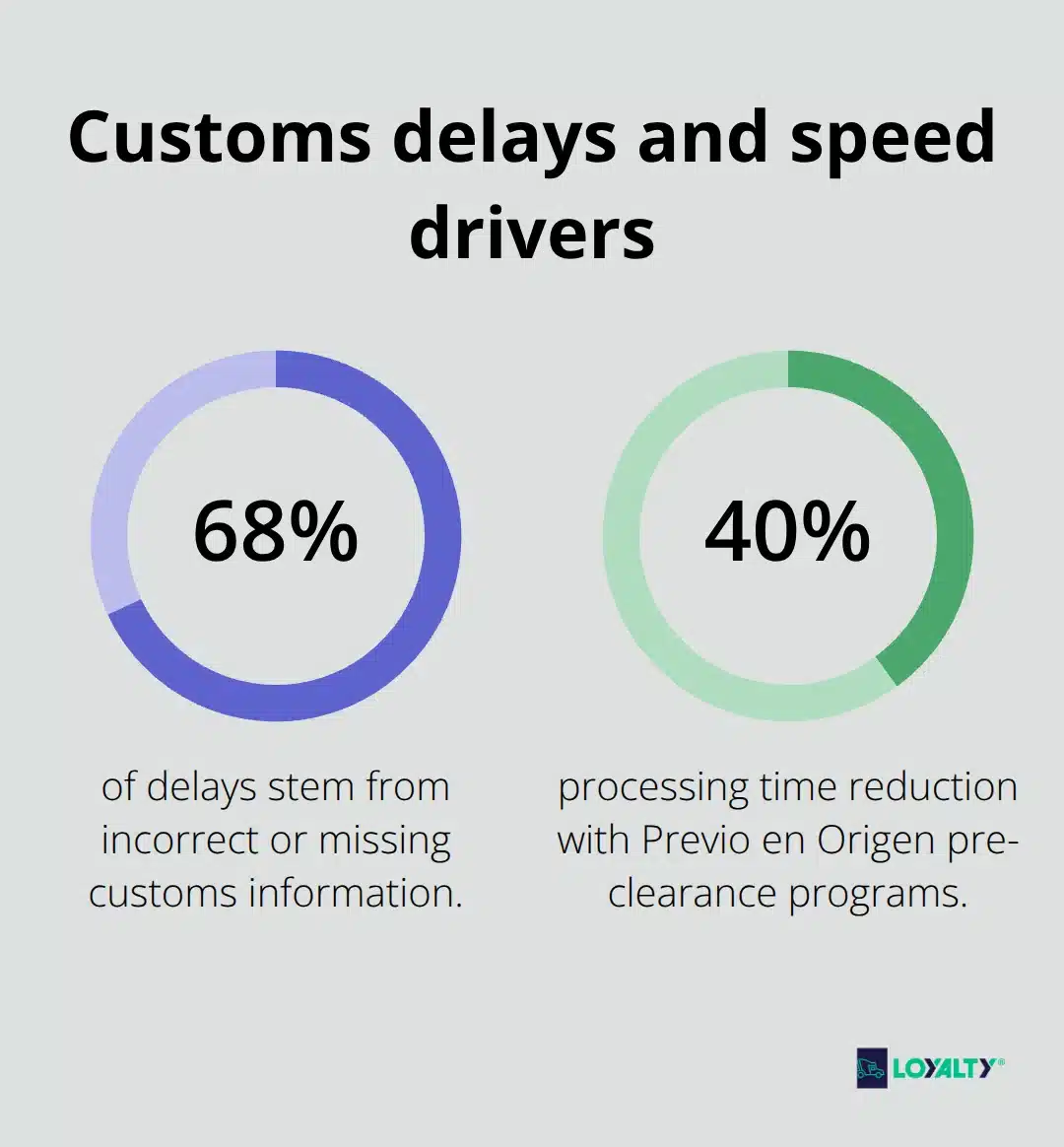
Customs clearance times vary dramatically based on documentation accuracy and cargo type. Standard clearance takes 2-4 business days for complete paperwork, but incomplete filings can extend this to 2-3 weeks. Mexico’s National Institute of Statistics and Geography reports that 68% of delays stem from incorrect or missing customs information. Pre-clearance inspections through Previo en Origen programs cut processing time by 40% but require advance coordination with your customs broker.
High-value shipments that exceed $50,000 face mandatory physical inspections that add 1-2 days to clearance times.
Border Crossing Patterns You Must Know
Peak crossing times occur Monday through Wednesday between 8 AM and 2 PM, when commercial traffic creates bottlenecks that last 4-8 hours. The Laredo-Nuevo Laredo crossing handles 40% of all US-Mexico trade but experiences the longest delays during these periods. Smart shippers schedule arrivals during off-peak hours (late afternoons, evenings, or weekends) to reduce wait times to under 2 hours. Winter months see 25% longer delays due to increased agricultural inspections, while summer brings additional scrutiny for temperature-sensitive goods.
Import Regulations That Impact Your Shipment
Mexico maintains strict import regulations that vary significantly across product categories. Consumer goods face different requirements than industrial equipment, with electronics requiring additional certifications from Mexican authorities. The Mexican Registry of Importers (Padrón de Importadores) registration becomes necessary for most commercial shipments, and this process takes 2-3 weeks for new importers. Certain products like pharmaceuticals, food items, and chemicals require special permits that can add weeks to your timeline if not obtained in advance. Understanding the broader picture of tariffs on Canada and Mexico rounds out your regulatory readiness.
Once you understand these documentation requirements, selecting the right transportation method becomes your next priority for successful Mexico freight operations.
Tired of paperwork errors costing you 3-5 days at the Mexico border?
Loyalty Logistics handles cross-border freight to Mexico with CBSA/SAT-aware documentation, vetted customs brokers, and Previo en Origen pre-clearance so your shipment clears in 24-48 hours, not weeks.
Which Transportation Method Works Best for Mexico Shipping
Cross-Border Trucking Delivers Maximum Control and Speed
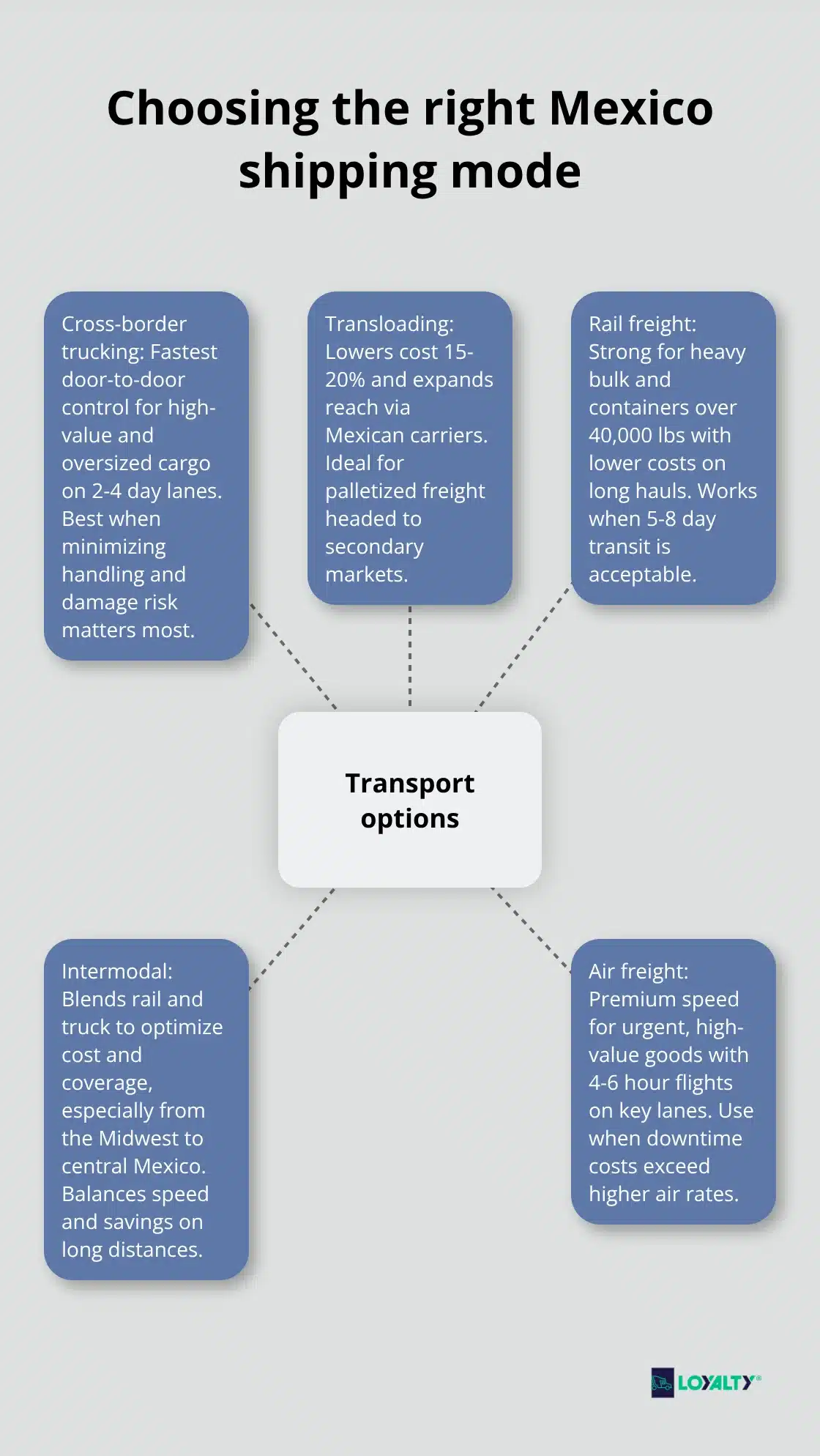
Cross-border trucking dominates Mexico freight operations, handling 78% of all US-Mexico trade according to the Bureau of Transportation Statistics. Through-trailer service provides the fastest option for high-value and oversized cargo, with transit times that average 2-4 days from major US cities to Mexico destinations. This method minimizes cargo handling and reduces damage risk by 60% compared to transloading operations. However, through-trailer service requires mandatory interchange agreements between carriers, which limits availability in remote Mexican locations.
Transloading offers broader geographic reach and typically costs 15-20% less than through-trailer service, making it ideal for palletized goods that head to secondary Mexican markets. The process involves transferring cargo from US trucks to Mexican carriers at border facilities (adding 12-24 hours to total transit time) but expands delivery options to areas where US trucks cannot operate legally.
Rail Freight Targets Heavy and Bulk Shipments
Rail freight between the US and Mexico has experienced remarkable growth, with Kansas City Southern reporting 30% faster transit times on major routes due to new cross-border infrastructure investments. Rail works best for bulk commodities and containers that weigh over 40,000 pounds, offering costs that average 40% below trucking rates for these shipments.
Intermodal combinations of rail and truck provide competitive alternatives for long-distance moves, particularly from the Midwest to central Mexico destinations. The rail option becomes most cost-effective when shipment weight exceeds 25,000 pounds and delivery timelines allow for 5-8 day transit windows.
Air Freight Commands Premium Pricing for Urgent Needs
Air freight delivers unmatched speed for urgent shipments, with major routes like Dallas to Mexico City completing in 4-6 hours. Air shipping costs typically run 8-12 times higher than trucking but becomes cost-effective for electronics, pharmaceuticals, and other high-value goods where speed justifies the expense.
Airlines handle time-sensitive cargo that cannot tolerate the 2-4 day trucking timeline, particularly for manufacturing components that support just-in-time production schedules. The weight threshold for air freight consideration typically falls below 500 pounds (unless extreme urgency drives the decision).
Understanding these transportation options helps you select the right method, but managing costs and avoiding common pitfalls requires additional strategic planning to protect your bottom line.
How Much Will Hidden Costs Actually Impact Your Budget
Currency Exchange Creates Unpredictable Expenses
Mexico freight shipping contains numerous hidden costs that inflate your budget by 25-40% above initial quotes. Currency exchange fluctuations create the most unpredictable expense, with the peso-dollar rate that changes daily and potentially adds $200-800 per shipment when rates move unfavorably during transit. Mexican customs brokers charge separate fees that range from $150-400 per shipment, while drayage costs at border crossings add another $75-200 (depending on wait times and cargo handling requirements). Modeling these layers with a freight shipping cost estimator before booking surfaces the true landed cost.

Detention fees accumulate at $50-75 per hour when trucks exceed allotted loading times, and weekend or holiday border crossings trigger surcharges that can reach $300-500 per shipment.
Insurance Gaps Create Massive Financial Exposure
Standard US cargo insurance typically terminates at the Mexican border and leaves shipments worth $100,000 or more completely unprotected during the most vulnerable transit phase. Mexican carriers operate under different liability limits that average just $2-3 per pound, which means a $50,000 electronics shipment receives maximum coverage of only $1,500 if damaged. Separate Mexican cargo insurance costs 0.15-0.25% of shipment value but becomes absolutely necessary for high-value freight. Weather-related delays during hurricane season increase damage risk by 40% and make comprehensive coverage even more critical for shipments between June and November.
Strategic Timing Prevents Most Costly Delays
Peak season delays between October and December cost shippers an average of $400 per day in storage fees at border facilities, while customs backlogs during these months extend clearance times to 7-10 days. Shipments that arrive Tuesday through Thursday reduce border wait times by 60% compared to Monday arrivals that compete with weekend backlog clearance. Mexican holiday schedules create predictable disruptions, with Independence Day celebrations in mid-September and Christmas season that cause 2-week processing delays (smart shippers build these into their timelines). Buffer time of 48-72 hours in delivery schedules prevents expensive expedited shipping costs that can double your transportation expense when deadlines approach. Carriers and brokers that publish itemized rates separate themselves from those that bundle Mexico-specific costs into opaque quotes; comparing options against the broader landscape of Mexico freight forwarders reveals which providers actually deliver value.
Watching $200-800 currency swings + $50-75/hour detention destroy your Mexico freight budget?
Tell us your lanes, products, and HS codes. We’ll quote with itemized customs fees, fuel surcharge caps, vetted Mexican broker relationships, and pre-cleared documentation so nothing surprises you.
Final Thoughts
Successful freight shipping to Mexico demands precise documentation, smart transportation choices, and thorough cost planning. Companies that master these elements cut delays by 70% and reduce unexpected expenses by up to 40%. The secret lies in buffer time, complete paperwork accuracy, and transportation modes that match your cargo and timeline needs.
Experienced cross-border partners transform complex Mexico freight operations into smooth processes. Established providers bring strong customs broker relationships, proven carrier networks, and real-time border visibility that prevents costly surprises. Their expertise in currency fluctuations, insurance requirements, and regulatory changes protects your shipments from common traps (that catch inexperienced shippers off guard). The reverse playbook applies for moves in the other direction: freight shipping to Canada shares many of the same pre-clearance and documentation principles.
Your next step involves partnering with a logistics provider that understands freight shipping to Mexico complexities. Explore our freight transportation services to see how we deliver comprehensive cross-border solutions across the U.S., Canada, and Mexico with the reliability your supply chain depends on.
Frequently Asked Questions
What documents are required for freight shipping to Mexico?
Mexico freight shipping requires a Commercial Invoice with detailed product descriptions and HS codes, a Bill of Lading in Mexican customs format, a Certificate of Origin for USMCA benefits, and the Pedimento de Importación filed by a licensed Mexican customs broker. High-value shipments may require additional permits depending on commodity (pharmaceuticals, food, electronics, and chemicals all face category-specific requirements).
How long does customs clearance take in Mexico?
Standard clearance takes 2-4 business days with complete paperwork. Incomplete filings can extend clearance to 2-3 weeks. Pre-clearance through Previo en Origen programs cuts processing time by 40% when coordinated with your customs broker. High-value shipments over $50,000 face mandatory physical inspections that add 1-2 days. Currency fluctuations and seasonal customs backlogs (October-December) further extend timelines.
Which transportation method is best for shipping freight to Mexico?
Cross-border trucking handles 78% of US-Mexico trade and delivers in 2-4 days for high-value cargo. Through-trailer service is fastest, while transloading costs 15-20% less but adds 12-24 hours. Rail works best for shipments over 25,000 pounds and offers costs 40% below trucking. Air freight is 8-12x more expensive than trucking but completes in 4-6 hours for under-500-pound urgent shipments.
What hidden costs should I plan for in Mexico freight shipping?
Hidden costs inflate Mexico shipping budgets by 25-40% above initial quotes. Currency exchange swings add $200-800 per shipment, Mexican customs broker fees range $150-400, drayage at the border adds $75-200, detention fees run $50-75/hour, weekend/holiday surcharges hit $300-500, and insurance gaps after the border can leave $100K+ shipments unprotected. Comprehensive Mexican cargo insurance costs 0.15-0.25% of shipment value.
Ready to Ship Freight to Mexico Without the Border Surprises?
Mexico freight pays off when documentation, customs broker, and pre-clearance line up. Tell us your lanes, products, HS codes, and timelines and we’ll quote with itemized customs fees, vetted Mexican brokers, Previo en Origen handling, and routing that respects peak season backlogs.
Related Articles
- How to Choose the Best Mexico Freight Forwarders: Sibling guide for selecting providers that actually understand Mexican customs.
- Customs Broker in Mexico: The licensed agente aduanal role that determines whether your shipment clears in 24 hours or 2 weeks.
- Mexico Tariffs: What You Need to Know: Tariff costs that estimators must account for on US-Mexico shipments.
Loyalty Logistics: Connecting businesses with opportunities across North America.
Written by: Carlos Robayo, Marketing Director at Loyalty Logistics
With expertise in logistics marketing and international trade, Carlos specializes in connecting businesses with efficient and reliable transport solutions for the North American market.

