

Choosing between a freight forwarder vs customs broker can make or break your international shipping strategy. Many businesses struggle with this decision, often leading to costly delays and compliance issues.
We at Loyalty Logistics see companies waste thousands of dollars annually by selecting the wrong service provider for their specific needs. The right choice depends on your shipment volume, geographic requirements, and operational complexity.
What Do Freight Forwarders and Customs Brokers Actually Do
Freight Forwarders Coordinate Your Transportation Network
Freight forwarders act as logistics coordinators who arrange transportation from origin to destination. They negotiate rates with carriers, manage documentation, and coordinate multiple transportation modes. The International Federation of Freight Forwarders Associations confirms these intermediaries handle the physical movement of goods but don’t transport cargo themselves. Understanding the key differences between freight brokers and forwarders helps clarify where each role fits.
These professionals excel at route optimization, shipment consolidation, and warehouse management services. Freight forwarders work with both imports and exports, which makes them valuable for companies with bidirectional trade flows. They maintain extensive carrier networks and can secure better rates through volume contracts.
Customs Brokers Handle Regulatory Compliance
Customs brokers are licensed professionals who specialize in clearing goods through customs authorities. U.S. Customs and Border Protection requires these professionals to pass rigorous examinations and maintain current licenses. They calculate duties and taxes, classify products with Harmonized Tariff Schedule codes, and file Import Security Filings 24 hours before vessel departure.
The National Customs Brokers & Forwarders Association of America reports that 97% of all U.S. goods enter through customs brokers. Their expertise prevents the $5,000 ISF penalties and $10,000+ fines for regulatory violations that frequently impact non-compliant importers. These professionals stay current with trade law changes and tariff updates.

Service Selection Depends on Your Primary Challenge
Transportation logistics concerns point toward freight forwarders. Companies that ship high volumes across multiple routes benefit most from their carrier relationships and consolidation services. Regulatory compliance risks indicate customs brokers as the better choice.
Importers who deal with complex product classifications, trade remedies, or frequent regulatory changes need specialized compliance knowledge. Many successful importers use both services simultaneously: freight forwarders manage logistics while customs brokers handle compliance requirements. For Mexico shipments, working with a licensed customs broker in Mexico alongside your freight forwarder dramatically reduces clearance times. This dual approach addresses both operational efficiency and regulatory safety.
Your specific business model, shipment characteristics, and risk tolerance will determine which factors matter most for your decision.
Need both forwarder logistics and customs broker compliance under one roof?
Loyalty Logistics coordinates carrier networks across U.S., Canada, and Mexico while working with licensed customs brokers at every major border crossing. Tell us your shipment profile.
Which Business Factors Determine Your Service Choice
Monthly Shipment Volume Sets Your Service Foundation
Your monthly shipment volume determines which service model delivers the best financial returns. Companies that ship fewer than 50 containers annually benefit more from customs brokers who charge per-transaction fees rather than freight forwarders that require minimum volume commitments. The Federal Maritime Commission reports that freight forwarders typically require 100+ annual shipments to justify their service contracts and provide meaningful rate reductions.
High-volume shippers gain access to better freight forwarder rates through consolidated bookings and preferred carrier relationships. Low-volume importers face minimum charges that make freight forwarder services cost-prohibitive compared to transaction-based customs broker fees. Vetting providers through the best freight brokerage services simplifies the comparison because experienced brokers verify forwarder rates and customs broker fees side-by-side.
Geographic Complexity Changes Service Requirements
Single-route importers from established trade lanes like China-Los Angeles can work effectively with specialized customs brokers who understand specific port requirements and common product classifications. These brokers develop expertise in particular trade corridors and streamline clearance processes for repeat shipments.
Multi-origin shippers that move goods from Southeast Asia, Europe, and Latin America need freight forwarders with global networks and route optimization capabilities. Companies waste 15-20% on transportation costs without proper route consolidation according to Logistics Management research. Freight forwarders coordinate complex multi-leg shipments and manage carrier relationships across different regions.
Budget Structure Preferences Impact Service Selection
Customs brokers charge transparent per-entry fees that range from $125-500 depending on shipment complexity, while freight forwarders embed costs into shipping rates with less visibility. Companies that prefer predictable compliance costs choose customs brokers for their straightforward fee structures and detailed invoices.
Freight forwarders bundle transportation and documentation services into single rates that simplify billing but reduce cost transparency. This approach works well for companies that want consolidated invoices and simplified vendor management rather than separate bills for transportation, documentation, and compliance services.
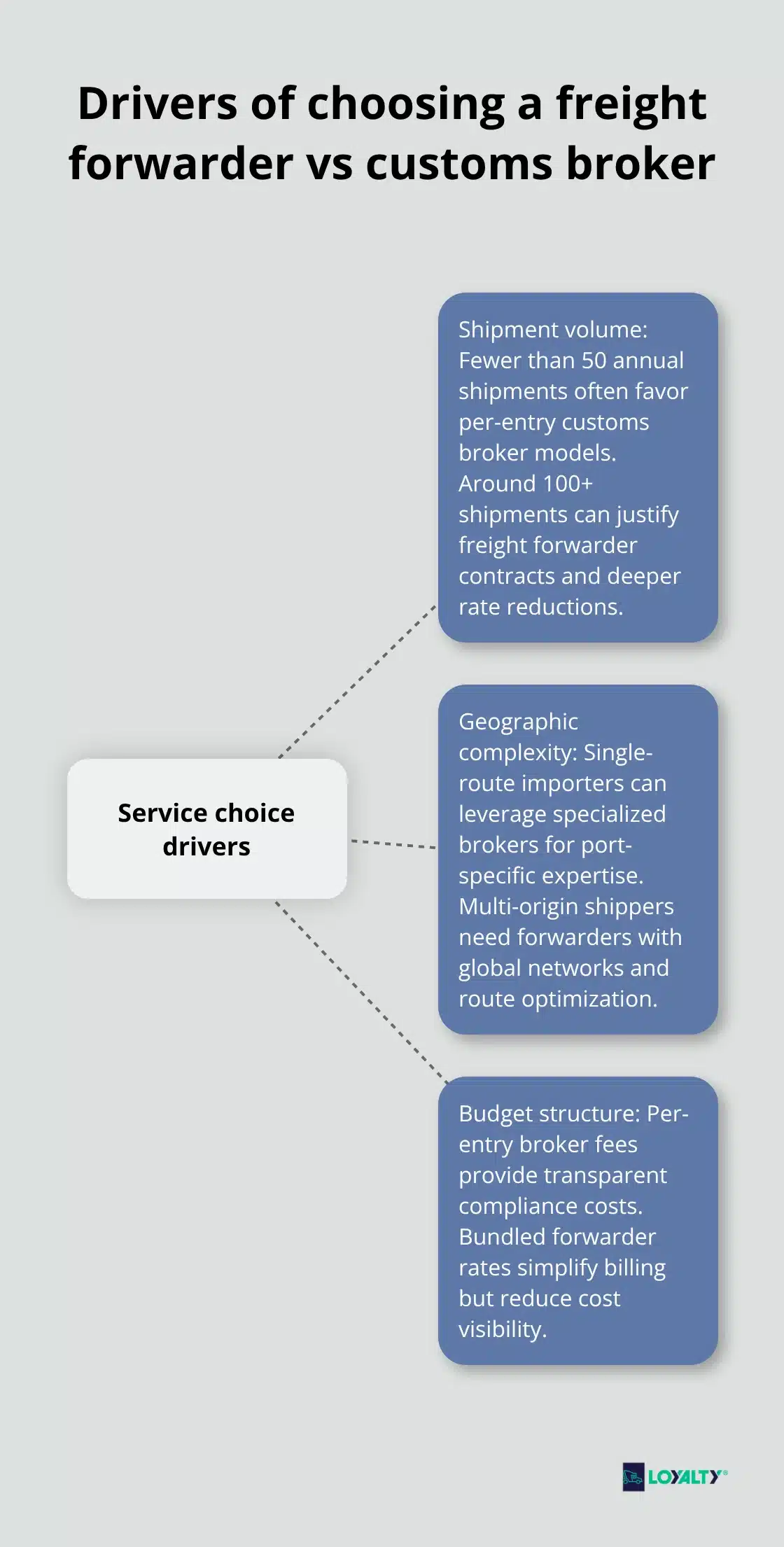
These volume, geographic, and budget considerations directly influence how different business scenarios require specific service approaches, especially when shipments cross into cross-border lanes where forwarders and brokers split duties.
Which Service Fits Your Business Model
Small Importers Need Customs Broker Expertise First
Small businesses that import fewer than 20 shipments annually should prioritize customs brokers over freight forwarders. The National Customs Brokers & Forwarders Association of America data shows that small importers face 60% more compliance violations when they skip professional customs assistance. Companies that import specialty products like electronics or medical devices need customs brokers who understand product-specific regulations and classification requirements.
Small importers typically pay $150-300 per customs entry, which remains cost-effective compared to freight forwarder minimum fees that often exceed $2,000 monthly. These businesses avoid the volume commitments that freight forwarders require while they access specialized compliance knowledge for complex product categories.
Manufacturing Operations Require Dual Service Strategies
Large manufacturers that move 200+ containers annually need both freight forwarders and customs brokers to optimize costs and compliance. Manufacturing companies that source raw materials from multiple countries benefit from freight forwarder consolidation services that reduce transportation costs by 25-30% (according to Supply Chain Management Review research).
These operations should assign freight forwarders to handle transportation logistics while customs brokers manage regulatory compliance for different product categories. Automotive and electronics manufacturers particularly benefit from this approach because they import components with different duty rates and trade remedy requirements.
E-commerce Demands Speed Over Cost Optimization
E-commerce companies that ship direct-to-consumer orders need customs brokers who specialize in expedited clearance processes rather than freight forwarders focused on cost reduction. Online retailers that import from China face average clearance times of 2-4 days with experienced customs brokers compared to 7-10 days without professional assistance.
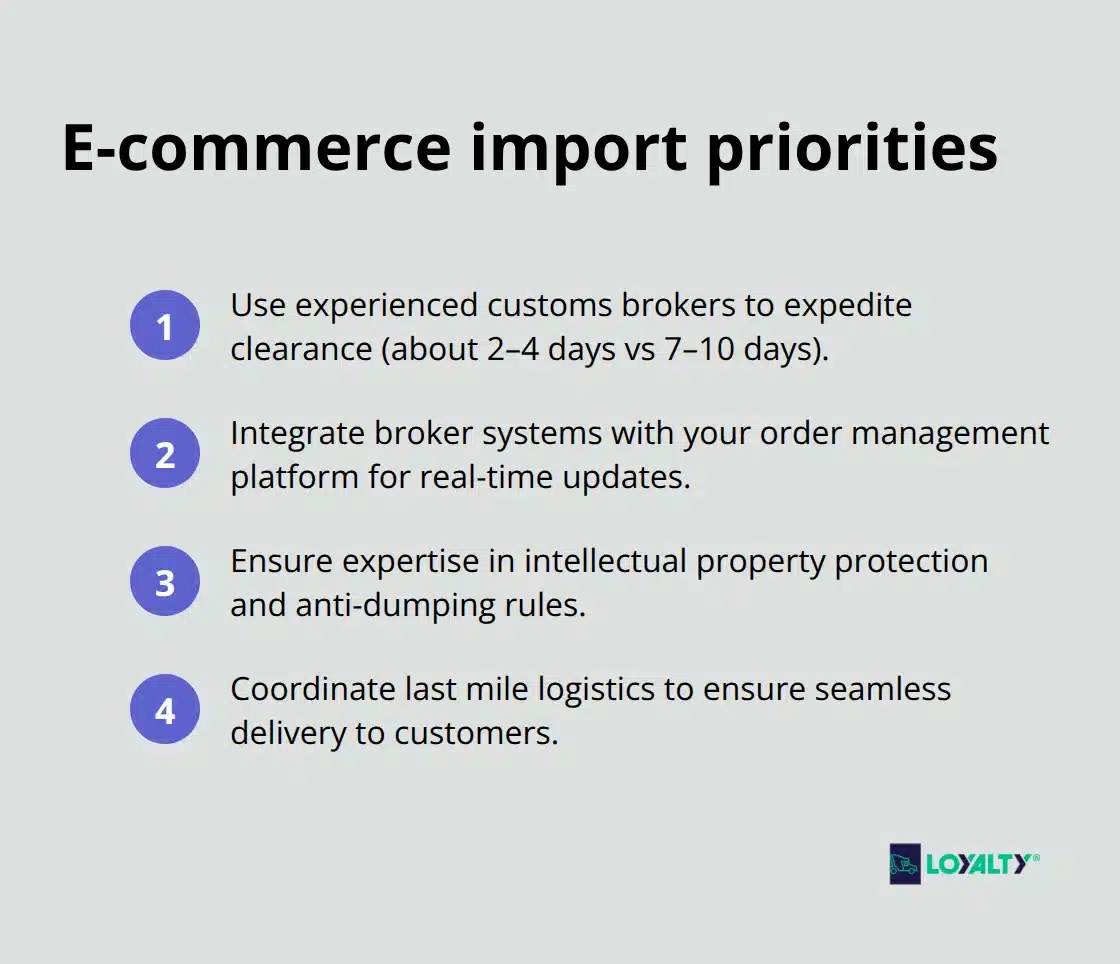
E-commerce businesses should select customs brokers with automated systems that integrate with their order management platforms and provide real-time updates. Companies that ship high-value consumer electronics or fashion items need customs brokers experienced with intellectual property protection and anti-dumping regulations that frequently affect these product categories. Understanding last mile logistics becomes crucial for these businesses to ensure seamless delivery to end customers.
Tired of juggling separate forwarder and customs broker invoices?
Tell us your shipment volumes, origins, and product categories. We’ll quote freight transportation paired with customs broker coordination so compliance and logistics show up on one transparent invoice.
Final Thoughts
The freight forwarder vs customs broker decision depends on your shipment volume, geographic complexity, and primary business challenges. Small importers with fewer than 50 annual shipments benefit most from customs brokers who provide specialized compliance expertise at transparent per-transaction rates. Large manufacturers that move 200+ containers annually should implement dual strategies that combine freight forwarder logistics coordination with customs broker regulatory compliance.
Your budget structure preferences also influence this choice. Companies that prioritize cost transparency prefer customs brokers with clear fee structures, while businesses that want consolidated bills benefit from freight forwarder bundled services. E-commerce operations require customs brokers who specialize in expedited clearance rather than cost optimization.
We at Loyalty Logistics understand these complex decisions and offer comprehensive transportation solutions across the U.S., Canada, and Mexico. Our advanced logistics capabilities help businesses optimize their supply chain efficiency while they reduce costs (whether you need refrigerated, flatbed, or LTL services). Explore our freight transportation services today to develop the right logistics strategy for your specific business requirements.
Frequently Asked Questions
What is the difference between a freight forwarder and a customs broker?
A freight forwarder coordinates the physical movement of goods (route planning, carrier negotiation, multi-modal transportation, consolidation, and warehousing) but does not transport cargo themselves. A customs broker is a licensed professional (CBP-certified in the U.S.) who clears goods through customs authorities by classifying products with HS codes, calculating duties and taxes, and filing Import Security Filings. Forwarders handle logistics; customs brokers handle regulatory compliance.
Do you need both a freight forwarder and a customs broker?
Many large manufacturers and high-volume importers use both simultaneously: freight forwarders manage transportation logistics while customs brokers handle regulatory compliance. Small importers with fewer than 50 annual shipments often only need a customs broker because freight forwarders require 100+ annual shipments to justify their minimum-volume contracts. The dual approach delivers operational efficiency plus regulatory safety for shipments crossing multiple borders.
How much do freight forwarders and customs brokers cost?
Customs brokers charge transparent per-entry fees of $125-500 depending on shipment complexity. Small importers typically pay $150-300 per customs entry. Freight forwarders embed costs into bundled shipping rates with less visibility, and minimum fees often exceed $2,000 monthly. Forwarders justify their fees on volumes of 100+ shipments annually through consolidated bookings and carrier rate reductions of 25-30%.
Which is better for small importers, a freight forwarder or customs broker?
Customs brokers fit small importers better. Companies importing fewer than 20 shipments annually face 60% more compliance violations without professional customs assistance, per the National Customs Brokers & Forwarders Association data. Customs broker per-entry fees ($150-300) remain cost-effective compared to freight forwarder minimum monthly fees over $2,000 plus volume commitments small importers cannot meet.
Ready to Build the Right Forwarder + Customs Broker Strategy?
Forwarder vs customs broker is rarely an either-or decision. Tell us your shipment volumes, origins, product categories, and compliance complexity and we’ll quote transportation paired with customs broker coordination so logistics and compliance work together on one transparent invoice.
Related Articles
- Freight Broker vs Freight Forwarder: Key Differences: Sibling guide that distinguishes brokers from forwarders (different from this customs-broker comparison).
- What Is a Customs Broker?: Definitional primer on the licensed broker role and CBP requirements.
- Customs Broker in Mexico: Mexico-specific (agente aduanal) requirements and how they affect cross-border clearance.
Loyalty Logistics: Connecting businesses with opportunities across North America.
Written by: Carlos Robayo, Marketing Director at Loyalty Logistics
With expertise in logistics marketing and international trade, Carlos specializes in connecting businesses with efficient and reliable transport solutions for the North American market.

