

Customs brokers handle the paperwork and compliance work that keeps your shipments moving across borders. Without one, delays and penalties can quickly eat into your margins.
At Loyalty Logistics, we’ve seen firsthand how many supply chain teams underestimate the complexity of customs clearance. A qualified customs broker isn’t a luxury-it’s a business necessity. Whether you’re shipping into the U.S. or need a customs broker specialized in Mexico’s import regulations and SAT compliance, understanding the role helps you choose the right partner.
The Core Work Customs Brokers Handle Every Day
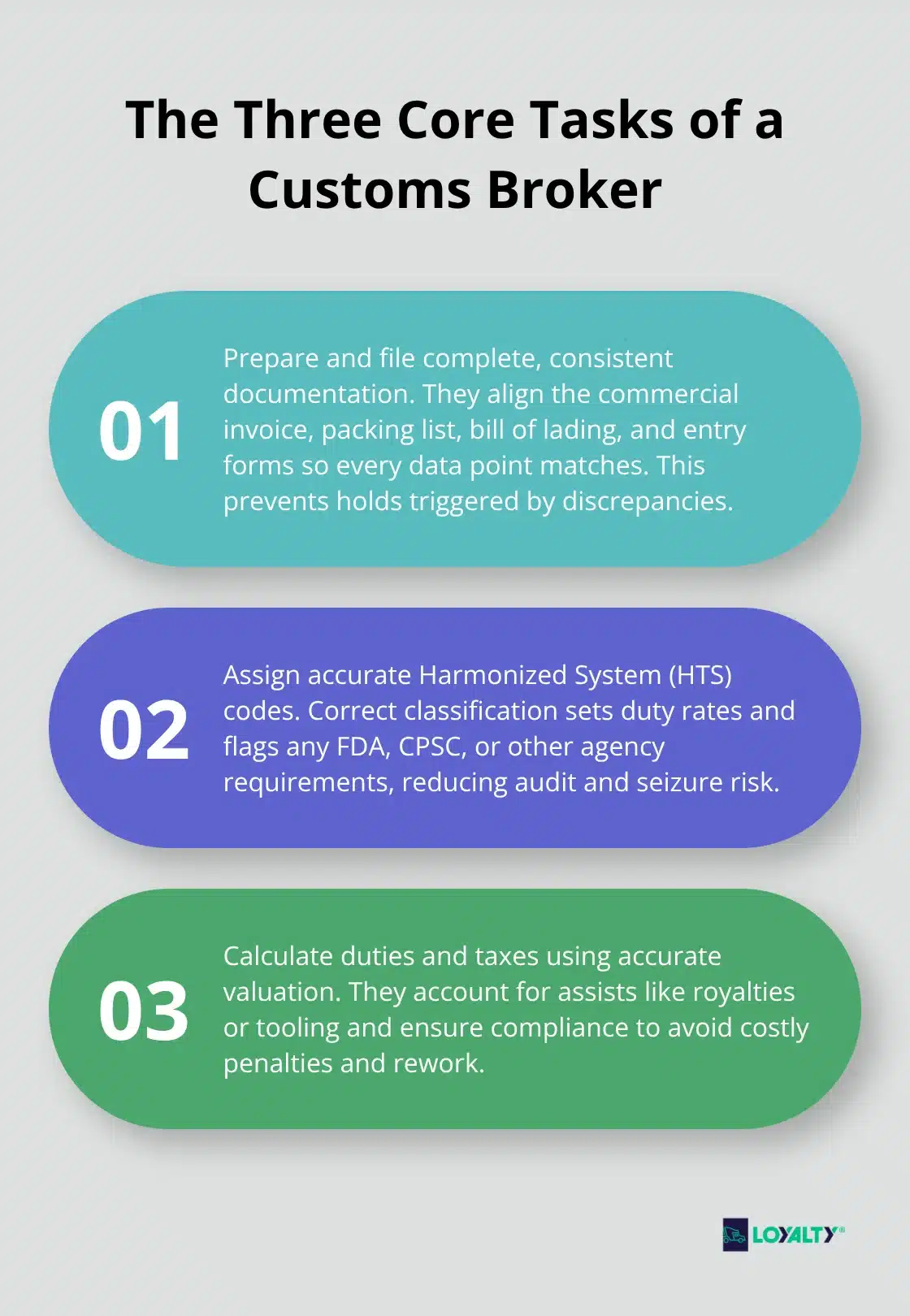
A customs broker’s job centers on three interconnected tasks that determine whether your shipment clears in days or gets stuck for weeks. First, they prepare and file the commercial invoice, packing list, bill of lading, and entry documentation with U.S. Customs and Border Protection or equivalent authorities in your destination country. This paperwork must align perfectly-any discrepancy between the invoice value and the packing list quantity triggers an examination. Second, they assign the correct Harmonized System code to your products, which directly determines your duty rate and whether regulatory agencies like the FDA or CPSC need to inspect the goods. A single misclassification can cost thousands in penalties; CBP expects importers to exercise reasonable care, and you remain legally responsible even if a broker makes the error. Third, they calculate duties and taxes based on accurate product valuation, considering assists like royalties or tooling that importers often overlook. Valuation errors can result in penalties up to twice the lawful duties owed or 20% of the dutiable value if negligence is involved.
Documentation Gaps Create Real Problems
Most delays occur because documentation does not match reality. If your commercial invoice lists items worth $50,000 but the bill of lading shows different quantities, CBP will hold the shipment for clarification. A customs broker prevents this by reviewing all documents before submission and flagging inconsistencies. They also handle the Importer Security Filing, required for ocean freight at least 24 hours before the vessel leaves port; missing or late ISF filings carry penalties up to $5,000 per violation. Country-of-origin marking must be permanent and legible on products themselves, not just packaging-improper marking invites a 10% marking duty or even seizure. Wood packaging used in pallets or crates requires ISPM-15 certification stamps or your entire shipment risks redelivery or destruction. A broker ensures these technical compliance points receive proper attention so your freight avoids detention over preventable issues.
Tariff Classification Controls Your Bottom Line
The 10-digit HTS code assigned to your product controls duty rates, which can range from zero to 25% depending on the classification. A broker with experience in your product category knows which tariff headings apply and can defend that classification if CBP questions it. They also identify whether your goods qualify for preferential trade agreements or duty-reduction programs like C-TPAT that lower your costs. For example, goods from certain countries may qualify for lower rates under trade preference programs if the broker properly documents origin. This matters significantly: a shipment misclassified under a higher duty rate wastes money on every unit imported, while underclassification triggers audits and penalties. Brokers stay current on tariff changes — recent shifts in U.S. tariffs on Canada and Mexico under USMCA have caught many importers off guard. Your broker adjusts your entry strategy accordingly when these shifts occur, protecting your margins and compliance standing.
Understanding what brokers actually do reveals why choosing the right partner matters so much for your operation.
Why Your Supply Chain Needs a Customs Broker
Border Delays Cost Real Money
Delays at the border cost money fast. When a shipment sits in customs for even three days, you pay demurrage fees, storage costs, and potentially lose customers to late delivery. A customs broker accelerates clearance by handling documentation correctly the first time, which prevents the examinations that create those delays. CBP won’t release goods until all paperwork matches perfectly and any regulatory agency requirements are satisfied. If your commercial invoice, packing list, and bill of lading contain discrepancies, CBP flags the entry for examination, adding five to ten business days to your timeline. A broker reviews all documents before submission, catching mismatches before they trigger holds. They also file your Importer Security Filing at least 24 hours before ocean freight departs-a mandatory step that carries penalties up to $5,000 per violation if missed. Without a broker managing these details, your supply chain loses predictability and your margins shrink from unnecessary holding costs.
Compliance Violations Carry Steep Penalties
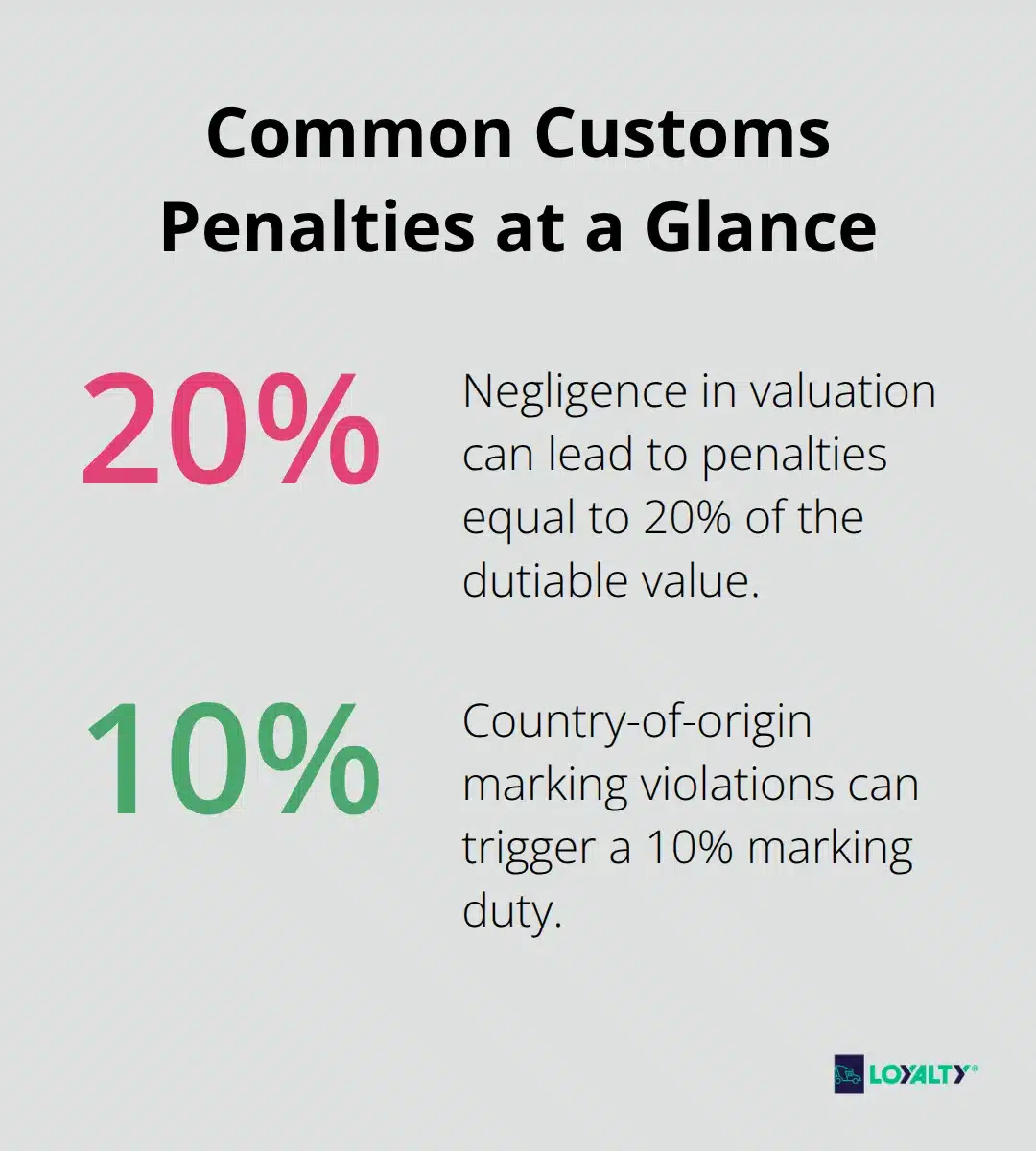
Compliance violations hit harder than most supply chain directors expect. CBP imposes penalties starting at $10,000 per violation for common mistakes like misclassification or incorrect valuation. Negligence in a valuation error can result in penalties reaching twice the lawful duties owed or 20% of the dutiable value. Misclassifying a product under the wrong HTS code exposes you to these fines plus the risk of shipment seizure in severe cases. Country-of-origin marking violations carry a 10% marking duty, and improper wood packaging certification under ISPM-15 standards can result in redelivery or destruction of your entire shipment.
Regulatory Changes Require Constant Attention
Recent changes to de minimis thresholds and enforcement of the Uyghur Forced Labor Prevention Act have caught many importers off guard, but brokers monitor these shifts and adjust your strategy proactively. A compliance violation damages your standing with CBP, which can lead to more frequent inspections and slower clearance on future shipments. Brokers reduce this risk by exercising reasonable care on your behalf and maintaining a clean compliance record that protects your operation long-term. They stay ahead of regulatory changes so you don’t have to track every policy shift yourself-your broker alerts you when new requirements affect your shipments and implements the necessary adjustments before problems arise. For companies shipping across North America, pairing your broker with a cross-border shipping strategy that covers U.S., Mexico, and Canada routes ensures compliance and logistics work together seamlessly.
When you understand the real cost of delays and penalties, the decision to partner with a qualified customs broker becomes clear. The next step is knowing whether you need a freight forwarder, a customs broker, or both for your specific trade routes and business model.
Shipping freight across the U.S., Mexico, or Canada border?
Loyalty Logistics coordinates customs clearance, carrier dispatch, and timely delivery so your shipments move without compliance delays or surprise fees.
Explore Cross-Border Freight Services →How to Choose the Right Customs Broker for Your Business
Verify Licensing and Direct Product Experience
Finding the right customs broker means moving past generic credentials to evaluate how well a firm understands your specific shipment patterns and trade corridors. Start by confirming that your broker holds an active customs broker license issued by U.S. Customs and Border Protection or the equivalent authority in your destination country. This license is non-negotiable, but it’s only the baseline. What matters more is whether the broker has direct experience clearing goods in your product category and the countries you import from.
A broker experienced in apparel shipments from Vietnam operates differently than one specializing in automotive parts from Mexico, because tariff classifications, regulatory agency requirements, and documentation standards vary dramatically by product and origin. Ask prospective brokers to describe their last five entries similar to yours and how they handled classification challenges specific to your products. If they cannot provide concrete examples, they lack the depth you need.
Assess Credentials and Port Presence
Industry certifications like C-TPAT participation and its compliance requirements signal that CBP views the broker as low-risk, which translates into faster clearance for your shipments. Beyond credentials, evaluate whether the broker has established relationships with customs authorities and regulatory agencies in your key ports and destination countries. A broker with strong connections at the Port of Los Angeles or Port of Houston can navigate delays more effectively than one working remotely without on-the-ground presence.
Ask directly whether they have staff stationed at your primary ports and what their average clearance time is for entries similar to yours. These on-the-ground relationships matter significantly when you need immediate answers about a flagged shipment or unexpected examination.
Evaluate Communication Systems and Real-Time Visibility
Communication systems matter equally to credentials and experience. Request access to their entry tracking portal and confirm they provide real-time updates on examination flags, duty assessments, and liquidation status. Many brokers still rely on email updates, which creates delays when you need immediate answers about a flagged shipment.
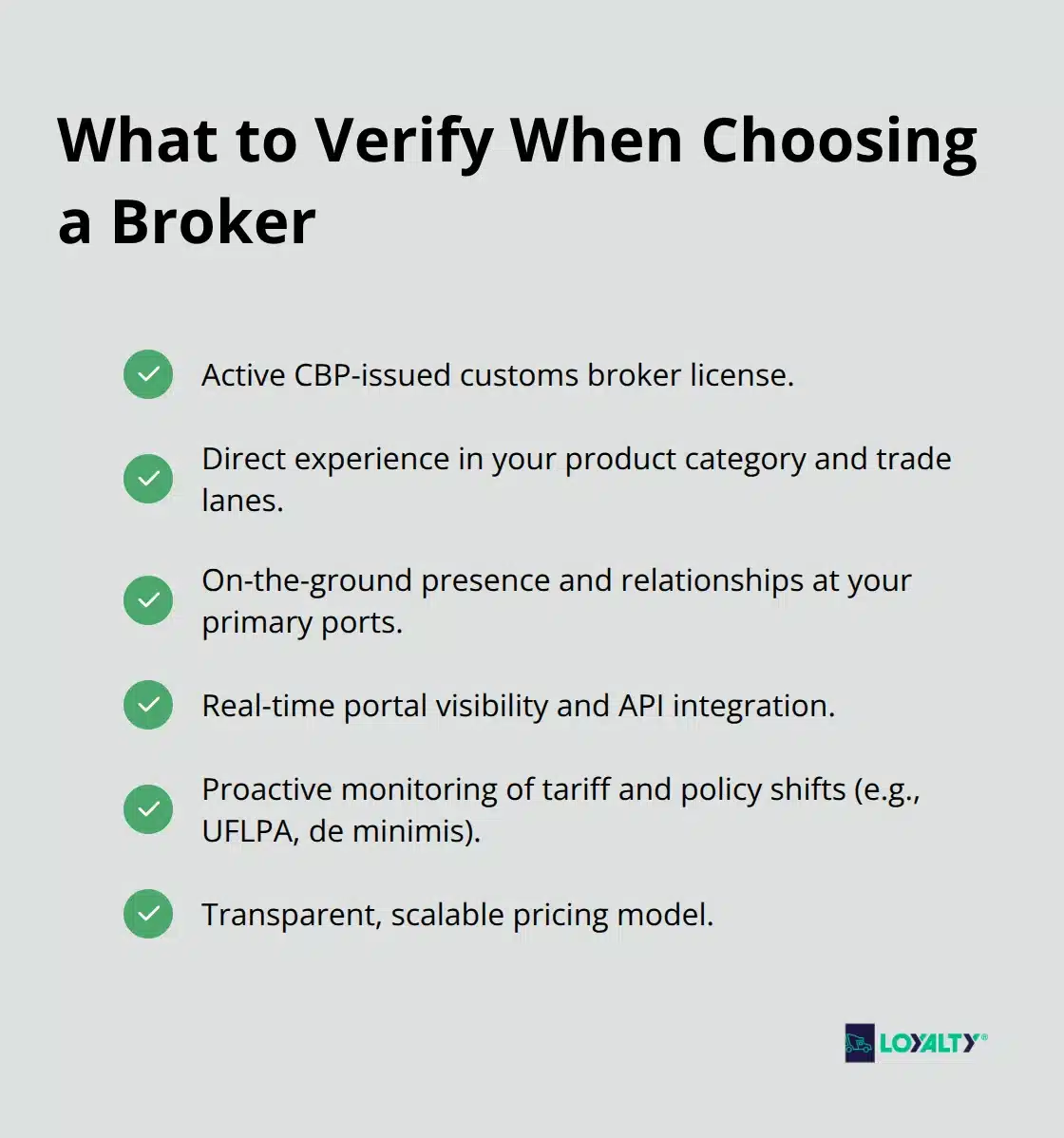
Your broker should offer API integration and Automated Commercial Environment (ACE) portal visibility so you monitor entries alongside your logistics partner without information gaps. Brokers who invest in supply chain visibility tools and real-time tracking systems give you the transparency needed to manage clearance proactively rather than reactively.
Confirm Proactive Regulatory Monitoring
A broker who stays ahead of regulatory changes prevents costly surprises. During your evaluation, ask whether they monitor tariff shifts, trade agreement updates, and agency enforcement priorities like UFLPA compliance. Recent changes to de minimis thresholds and enforcement strategies have caught many importers off guard, but a proactive broker alerts you to these shifts before they affect your shipments.
This forward-looking approach protects your operation long-term and prevents the compliance violations that damage your standing with CBP and trigger more frequent inspections on future shipments.
Clarify Fee Structure and Scalability
Finally, clarify their fee structure upfront and confirm whether they charge per entry, monthly retainers, or transaction-based rates. Transparent pricing prevents disputes later and helps you forecast compliance costs accurately as your import volume scales. A broker who explains their pricing model clearly demonstrates the professionalism and transparency you need in a long-term partner.
Need reliable cross-border freight with customs coordination?
Get a no-obligation quote from Loyalty Logistics — we handle the logistics so your broker can focus on clearance.
Get a Free Quote →Final Thoughts
A customs broker handles the technical and regulatory work that determines whether your shipments clear smoothly or get delayed at the border. They manage documentation accuracy, assign correct tariff classifications, calculate duties properly, and monitor compliance requirements that shift constantly. Without this expertise, your supply chain faces preventable delays, penalties starting at $10,000 per violation, and the operational friction that erodes margins across every shipment. Understanding what is a customs broker and why they matter transforms how you approach cross-border logistics.
The real impact of choosing the right broker shows up in your bottom line. Faster clearance reduces demurrage and storage costs, while accurate classification prevents duty overpayment and audit exposure. Proactive regulatory monitoring keeps you ahead of enforcement shifts like UFLPA requirements or de minimis threshold changes, and a broker with direct experience in your product category understands the specific documentation standards and tariff nuances that generic brokers miss. Real-time entry visibility and transparent fee structures separate partners who understand your operation from those offering generic services.
At Loyalty Logistics, we work with experienced customs brokers to ensure your shipments clear efficiently while maintaining the reliability your business demands.
Related Articles
• Customs Broker in Mexico – Deep dive into Mexico-specific customs requirements, SAT compliance, and broker selection
• How to Navigate Freight Shipping to Mexico Successfully – End-to-end guide for shipping into Mexico
• Mexico Tariffs: What You Need to Know – Tactical breakdown of Mexico’s current tariff landscape
• What Is Bonded Cargo and How Does It Work? – Explains bonded warehouses, customs regimes, and duty deferral options
Ready to Streamline Your Cross-Border Shipments?
Loyalty Logistics works alongside your customs broker to handle carrier dispatch, border crossing coordination, and final delivery across the U.S., Mexico, and Canada. We specialize in compliance-heavy freight so your supply chain runs without delays or surprise costs.
Loyalty Logistics: Connecting businesses with opportunities across North America.
Written by: Carlos Robayo, Director of Marketing at Loyalty Logistics
With experience in logistics marketing and international trade strategies, Carlos specializes in connecting companies with efficient, reliable transportation solutions for the North American market.

