
Cross-border logistics faces real threats every day. Customs delays, weather disruptions, and supplier failures can halt your operations and drain your budget.
Supply chain risk management isn’t optional anymore. At Loyalty Logistics, we’ve seen firsthand how companies that prepare for disruption recover faster and spend less on emergency fixes.
What Actually Disrupts Cross-Border Supply Chains
Customs Delays and Documentation Failures
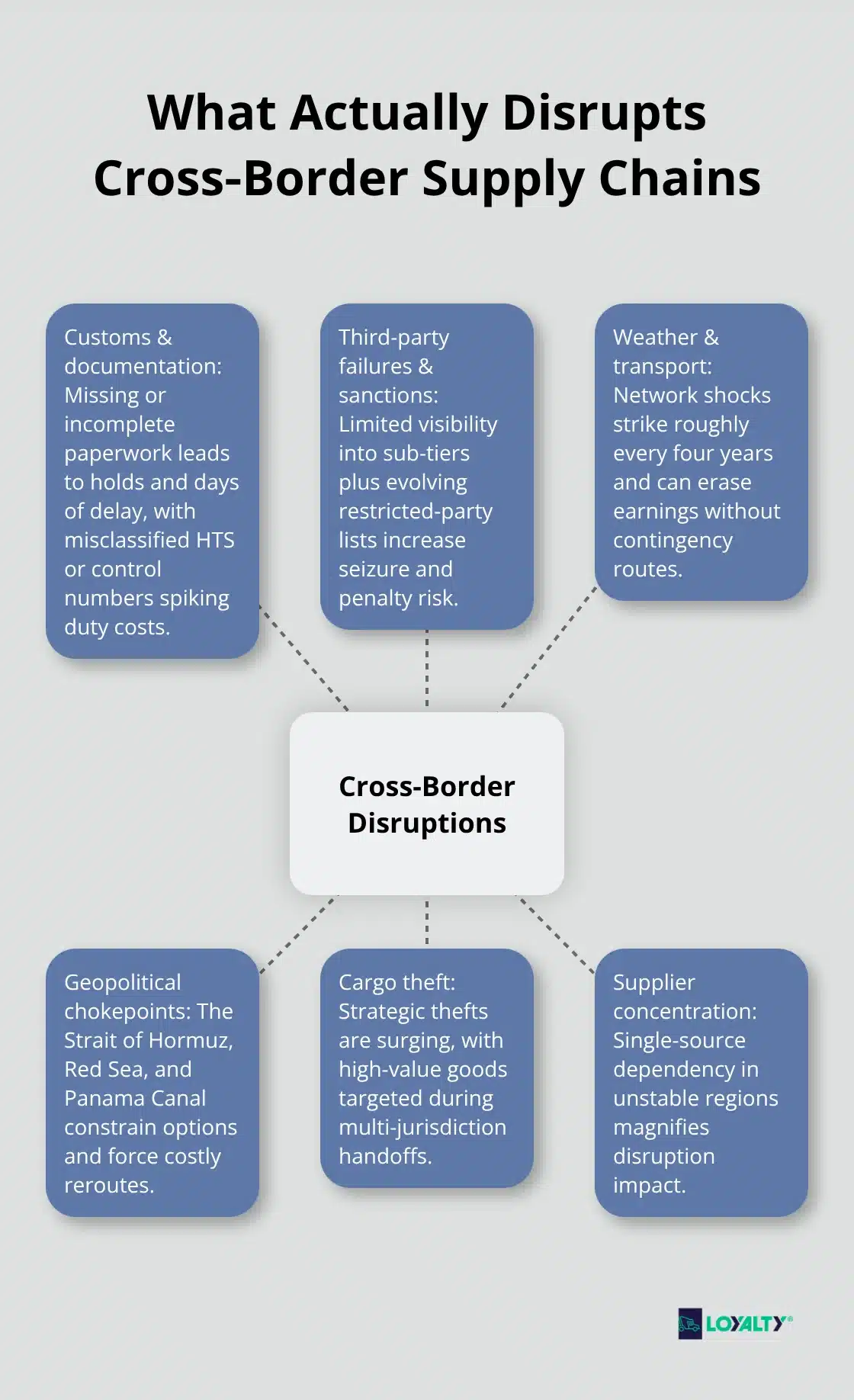
Customs delays hit harder than most logistics managers expect. Missing or incomplete documentation causes the leading border holds, and this problem repeats across cross-border operations. Commercial invoices, packing lists, and customs broker details must be collected and verified before dispatch-not after. When these arrive incomplete, your shipment sits idle while inspectors request corrections, adding days to transit time. Working with a qualified customs broker who understands Mexico’s import regulations eliminates most documentation failures before they reach the border.
Tariff classifications create another layer of risk. An incorrect HTS or Export Control Number triggers holds or reclassifications that spike your duty costs. The real cost isn’t just the delay; it’s the cascade effect when customers don’t receive goods on schedule and your team scrambles to explain why.
Third-Party Failures and Sanctions Exposure
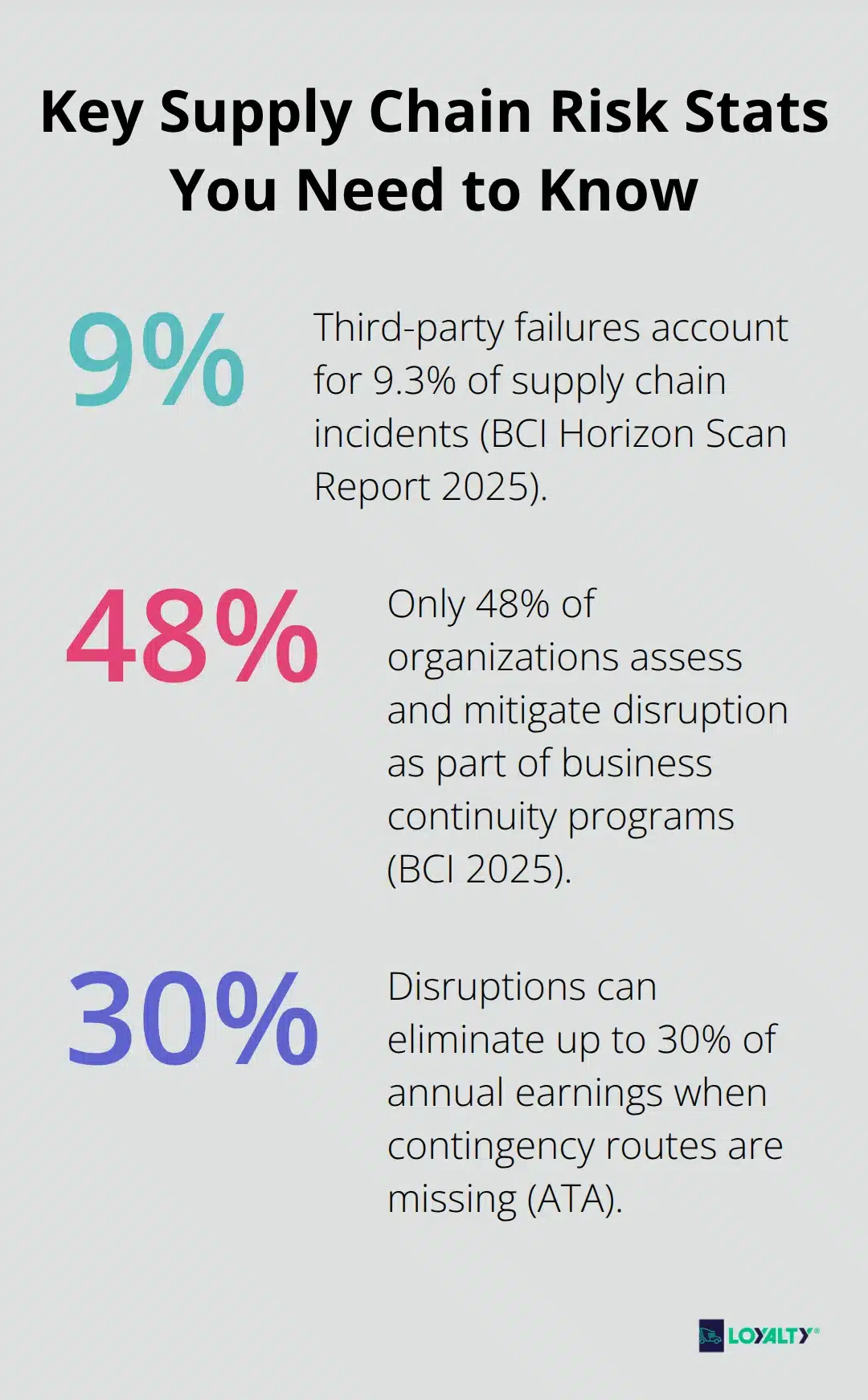
Compliance exposure runs deeper than tariff codes. According to the BCI Horizon Scan Report 2025, third-party failures account for 9.3% of supply chain incidents, and this risk compounds when you lack visibility into sub-tier suppliers. Sanctions screening is critical but often overlooked. Thomson Reuters Global Trade data shows over 790 restricted-party lists and more than 450,000 list updates occurred in 2025 alone.
Weather, Transportation, and Geopolitical Chokepoints
Weather and transportation disruptions are unavoidable, but their impact depends on your network design. The American Trucking Association reports that disruptions hit supply chains roughly every four years and can wipe out up to 30% of annual earnings when companies lack contingency routes. Geopolitical instability and sanctions create chokepoints-the Strait of Hormuz, Red Sea, and Panama Canal all carry elevated risk. These aren’t theoretical concerns; they directly reduce your shipping options and force costly reroutes.
Supplier failures escalate quickly when you depend on a single source in unstable regions. Only 48% of organizations assess and mitigate supply chain disruption as part of their business continuity programs according to the BCI Continuity and Resilience Report 2025, which means most companies operate without a tested recovery plan.
The Rising Threat of Cargo Theft
Cargo theft is surging across borders. Strategic thefts rose approximately 1,500% from Q1 2024 to Q1 2025, and the average loss per incident exceeds $200,000. High-value goods-electronics, pharmaceuticals, luxury items-face growing risk in transit, especially across borders where identity verification and chain-of-custody controls are weaker. Proper cargo securing techniques and chain-of-custody protocols reduce theft exposure significantly at every handoff point. The cargo theft problem demands immediate attention because your freight moves through multiple jurisdictions and handoff points where theft risk multiplies.
These disruptions don’t operate in isolation. They interact and amplify each other, which is why identifying and assessing your vulnerabilities requires a systematic approach.
How to Map Risk Across Your Entire Supply Network
Start with Complete Network Visibility
You cannot manage what you cannot see. Map every supplier, carrier, and intermediary in your supply chain-not just Tier 1, but Tier 2 and Tier 3 as well. Complex interdependencies with smaller legacy vendors create blind spots that hide compliance and security gaps until a disruption forces them into the open. Programs like C-TPAT provide a structured framework for vetting partners and securing your supply chain against these hidden vulnerabilities. Document ownership structures carefully because sanctions apply to transactions even when the listed company is not the ultimate owner. This means you need visibility into who actually owns or controls each supplier, not just their official registration.
Automate Supplier Risk Assessment
Use automation to evaluate import and export risk across your network. Questionnaires with automatic alerts for high-risk responses and a central data repository let you score suppliers consistently without manual spreadsheet chaos. The BCI Horizon Scan Report 2025 found that only 48% of organizations assess and mitigate supply chain disruption as part of their business continuity programs, which tells you most competitors operate blind. Assign clear ownership for supplier evaluation, network mapping, and continuous monitoring so risk management gets funded and prioritized instead of treated as a compliance checkbox.
Audit Your Customs Documentation Practices
Conduct regular audits of how your team handles customs documentation. Missing or incomplete information causes the leading border delays, so audit how commercial invoices, packing lists, and customs broker details flow through your operations before dispatch. Verify HTS classifications and Export Control Numbers on high-value shipments because an incorrect classification triggers reclassifications that spike duty costs and delay clearance. Understanding how tariffs on Canada and Mexico shift under current trade agreements helps your team catch misclassifications before they reach the border. Post-entry audits uncover hidden supply chain risks and potential duty overpayments that compound over time.
Implement Continuous Monitoring and Screening
Implement continuous monitoring with real-time data feeds and geofencing alerts. IoT sensors and AI-driven analytics detect anomalies early, catching suspicious patterns before they become losses. Deploying supply chain visibility tools with real-time tracking capabilities transforms how your team detects and responds to disruptions. Sanctions screening must run continuously because Thomson Reuters Global Trade data shows over 450,000 list updates occurred in 2025 alone. Automation lets your team focus on investigating alerts rather than gathering every data point manually (this approach is sometimes called “management by exception”).
Build an Internal Risk Team with Accountability
Establish an internal risk team with senior sponsorship so your organization prioritizes risk management across all levels. Without accountability, these activities drift and gaps resurface. Your team needs the authority to request information from suppliers, halt shipments when red flags appear, and escalate compliance concerns to leadership. With these systems in place, you’re ready to move beyond identification and assessment into the practical strategies that actually reduce disruption frequency and cost.
Need a transportation partner built for cross-border complexity?
Loyalty Logistics manages carrier networks, customs coordination, and border crossings across the U.S., Mexico, and Canada — so disruptions don’t become delays.
Explore Cross-Border Freight Services →Reducing Disruption Through Network Redundancy and Real-Time Control
Build Redundancy Into Your Carrier Network
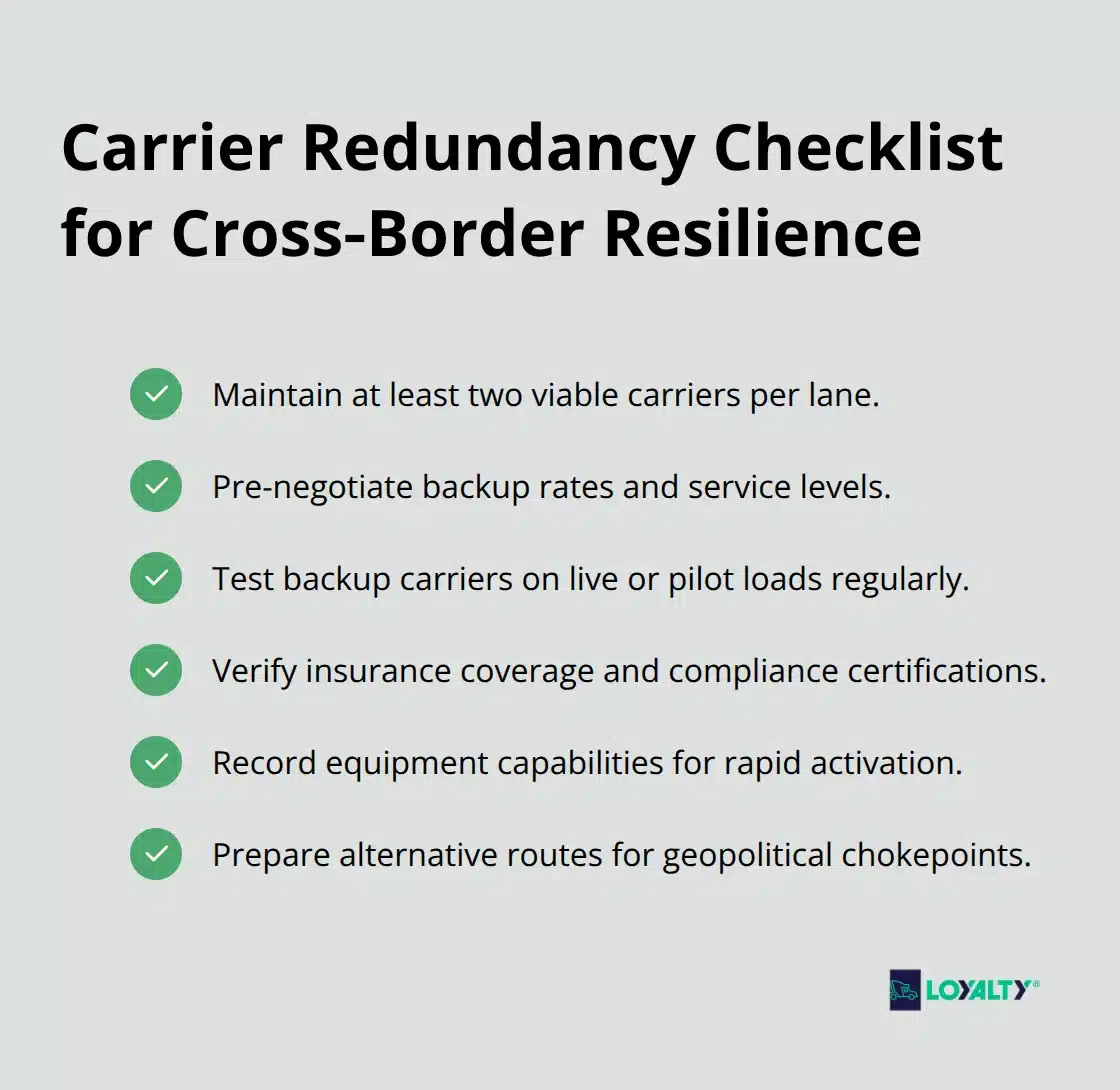
Network redundancy stops single points of failure from becoming catastrophic losses. Most logistics managers rely on one or two preferred carriers and routes, which means a weather event, labor action, or capacity constraint forces expensive emergency reroutes or shipment delays. The American Trucking Association data shows disruptions hit supply chains every four years and can eliminate up to 30% of annual earnings, yet companies continue operating with minimal backup options. You need at least two viable carriers per lane and alternative routing options for geopolitical chokepoints like the Strait of Hormuz, Red Sea, and Panama Canal.
When you maintain a vetted network of secondary carriers with pre-negotiated rates and service agreements, you eliminate the scramble for capacity when your primary option fails. Test those backup carriers regularly, not just keeping them on file. Document their insurance coverage, compliance certifications, and specific equipment capabilities so you can activate them quickly without negotiation delays.
Account for Cross-Border Specifics
For cross-border moves to Mexico, carriers must understand local restrictions. Mexico City has strict truck-hour windows, tolls vary significantly by region, and fuel costs impact final pricing differently than domestic lanes. A comprehensive cross-border shipping strategy that covers routing, documentation, and carrier selection reduces the variables that create disruptions on Mexico and Canada lanes. Cargado Market Rates provides verified bids across 2,000-plus lanes with weekly updates, giving you confidence that your quoted rates reflect actual market conditions rather than guesses. This pricing intelligence prevents under- or overquoting and protects your margins when you need to activate backup carriers at short notice.
Maintain Strategic Buffer Stock
Strategic buffer stock for critical components absorbs shocks without forcing costly expedited shipments or production halts. McKinsey research shows that targeted safety stock for components with long lead times or high disruption exposure cushions demand swings and supply interruptions far more cost-effectively than emergency logistics. Calculate which components create the longest lead times or highest replacement costs, then maintain 2-4 weeks of inventory for those items depending on your demand volatility and supplier reliability. This approach costs far less than the penalty of a production stoppage or customer service failure.
Deploy Real-Time Visibility Tools
Real-time visibility tools-IoT sensors, geofencing, and AI-driven analytics-transform your ability to detect problems before they cascade into major disruptions. Automation lets your team focus on investigating alerts rather than manually gathering data across multiple systems and carriers. When you implement end-to-end visibility from suppliers through final delivery, you catch customs holds, transportation delays, and theft attempts hours or days earlier than teams relying on phone calls and email updates. This early detection window gives you time to notify customers, arrange alternative routing, or activate contingency suppliers before orders miss commitments.
Want to stress-test your cross-border logistics?
Get a no-obligation quote from Loyalty Logistics and see how our carrier network and customs coordination reduce your exposure to delays and disruptions.
Get a Free Quote →Final Thoughts
Supply chain risk management requires ongoing attention, not a one-time audit. The strategies we’ve covered-mapping your network, automating supplier assessments, building carrier redundancy, and deploying real-time visibility-work together to reduce disruption frequency and cost. Disruptions hit supply chains every four years and can eliminate up to 30% of annual earnings, while strategic cargo thefts rose 1,500% from Q1 2024 to Q1 2025, making preparation non-negotiable.
Start by auditing your current state honestly. Identify your blind spots, suppliers without sub-tier transparency, routes dependent on single carriers, and components with the longest lead times. Then prioritize the gaps that pose the highest financial risk to your operation. Build your internal team with clear accountability and senior sponsorship so risk management receives dedicated resources and funding instead of drifting when disruptions hit.
At Loyalty Logistics, we understand that cross-border operations demand partners who deliver consistently — with vetted carrier networks, customs coordination, and the redundancy your supply chain needs to absorb disruptions without missing commitments.
Related Articles
• How to Optimize Your Supply Chain Effectively – Broader supply chain optimization strategies that complement risk management
• Harnessing Supply Chain Analytics for Smarter Logistics Decisions – Data-driven approaches to identify and predict supply chain vulnerabilities
• How to Choose the Right Cargo Insurance Coverage – Protect your freight financially when disruptions do occur
• What Is a Customs Broker? – Understand the compliance partner that prevents documentation-driven delays
Ready to Build a More Resilient Cross-Border Supply Chain?
Loyalty Logistics provides vetted carrier networks, customs broker coordination, and real-time shipment visibility across the U.S., Mexico, and Canada. We help you build the redundancy and reliability your supply chain needs to absorb disruptions without missing delivery commitments.
Loyalty Logistics: Connecting businesses with opportunities across North America.
Written by: Carlos Robayo, Director of Marketing at Loyalty Logistics
With experience in logistics marketing and international trade strategies, Carlos specializes in connecting companies with efficient, reliable transportation solutions for the North American market.

