

Supply chain security has become a top priority for businesses moving goods across international borders. The Customs-Trade Partnership Against Terrorism (CTPAT) program offers a proven path to strengthen security while streamlining operations.
At Loyalty Logistics, we’ve seen how understanding what is CTPAT can transform a company’s logistics strategy. This voluntary program delivers measurable benefits that extend far beyond basic compliance requirements.
What Makes CTPAT Essential for Modern Trade
The Customs-Trade Partnership Against Terrorism represents the largest voluntary government-business initiative to secure and facilitate international trade. U.S. Customs and Border Protection launched this program in November 2001 as a direct response to the September 11 attacks, after officials recognized that private companies control roughly 80% of critical infrastructure protection responsibilities. The program now includes over 11,400 certified partners across multiple industry sectors, from manufacturers and importers to logistics providers and port authorities.
The Security-Trade Balance CBP Created
CBP designed CTPAT around a simple but powerful concept: companies that demonstrate robust security measures receive expedited processing and reduced inspections. This trade-off addresses the fundamental challenge that has faced international commerce since 2001. Security measures that once slowed border crossings now accelerate them for trusted partners. The program operates through three tiers of membership, with Tier 3 partners who receive the most significant benefits (including access to dedicated lanes and priority processing during high-alert periods). For companies shipping between the US, Canada, and Mexico, understanding cross-border shipping fundamentals provides essential context for maximizing CTPAT benefits.
How Multiple Agencies Support CTPAT Success
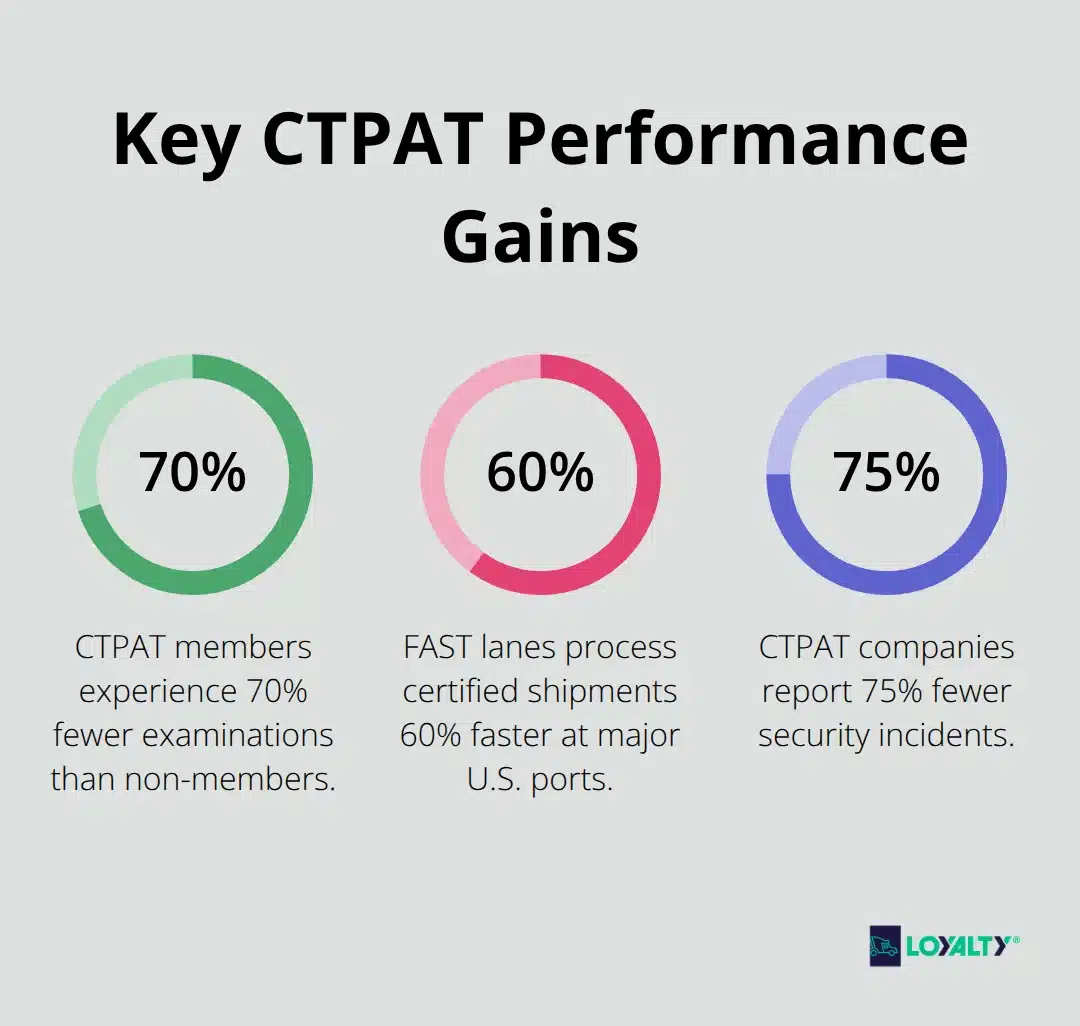
While CBP manages the program, CTPAT success depends on coordination with other federal agencies including the Transportation Security Administration, Immigration and Customs Enforcement, and the Coast Guard. These agencies share intelligence and coordinate inspections to create a comprehensive security framework. The Department of Homeland Security reports that CTPAT members experience 70% fewer examinations compared to non-members, which translates directly into faster cargo movement and reduced logistics costs.
The Foundation for Supply Chain Benefits
This multi-agency approach transforms what could be bureaucratic complexity into streamlined operations for certified companies. The program establishes the groundwork for significant operational advantages that extend well beyond basic security compliance (particularly in areas of cost reduction and competitive positioning).
How Does CTPAT Transform Your Bottom Line
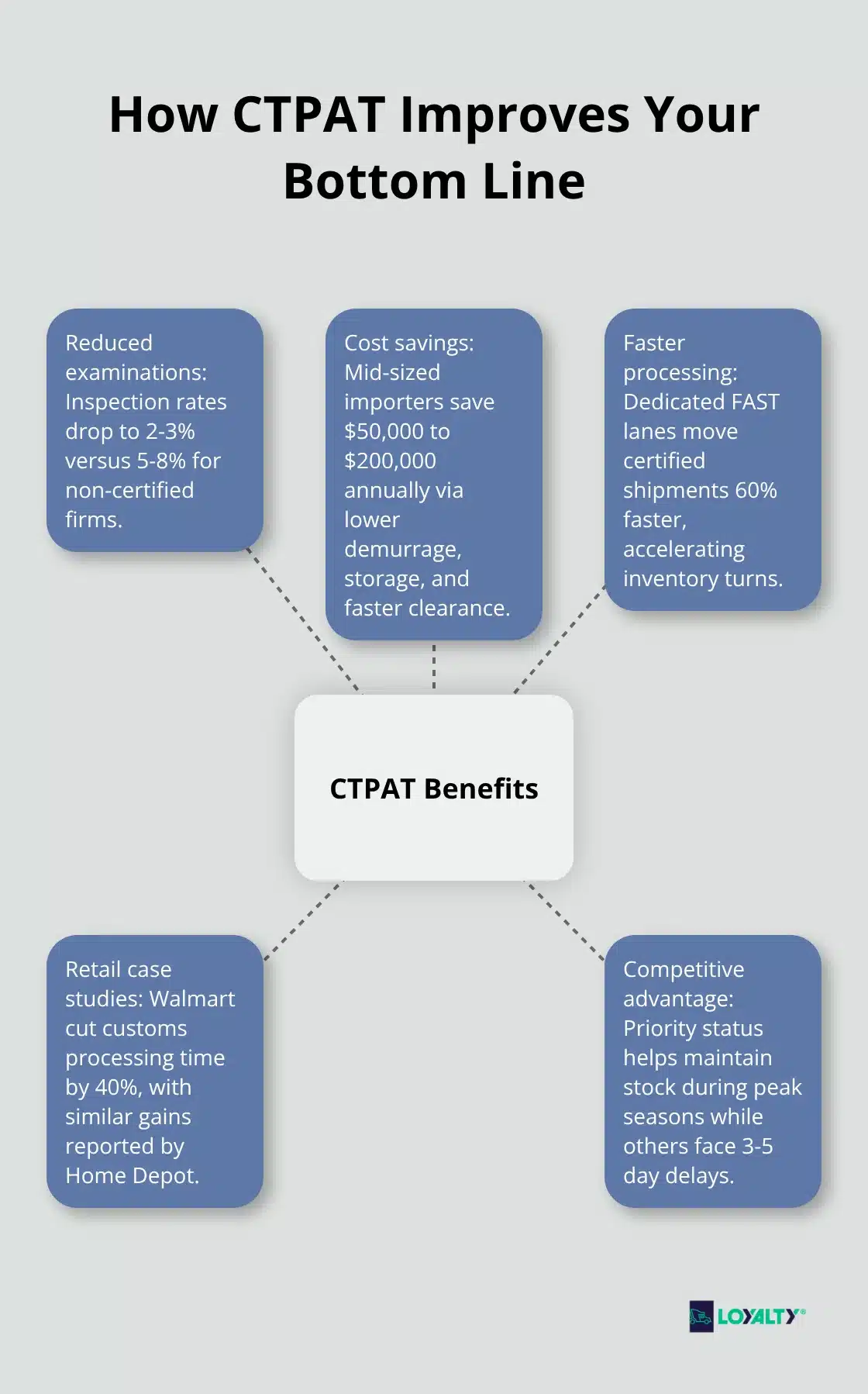
CTPAT membership delivers immediate financial returns through reduced inspection rates and accelerated cargo processing. Members experience examination rates as low as 2-3% compared to the standard 5-8% for non-certified companies, according to CBP data. This reduction translates to savings of $50,000 to $200,000 annually for mid-sized importers through decreased demurrage fees, storage costs, and expedited clearance times. Walmart reported a 40% reduction in customs processing time after CTPAT certification, while Home Depot documented similar improvements across their supply chain operations.
Priority Processing Creates Competitive Edge
CTPAT members gain access to dedicated processing lanes and priority treatment during peak seasons and security alerts. The program’s Fast and Secure Trade lanes at major ports like Los Angeles and Long Beach process certified shipments 60% faster than standard channels. This advantage becomes particularly valuable during holiday seasons when non-certified importers face delays of 3-5 additional days. Companies like Target leverage this priority status to maintain inventory levels during critical selling periods (which gives them a significant market advantage over competitors who struggle with unpredictable delivery schedules).
Enhanced Security Standards Reduce Risk Exposure
The program’s security requirements create a comprehensive risk management framework that protects against cargo theft, contamination, and supply chain disruptions. CTPAT companies report 75% fewer security incidents compared to non-certified businesses, according to Department of Homeland Security statistics. These security improvements reduce insurance premiums by 10-15% and minimize costly product recalls or contamination events. Beyond certification requirements, implementing proper cargo securing techniques further protects shipments throughout the transportation process. The program’s supply chain partner verification requirements also help companies identify and eliminate high-risk vendors before problems occur (which creates stronger operational resilience across international trade networks).
Implementation Requirements Drive Long-Term Value
These financial and operational benefits come with specific compliance obligations that companies must meet to maintain their certified status. The security assessment process and documentation requirements form the foundation of CTPAT membership.
What Steps Lead to CTPAT Certification
Security Assessment and Application Process
CTPAT certification demands companies complete a comprehensive security assessment that CBP reviews through a detailed application process that takes 90-120 days on average. The initial application requires extensive documentation that includes facility layouts, security protocols, employee background check procedures, and cargo handling processes. Companies must submit these materials through CBP’s online portal and respond to follow-up questions within specified timeframes to maintain their application status.
Physical Security Standards and Personnel Requirements
Companies must demonstrate physical security measures such as perimeter fencing with adequate lighting, access control systems, and surveillance equipment that covers all cargo areas. Personnel requirements include background checks on employees with access to cargo or security-sensitive areas, plus mandatory security training programs that companies update annually. CBP validates these measures through on-site inspections that examine everything from gate procedures to container sealing protocols (with inspectors spending 2-3 days at each facility).
Supply Chain Partner Verification Process
Supply chain partner verification represents the most complex certification requirement, as companies must validate the security practices of every vendor, supplier, and service provider in their logistics network. This process involves security assessments of partners, written security agreements, and ongoing monitoring systems that track compliance. Understanding the differences between 3PL and 4PL providers helps companies evaluate which logistics partnerships align with CTPAT security requirements. Companies like FedEx and UPS maintain dedicated teams of 15-20 specialists solely for partner verification activities, while mid-sized importers typically need 6-12 months to complete initial partner assessments.
Ongoing Compliance and Monitoring Requirements
CBP expects certified companies to terminate relationships with non-compliant partners within 30 days of identification (which makes this verification process a continuous operational requirement rather than a one-time certification step). Companies must conduct annual self-assessments and report security incidents within 24 hours to maintain their certified status.

Final Thoughts
CTPAT certification transforms international logistics through measurable security and efficiency gains. The data speaks clearly: certified companies experience 70% fewer examinations, save $50,000-$200,000 annually, and gain 60% faster processing through dedicated lanes. These benefits create competitive advantages that extend far beyond basic compliance.
The certification process requires significant investment in security assessments, physical infrastructure, and supply chain partner verification. Companies that complete these requirements position themselves for long-term operational excellence and reduced risk exposure across their international trade operations. What is CTPAT becomes clear when businesses see these tangible results in their daily operations.
For companies shipping to Mexico, understanding how tariffs and trade policies affect US-Mexico commerce complements CTPAT preparation by providing insight into the broader regulatory landscape. CTPAT certification represents a strategic decision that impacts every aspect of supply chain management, and companies ready to begin this process should start with comprehensive security assessments and partner evaluations.
Related Articles
- Mastering Cross-Border Shipping in North America (Guide) – Comprehensive strategies for US-Mexico-Canada logistics operations
- Cross Border Shipping: Complete Guide to Navigating International Shipping Challenges – Documentation requirements and customs procedures explained
- The Art of Securing Cargo for Damage-Free Delivery – Security best practices that complement CTPAT requirements
- How to Navigate Cross Border Shipping from US to Canada – Specific compliance requirements for the northern trade corridor
Partner with a CTPAT-Ready Logistics Provider
At Loyalty Logistics, we understand the security and compliance demands of cross-border shipping. Our operations align with CTPAT standards, giving your shipments the expedited processing and reduced inspection rates that certified supply chains require across the US, Mexico, and Canada.
Whether you’re pursuing CTPAT certification or need a logistics partner who already meets these security benchmarks, our team provides the documentation support, cargo tracking, and border crossing expertise your international operations demand.

![Mastering Cross-Border Shipping in North America [Guide]](https://www.whyloyalty.com/wp-content/uploads/emplibot/nafta-shipping-hero-1759752467-150x150.webp)