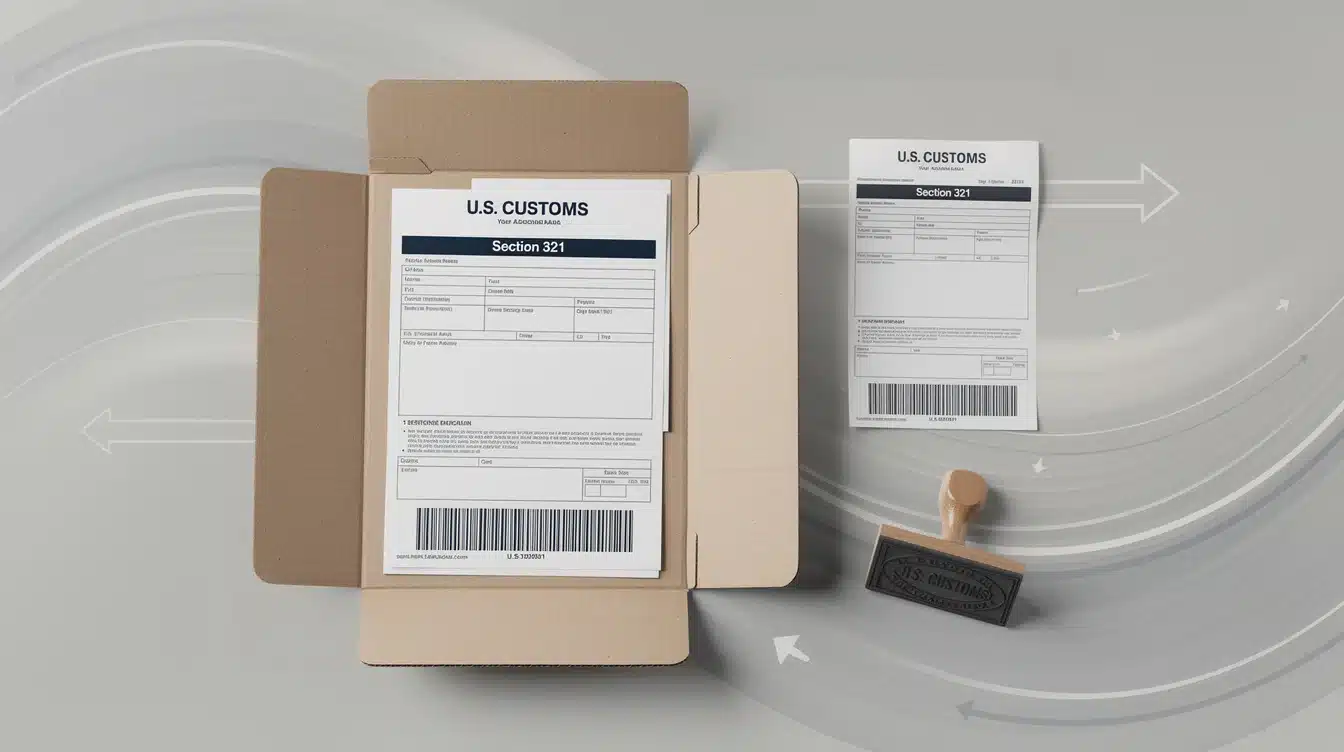
Section 321 US Customs rules determine what crosses your border and at what cost. Get these wrong, and your shipments face delays, penalties, and unexpected expenses that eat into margins.
At Loyalty Logistics, we’ve seen firsthand how confusion around import regulations creates bottlenecks in cross-border freight operations. This guide breaks down the rules that matter most and shows you how to stay compliant without slowing down your supply chain.
What Section 321 Actually Controls
Section 321 of the Tariff Act of 1930 sets the threshold for duty-free imports in the United States. Shipments valued under $800 enter duty-free, while anything above that threshold faces standard tariff rates based on the Harmonized Tariff Schedule. This rule applies broadly to merchandise crossing into the U.S., though specific country and product exclusions apply (verify current CBP policy for China-origin imports and other restricted categories). The threshold has remained unchanged since 2016, even as inflation has eroded its practical value. For cross-border logistics managers, this means a $799 shipment and an $801 shipment receive completely different treatment at the border, creating a hard line that determines your landed costs and processing speed. A valuation error of just a few dollars pushes shipments into duty territory unexpectedly. CBP uses the price actually paid or payable for the merchandise to calculate Section 321 eligibility, excluding freight and insurance. This valuation must match your commercial invoice exactly, or CBP will reject the entry and demand corrections before release.
How Tariff Classification Drives Your Costs
Tariff classification determines duty rates, and the Harmonized Tariff Schedule contains approximately 14,000 product codes with rates ranging from free to over 50 percent. A single misclassified item transforms a low-cost import into an expensive one. Certain textiles and automotive parts carry duties exceeding 20 percent, while industrial materials often qualify for lower rates. Reviewing tariffs on Canada and Mexico alongside Section 321 eligibility reveals which shipments belong below the de minimis threshold and which need full HTS classification. The Customs Rulings Online Search System allows you to review prior rulings on similar products before shipment, yet most companies skip this step and encounter classification errors at the border. When CBP examines your shipment, you pay Centralized Examination Station fees for devanning, handling, and storage, costs that vary by region but routinely exceed $500. Documentation errors compound these expenses significantly.
Documentation Errors That Trigger Delays
Mismatched product descriptions, incorrect country of origin, and inaccurate valuations trigger secondary inspections that delay release by hours or days. In February 2025, cross-border freight between the U.S., Mexico, and Canada reached $131.6 billion according to the Bureau of Transportation Statistics, and every delayed shipment in that flow represents lost revenue and customer trust. The solution requires ruthless documentation discipline before shipment leaves your facility. Implement multi-point verification that requires a second review of all customs forms, product descriptions, and declared values. Never release a shipment without explicit broker confirmation that all paperwork matches your inventory.
Building Your Compliance Foundation
Documentation consistency prevents costly rework at the border. Common errors include mismatched product descriptions, incorrect HS codes, missing country of origin, and inaccurate valuations. A second pair of eyes catches these mistakes before CBP does. Establish a pre-shipment checklist that requires explicit broker confirmation before any load departs your warehouse.
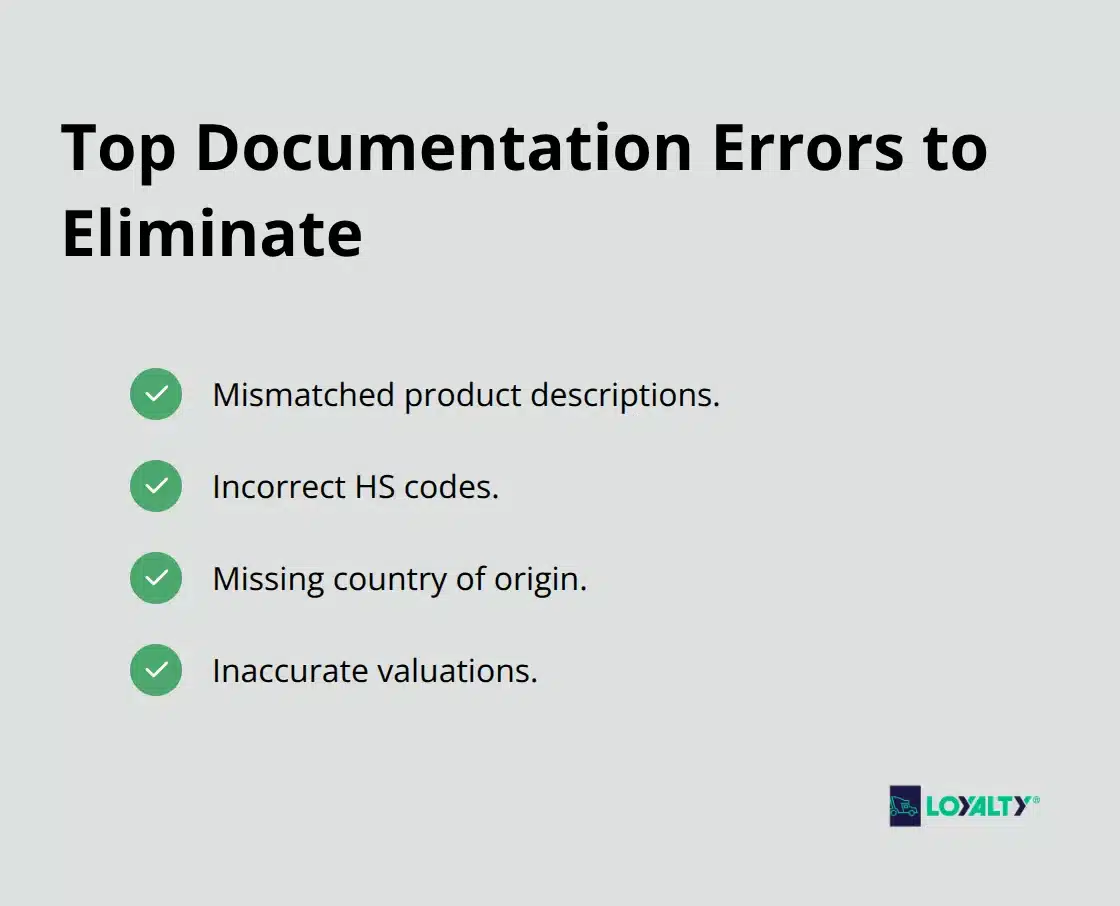
This single step eliminates rejected entries and the cascade of delays that follow. Your logistics partner should verify cross-border certifications, maintain adequate international insurance, and hold the proper operating authority to handle your shipments correctly. These details matter because they determine whether your freight moves smoothly or stalls at the border.
The foundation you build now, accurate documentation, broker alignment, and verified carrier credentials, determines whether your cross-border operations run on schedule or face constant disruptions. The next section examines the specific regulations and compliance requirements that govern tariff classification, documentation standards, and the regional differences between U.S., Canada, and Mexico operations.
Hitting Centralized Examination fees because Section 321 valuations or HTS codes keep getting flagged at CBP?
Loyalty Logistics coordinates cross-border freight with in-house customs teams, pre-shipment documentation verification, and Section 321 eligibility checks across U.S., Canada, and Mexico lanes.
Key Regulations and Compliance Requirements
Tariff Classification Determines Your Landed Costs
The Harmonized Tariff Schedule contains roughly 14,000 product codes, and selecting the wrong one transforms your landed cost overnight. A textile classified under the wrong heading can trigger duties exceeding 20 percent, while the correct classification might qualify for preferential rates under USMCA. CBP assigns duty rates based on your product code, not your product description, so precision matters absolutely. You obtain binding rulings under 19 C.F.R. 177 through the Customs Rulings Online Search System, which lets you review prior decisions on identical or similar merchandise before your shipment arrives. Most companies ignore this step and pay the price when CBP reclassifies their goods at the border. Manufacturing operations that use the IMMEX program for temporary imports stack a second layer of duty deferral on top of Section 321 and USMCA qualification.
Valuation Standards That CBP Enforces Strictly
The Tariff Act of 1930 defines customs value as the price actually paid or payable for merchandise, excluding freight and insurance but including any assists like engineering or design work provided by the buyer. If your declared value doesn’t match your commercial invoice, CBP rejects the entry and demands corrections before release. This valuation precision applies equally to all three North American markets, yet regional differences in how each country applies those valuations create compliance traps that catch unprepared shippers. Strategies for U.S. Canada Mexico shipping address how those regional differences play out in practice.
Documentation Standards Vary Across Borders
Documentation standards differ fundamentally between U.S., Canadian, and Mexican ports, and a form that clears CBP may fail at a Mexican customs office. The U.S. requires Importer Security Filing data ten days before ocean vessel arrival under the 10+2 rule, while Canada demands different advance information through separate systems, and Mexico operates under its own documentation framework entirely. Missing or incorrect country of origin statements trigger secondary inspections in all three countries. Many companies list origin as the port of departure rather than the actual manufacturing location, a costly mistake that delays clearance by 24 to 48 hours.
Examination Costs and Documentation Accuracy
When CBP examines your shipment, you absorb all Centralized Examination Station fees for devanning and handling, which routinely exceed $500 depending on region. Cross-border freight between the U.S., Mexico, and Canada reached $131.6 billion in February 2025 according to the Bureau of Transportation Statistics, meaning delays compound across entire supply chains. Your documentation must match exactly across your commercial invoice, packing list, and customs declaration, with product descriptions identical in every instance. A second review before shipment departure catches mismatches that would otherwise create border holds. Companies that combine Section 321 with strategic bonded cargo storage maintain even tighter cash-flow control over high-duty imports.
Broker Selection Eliminates Handoff Delays
Working with a customs broker who maintains physical presence and in-house clearance teams on both sides of the border eliminates the handoff delays that plague companies relying on multiple intermediaries. The right broker verifies USMCA eligibility, confirms country of origin accuracy, and catches valuation errors before CBP does. These operational details determine whether your freight moves smoothly or stalls at inspection points. The next section examines practical strategies that reduce documentation friction and accelerate your cross-border operations.
How to Build a Documentation System That Prevents Border Delays
Establish a Three-Step Verification Checkpoint
Documentation discipline separates companies that move freight on schedule from those that face constant rework at the border. The most effective approach treats your pre-shipment process as a quality control checkpoint rather than an administrative formality. Create a three-step verification system before any shipment leaves your facility: first, compare your commercial invoice against your packing list to confirm product descriptions match exactly; second, verify that country of origin reflects the actual manufacturing location, not the port of departure; third, cross-check declared value against your invoice to ensure CBP valuations align precisely.
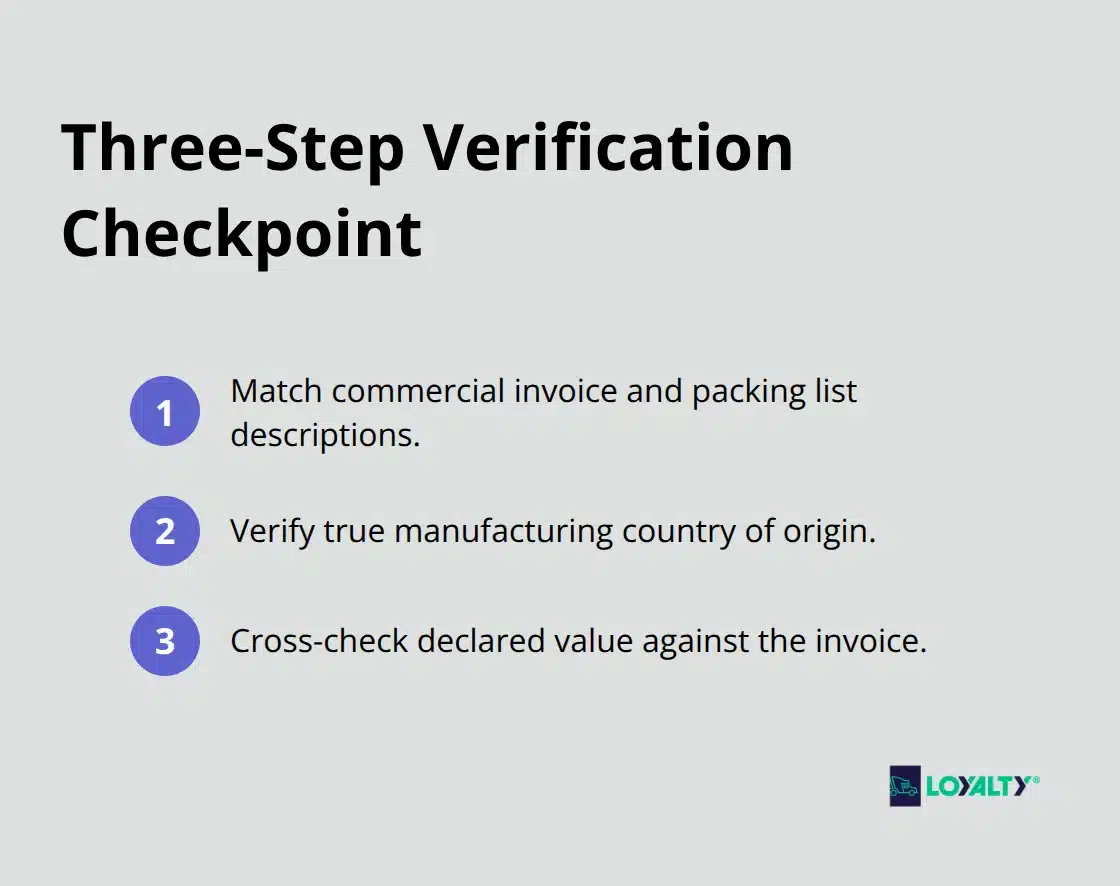
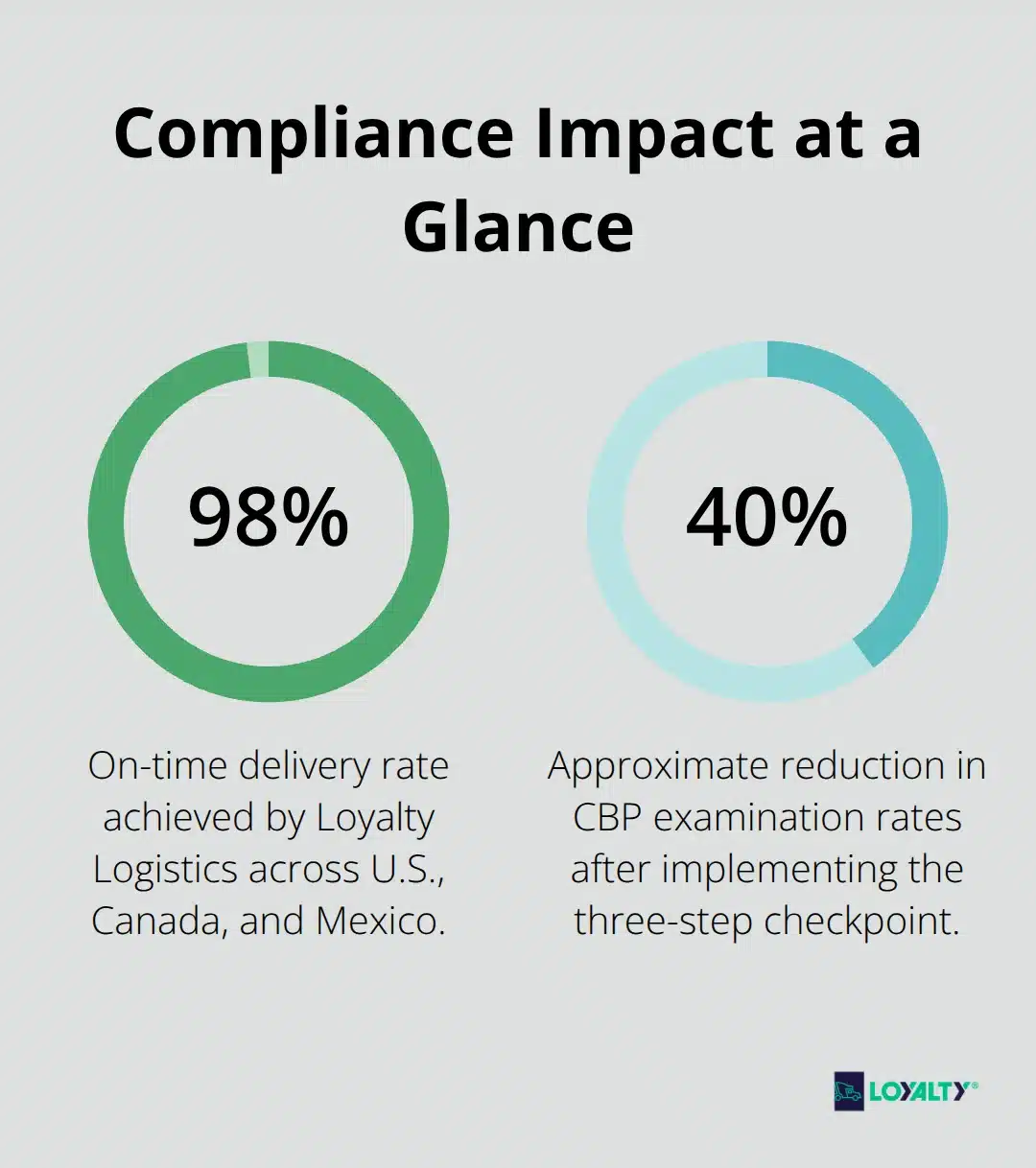
Assign one person the authority to halt shipments that fail verification, and that person reports directly to your logistics manager. Companies that implement this checkpoint reduce CBP examination rates by approximately 40 percent according to industry reporting on compliance effectiveness.
Align With Your Customs Broker Before Shipment
Your customs broker must confirm all documentation before departure, not after. Establish broker relationships 2-3 weeks before your first cross-border shipment. This advance window allows your broker to review your documentation standards, flag potential issues, and integrate their requirements into your warehouse procedures. Never release a shipment without written broker approval that explicitly confirms product classification, valuation accuracy, and country of origin. This single discipline eliminates rejected entries and the cascade of delays that follow.
Deploy Technology to Flag Compliance Gaps
Technology accelerates compliance without replacing human judgment. Implement an electronic document management system that captures product details, HS codes, and country of origin in a centralized database accessible to warehouse staff, procurement, and your customs broker simultaneously. Real-time tracking systems that monitor shipment status from pickup through border clearance reveal exactly where delays occur and which documentation gaps trigger secondary inspections. Most companies discover that 60-70 percent of their border holds stem from three preventable errors: mismatched product descriptions, incorrect HS codes, and undocumented country of origin. A compliance database that flags these issues before shipment departure costs far less than paying Centralized Examination Station fees that routinely exceed $500 per examination.
Partner With Logistics Providers That Maintain Border Presence
Your logistics partner should maintain physical presence and in-house customs clearance on both sides of the border, eliminating handoff delays between multiple intermediaries. This operational structure determines whether your freight moves smoothly or faces the delays that compound across entire supply chains. Loyalty Logistics operates across U.S., Canada, and Mexico with a 98% on-time rate and more than 10,000 successful deliveries, providing the border expertise and operational continuity that prevents examination holds and accelerates release times.
Need cross-border freight backed by Section 321 eligibility checks, HTS verification, and 98%+ on-time performance?
Tell us your SKUs, shipment values, and lanes. We’ll quote cross-border freight with in-house customs broker support, pre-shipment documentation verification, and detailed Section 321 eligibility models so $500+ exam fees stay off your invoice.
Final Thoughts
Section 321 US Customs rules determine whether your cross-border operations run smoothly or face constant disruption. The threshold that separates duty-free entry from tariff liability, the tariff classifications that drive your landed costs, and the documentation standards that CBP enforces all depend on your ability to verify accuracy before shipment departure. Companies that implement a three-step verification checkpoint catch the mismatched product descriptions, incorrect HS codes, and undocumented country of origin that trigger most secondary inspections, and the examination fees that routinely exceed $500 per hold.
Broker alignment 2-3 weeks before your first shipment establishes the documentation standards and classification accuracy that keep freight moving without delays. Technology that flags compliance gaps in real time transforms your pre-shipment process from an administrative burden into a competitive advantage that protects your margins. A customs broker with physical presence and in-house clearance on both sides of the border eliminates the handoff delays that compound across entire supply chains.
We at Loyalty Logistics operate across U.S., Canada, and Mexico with in-house customs expertise that handles tariff classification, valuation accuracy, and documentation verification so your freight moves without the delays that cost you revenue. Explore our freight transportation services to transform your cross-border operations into a reliable competitive advantage.
Frequently Asked Questions
What is Section 321 of the Tariff Act?
Section 321 of the Tariff Act of 1930 establishes the de minimis exemption for U.S. imports. Shipments valued at or below $800 (per person, per day) enter duty-free without formal entry procedures, while anything above that threshold faces standard tariff rates based on the Harmonized Tariff Schedule. The $800 threshold has been in place since 2016. Section 321 applies broadly to commercial and personal imports, though specific country and product exclusions apply depending on current CBP policy; verify eligibility for your specific origin and commodity before assuming duty-free treatment.
What is the $800 de minimis threshold?
The $800 de minimis threshold is the maximum shipment value that qualifies for duty-free entry under Section 321. CBP calculates the threshold using the price actually paid or payable for the merchandise, excluding freight and insurance. A $799 shipment enters duty-free; an $801 shipment requires formal entry and standard tariff treatment. The threshold applies per person, per day, which means high-volume importers cannot split single transactions into multiple sub-$800 shipments to evade duties; that practice triggers CBP penalties.
What documentation is required for Section 321 imports?
Section 321 imports require accurate commercial invoices with detailed product descriptions, declared values matching the invoice exactly, and correct country of origin reflecting the actual manufacturing location (not port of departure). HS codes must align with the Harmonized Tariff Schedule for the specific product type. Most shipments also need a bill of lading. Mismatched descriptions, incorrect country of origin, or inaccurate valuations trigger secondary inspections and Centralized Examination Station fees that routinely exceed $500.
How do you avoid Section 321 reclassification at customs?
Avoid reclassification through a three-step verification checkpoint before every shipment: first, match commercial invoice against packing list for identical product descriptions; second, verify country of origin reflects actual manufacturing location; third, cross-check declared value against the invoice to ensure CBP-compatible valuation. Use the Customs Rulings Online Search System to review prior CBP decisions on similar products. Establish customs broker relationships 2-3 weeks before first shipment so they can verify HS codes, valuations, and country of origin in advance. Companies that implement this discipline reduce CBP examination rates by approximately 40%.
Ready to Run Section 321 Imports Without Examination Fees?
Section 321 compliance rewards shippers who partner with carriers running in-house customs verification, HTS validation, and pre-shipment documentation review. Tell us your SKUs, shipment values, and lanes and we’ll quote cross-border freight with Section 321 eligibility checks, customs broker support, and 98% on-time performance.
Related Articles
- What Is a Customs Broker?: Role definition and licensure for the broker who verifies Section 321 eligibility.
- U.S. Canada Mexico Shipping: Trilateral USMCA playbook that pairs with Section 321 strategy.
- What Is Bonded Cargo and How Does It Work?: Duty deferral strategy for shipments above the $800 threshold.
Loyalty Logistics: Connecting businesses with opportunities across North America.
Written by: Carlos Robayo, Marketing Director at Loyalty Logistics
With expertise in logistics marketing and international trade, Carlos specializes in connecting businesses with efficient and reliable transport solutions for the North American market.