
Shipping freight from Canada involves navigating complex regulations, unpredictable weather, and tight timelines. Most logistics managers struggle with customs documentation, driver shortages, and cost control across the border.
We at Loyalty Logistics help you cut through these obstacles with practical solutions tailored to your cross-border operation. This guide covers what you need to know to move freight efficiently and compliantly.
What Documents Do You Actually Need for Cross-Border Freight?
Getting freight across the Canada-U.S. border requires specific paperwork, and missing even one document causes delays that cost money. The Canada Border Services Agency enforces strict documentation rules, and the Single Window Initiative introduced in 2019 means you must file electronic data that gets shared across multiple government agencies at once. This sounds complex, but it’s actually simpler than the old system where you submitted duplicate information to different departments. A Bill of Lading is legally required to move any freight and must accompany your shipment. You also need a Commercial Invoice that includes vendor and consignee details, item descriptions, weights, unit prices, extended prices, currency, and delivery terms. These two documents must match exactly-mismatches between the BOL and invoice rank among the most common reasons for border delays.
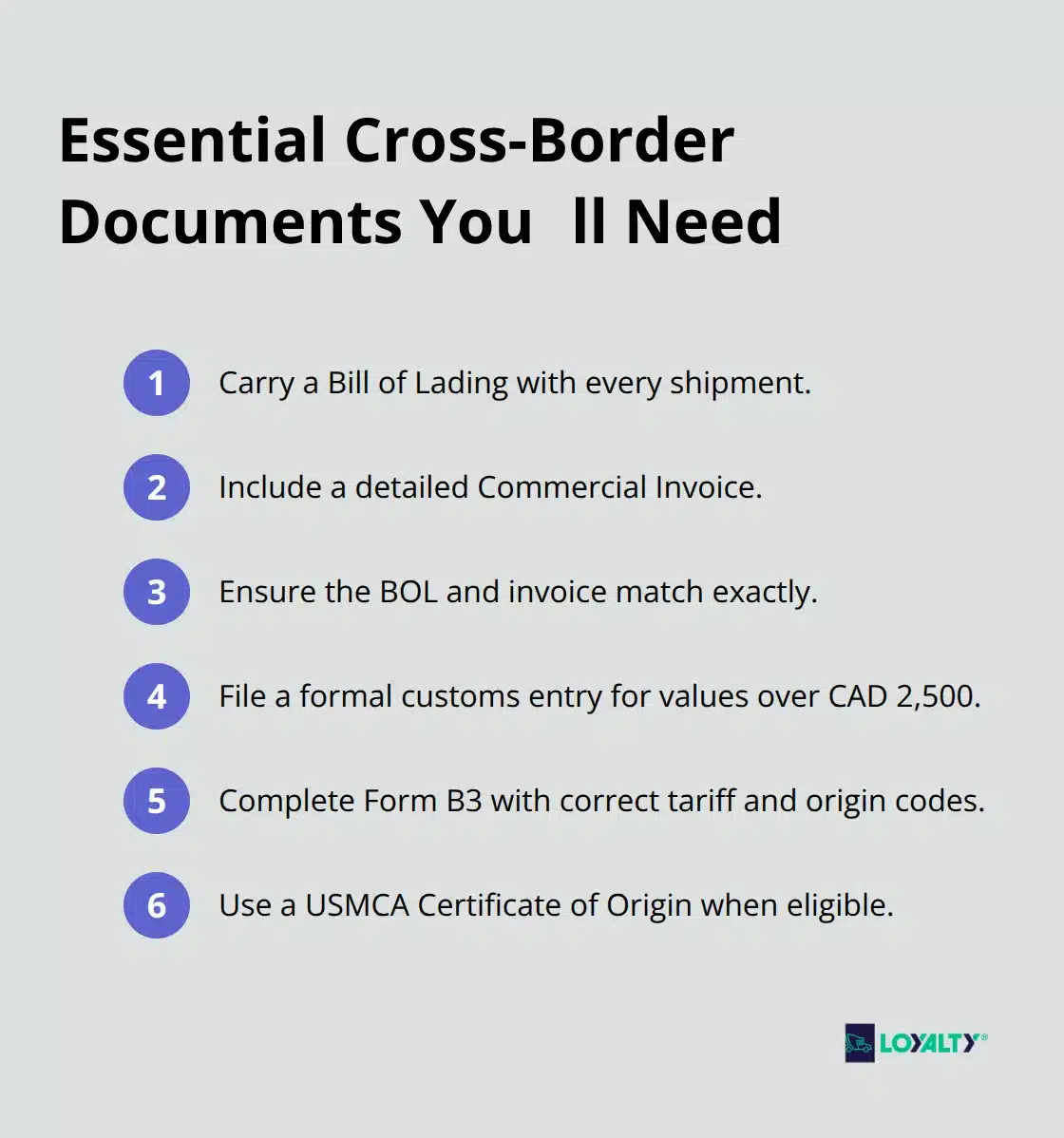
For formal entries over CAD 2,500, you must file a formal customs entry with more than 20 required data elements. Form B3, the Canada Customs Coding Form, has 51 fields and requires special codes for mode, tariff treatment, and origin; incorrect codes here will slow your clearance significantly.
Get Your Tariff Classification Right the First Time
Tariff classification determines your duty rate, and incorrect HS codes rank as a leading source of delays and post-release corrections. The Harmonized System uses standardized six-digit codes internationally, but if you choose wrong, CBSA will flag it. You need to describe items specifically-not vaguely. Say wiper blades, not auto parts. Generic descriptions trigger additional checks that add days to your timeline. Under USMCA tariff rules, you need a Certificate of Origin to claim duty-free benefits for eligible goods, and this certificate can now be electronic. The problem: eligibility isn’t automatic, and claiming benefits incorrectly results in penalties. Many shippers skip this step or get it wrong, leaving money on the table. A licensed customs broker can determine the correct code and help you claim valid preferential treatment, which costs less than paying unnecessary duties. Origin itself is tricky-it’s where goods are manufactured, not where they ship from. Incorrect origin declarations delay clearance and can trigger reclassifications after release.
Pre-Clear Before You Arrive at the Border
Preclearance systems in Canada (PARS) and the U.S. (PAPS) let you submit release information before your truck reaches the border. This reduces crossing times from hours to minutes in some cases, depending on traffic and the crossing point. You file data electronically, and border officials review it ahead of arrival. This works only if your documentation is complete and accurate-incomplete submissions won’t clear faster. Plan and verify all required paperwork with your customs broker at least a full week before shipment. Online clearance visibility tools let you monitor pre-clearance progress as your shipment approaches, so you know the status before arrival. Almost 30,000 trucks cross the Canada-U.S. border daily, and the ones that move fastest are those with pre-clearance and accurate documentation. If your goods require permits from other government departments-food items need CFIA approval, drugs need Health Canada approval-identify those agencies early. Delays at the border are largely avoidable with complete CBSA documentation and compliance data, according to the Canada Border Services Agency itself. Don’t wait until your truck is at the crossing to discover a missing permit or incorrect HS code.
Identify Regulatory Requirements Beyond Customs
Many shipments require approvals from other government departments beyond CBSA. Food and plant products need CFIA clearance, while drugs and medical devices require Health Canada approval. You must identify applicable agencies early in your planning process, not after your freight arrives at the border. Alcohol and tobacco shipments also require provincial or territorial authority checks in addition to federal import guidance. The CBSA Reference List for Importers helps you identify which agencies apply to your goods. Controlled goods under the Defence Production Act require registration with the Controlled Goods Program before shipment. Compliance with marking and labeling requirements, including country of origin, affects clearance speed and can result in penalties if overlooked. Verify all regulatory needs on the CBSA website before shipping, since requirements change and archived guidance may not reflect current rules.
Work With a Customs Broker to Avoid Costly Mistakes
A licensed customs broker handles document transmission, release requests, and duty payments on your behalf. Brokers can obtain release, prepare and transmit documents, and maintain records, which speeds your clearance significantly. You remain responsible for all accounting and potential reclassifications even when using a broker, so maintain thorough records. The CBSA maintains a licensed customs broker list to help you find qualified professionals. Brokers perform services for a fee, but the cost is typically far less than the delays and penalties that result from documentation errors. Many shippers attempt to handle cross-border compliance alone and end up paying more in corrected duties and lost time than a broker would have charged. Your broker should work with you at least a full week before shipment to verify all required paperwork and identify any permits or special requirements. This advance planning is what separates fast border crossings from costly delays.
The documentation and compliance work you do before shipment directly determines whether your freight clears in hours or sits at the border for days. With nearly 30,000 trucks crossing daily and competition for border resources, shippers who prioritize accuracy and preclearance move faster and cheaper than those who cut corners. Your next step is selecting the right transportation mode and service level for your specific shipment, which depends on weight, distance, timeline, and budget constraints.
Tired of CBSA holds stalling your Canadian freight?
Loyalty Logistics files PARS preclearance, works with CBSA-licensed brokers, and verifies USMCA paperwork a week before pickup so your shipment crosses in minutes, not hours.
Choosing the Right Freight Solution for Your Needs
Direct Carriers vs. Freight Brokers: Which Path Fits Your Operation
Cross-border freight moves via three main pathways: direct with a carrier that holds authority in both countries, through a cross-border 3PL or freight broker with access to multiple carriers, or via a combination approach depending on your shipment characteristics. The decision hinges on weight, distance, timeline, and how much control you need over the process. Not all carriers hold dual authority-many U.S. carriers cannot legally operate in Canada and vice versa. A cross-border 3PL or freight broker solves this by connecting you to hundreds of carriers and giving you flexibility for capacity and competitive pricing, especially if you ship irregularly or in smaller volumes. High-volume shippers moving regular truckloads benefit from direct carrier relationships and negotiated rates. Small to mid-sized businesses shipping sporadically get better pricing and fewer empty miles through a broker network.
LTL vs. Full Truckload: Match Your Shipment Size to Service Type
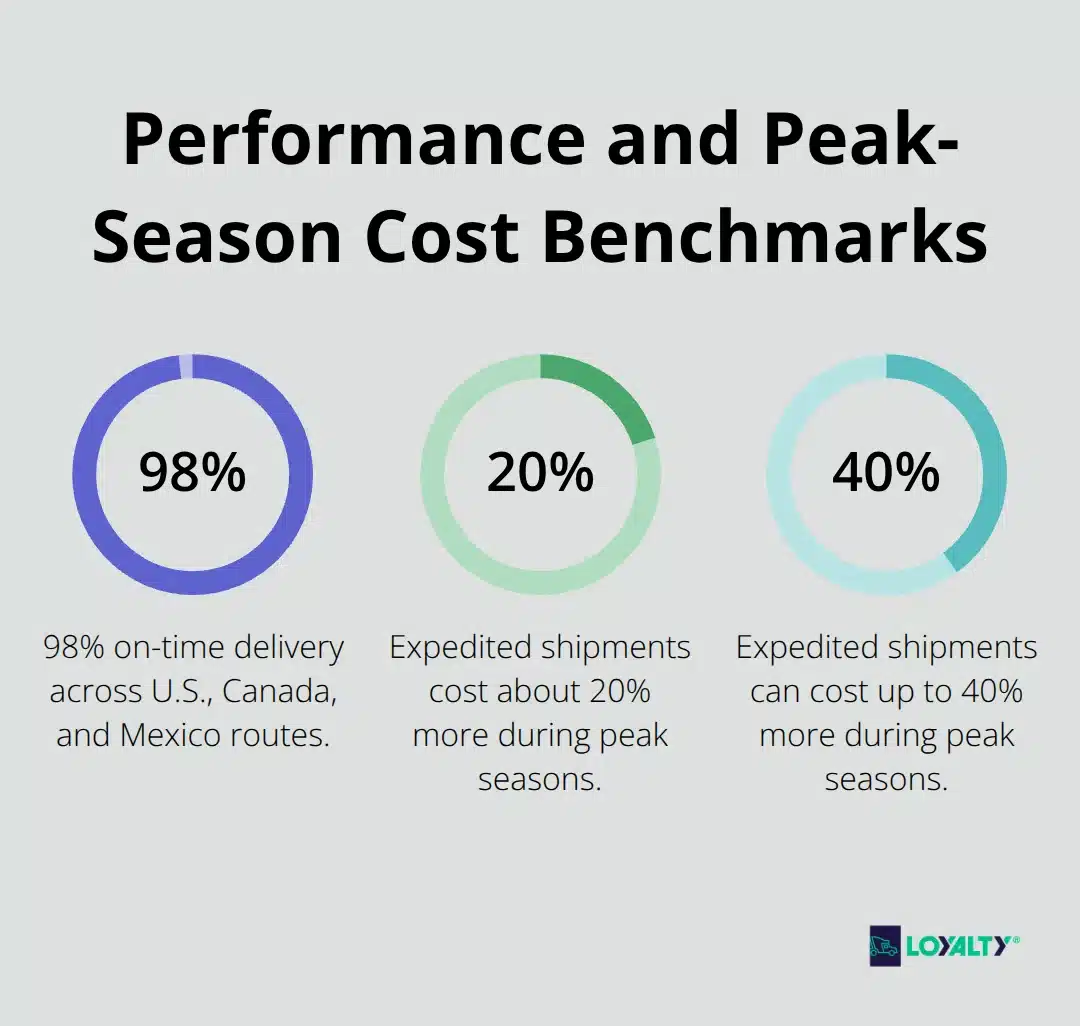
For shipments under 15,000 pounds, Less-Than-Truckload (LTL) service offers cost efficiency without paying for empty truck space. LTL freight between Canada and the U.S. typically arrives in 2 to 4 business days after customs clearance, though actual timing depends on your service level and which crossing point you use. A dedicated carrier with authority to operate in both countries works best for full truckload shipments exceeding 15,000 pounds, giving you exclusive truck use and direct border crossing at volume-based pricing. Loyalty Logistics provides refrigerated, reefer, and flatbed trucks alongside LTL options, with a 98% on-time delivery rate across U.S., Canada, and Mexico routes.
Control Your Costs Through Smart Service Selection and Optimization
Cost factors in cross-border freight include destination distance, package weight and dimensions, required speed, applicable duties and taxes, and which carrier you select. Ground service costs significantly less than expedited or overnight services for most routes, though the time difference rarely justifies the premium. Representative discounts show U.S. Ground service at approximately $11.31 for 5 to 7 day delivery, though rates vary by distance and weight. Packaging optimization directly reduces your bill-use appropriately sized boxes, minimize dimensional weight, and choose recycled materials to cut costs without sacrificing protection. Print postage at home to access carrier discounts and streamline label creation. If you ship 250 or more shipments weekly, negotiate complimentary pickup; otherwise, drop off at a local carrier branch to eliminate pickup fees. Route timing matters significantly: Toronto to Detroit typically costs less and moves in roughly 2 days, while Vancouver to Los Angeles takes 3 to 4 days and costs more due to distance. Understanding the baseline of trucking costs in Canada helps you benchmark quotes against what is realistic for the lane. Plan a shipping calendar to standardize delivery timelines and avoid last-minute shipments that command premium rates. Nearly 30% of all Canada-U.S. cross-border freight moves by truck annually, and the shippers who pay the lowest rates consolidate shipments, use preclearance to avoid border delays, and select service levels that match actual business needs rather than defaulting to expedited options. Transparent pricing with no hidden fees (including customs support, weight and volume calculations, distance, and service level) lets you compare providers fairly and forecast costs accurately.
Your transportation mode and service selection directly impact both your delivery timeline and your bottom line. The next section examines the real obstacles that disrupt freight movement across North America and how to plan around them.
Paying expedited premiums 20-40% above standard because capacity ran out?
Tell us your lanes and typical volumes. We’ll quote consolidated LTL, dedicated FTL, or reefer capacity with itemized rates and no fuel-surcharge surprises.
Common Challenges in Canada Freight Shipping
Winter Weather Disrupts Major Cross-Border Routes
Winter conditions on major cross-border routes shut down traffic regularly, and spring thaw creates unpredictable delays that no amount of planning fully eliminates. The Trans-Canada Highway and routes through the Rocky Mountains experience closures that strand shipments for 12 to 48 hours, forcing you to reroute through longer distances or wait for conditions to clear. Eastern routes through Quebec and Ontario face similar winter disruptions, though less severe than western corridors. Geographic reality means your Toronto-to-Detroit shipment moves faster and more predictably than Vancouver-to-Los Angeles, which adds 1 to 2 days simply due to terrain and distance.
The bigger operational problem isn’t weather itself-it’s that most logistics managers fail to build adequate buffer time into their timelines. A shipment planned for 3 days becomes a crisis when winter adds 2 days, yet the same manager would accept a 5-day timeline without complaint if communicated upfront. Talk to your carrier about seasonal routing alternatives and realistic timelines before you commit to delivery dates with customers. Some routes have reliable detour options; others don’t.
Driver Shortages and Capacity Constraints Hit Harder Than Weather
Driver availability and truck capacity constraints hit harder than weather because they represent structural problems in the market, not temporary obstacles. Almost 30,000 trucks cross the Canada-U.S. border daily according to border statistics, yet the trucking industry faces a chronic driver shortage that worsens each year. You cannot hire your way out of this problem-you can only plan around it.
Shippers who consolidate less-than-truckload freight into full loads move faster and cheaper than those shipping sporadic small shipments. Consolidation reduces the number of trucks needed and improves carrier utilization, which means carriers prioritize your shipments and offer better rates. If you cannot consolidate, use a freight broker with access to hundreds of carriers rather than relying on a single carrier who may lack capacity when you need it.
Peak Seasons Create Capacity Crunches and Higher Costs
Peak seasons-Q4 retail, harvest periods in agriculture, back-to-school-create capacity crunches where carriers book out 5 to 10 days in advance. Plan your shipments around these peaks or accept that expedited service will cost 20 to 40 percent more during these windows. Carriers prioritize high-margin expedited shipments over standard service when capacity tightens, which means your standard shipment waits longer.
Supply Chain Disruptions Cascade When Multiple Problems Hit Simultaneously
Supply chain disruptions cascade quickly once customs delays, weather, or capacity constraints hit simultaneously. A shipment delayed 2 days at the border combined with a truck shortage and winter weather becomes a 5-day delay that destroys your delivery promise. The solution isn’t to absorb delays-it’s to build realistic timelines, use preclearance to eliminate customs delays, and maintain relationships with carriers who communicate proactively when problems emerge.
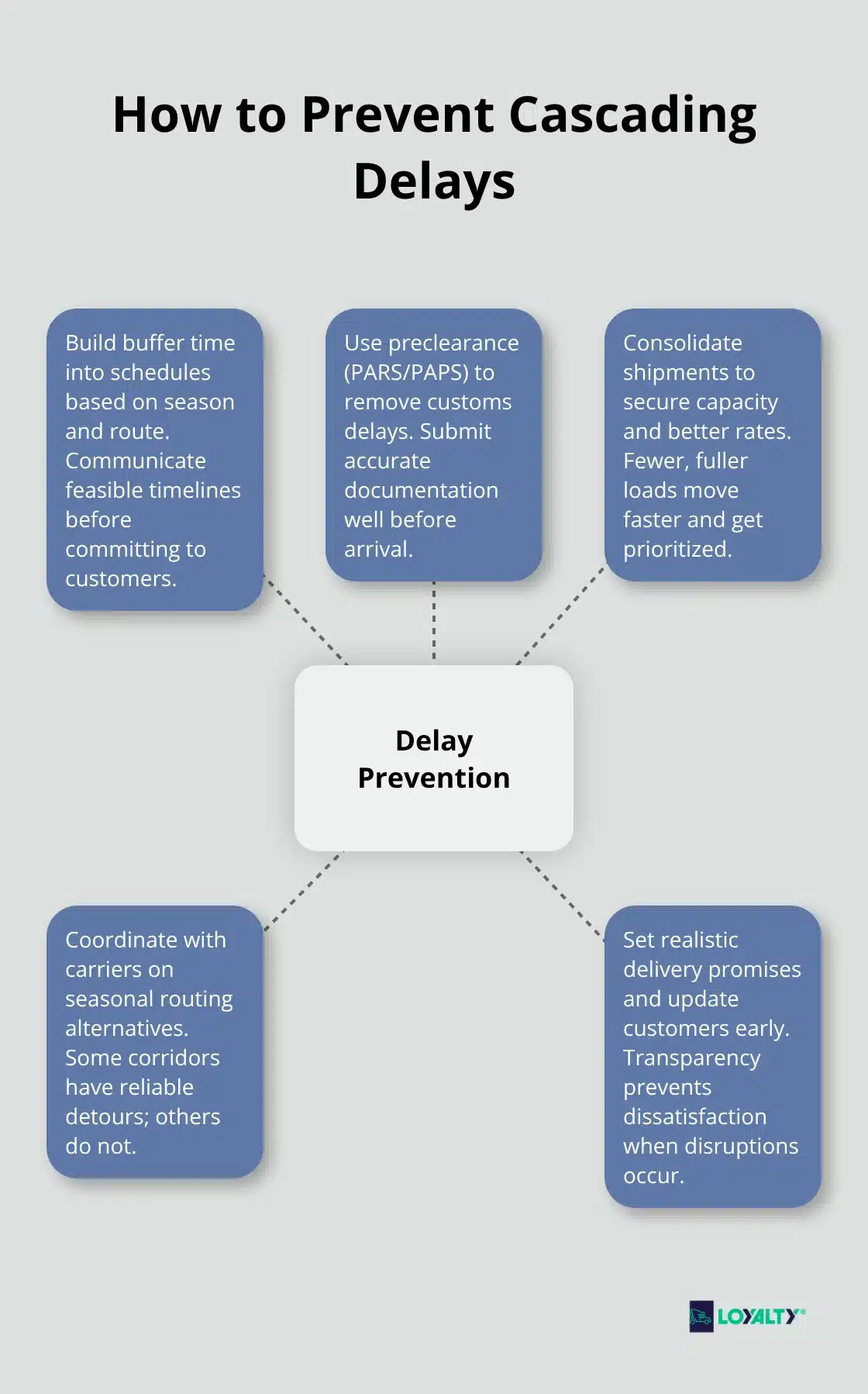
Transparency about realistic timelines prevents customer dissatisfaction far more effectively than promising speed you cannot guarantee. Loyalty Logistics operates across the U.S., Canada, and Mexico with refrigerated, reefer, and flatbed trucks alongside LTL options, allowing you to consolidate shipments efficiently without sacrificing speed or flexibility. When you work with a carrier who understands these constraints and communicates openly about what’s possible, you avoid the surprises that damage customer relationships and your reputation.
Final Thoughts
Shipping freight from Canada successfully requires three core actions: handle documentation correctly before your shipment leaves, select the right transportation mode for your weight and timeline, and build realistic schedules that account for weather, capacity constraints, and border processing. Logistics managers who prioritize preclearance, verify paperwork a full week before shipment, and work with licensed customs brokers move freight faster and cheaper than those who treat compliance as an afterthought. The shippers paying the lowest rates consolidate loads, avoid peak season premiums, and match service levels to actual business needs rather than defaulting to expedited options that cost 20 to 40 percent more.
We at Loyalty Logistics understand these operational realities because we move freight across the U.S., Canada, and Mexico daily. Our refrigerated, reefer, and flatbed trucks alongside LTL shipping options provide flexibility to consolidate efficiently without sacrificing speed, and we maintain a 98% on-time delivery rate across all routes. Our team communicates proactively about realistic timelines and potential obstacles, preventing the surprises that damage customer relationships when you ship freight from Canada.
Connect with a carrier who understands cross-border complexity and can support your specific shipment characteristics. Explore our freight transportation services or reach out directly to discuss your Canadian freight needs. Whether you ship full truckloads regularly or consolidate sporadic LTL freight, we provide the reliability and transparency that turn logistics from a cost center into a competitive advantage.
Frequently Asked Questions
What documents do you need to ship freight from Canada to the U.S.?
To ship freight from Canada to the U.S., you need a Bill of Lading, Commercial Invoice (with vendor and consignee details, item descriptions, weights, unit prices, and delivery terms), and accurate Harmonized System (HS) codes. For formal entries over CAD 2,500 you must file Form B3 (Canada Customs Coding Form) with 51 fields. USMCA-eligible goods need a Certificate of Origin, and controlled goods like food, drugs, or Defence Production Act items need specific permits from CFIA, Health Canada, or the Controlled Goods Program.
How long does shipping freight from Canada to the U.S. take?
LTL freight between Canada and the U.S. typically arrives in 2 to 4 business days after customs clearance. Toronto to Detroit moves in roughly 2 days, while Vancouver to Los Angeles takes 3 to 4 days due to distance. Border crossing time varies from minutes (with PARS or PAPS preclearance) to 12+ hours during peak seasons or when documentation is incomplete. Winter storms can add 12 to 48 hours on western routes through the Rocky Mountains.
What is the difference between PARS and PAPS in Canada-U.S. freight?
PARS (Pre-Arrival Review System) is Canada’s preclearance program for freight entering Canada, and PAPS (Pre-Arrival Processing System) is the U.S. equivalent for freight entering the United States. Both systems let you submit release information before your truck reaches the border so officials can review documentation in advance. With accurate and complete submissions, these systems reduce crossing times from hours to minutes. Incomplete submissions do not clear faster.
Should you use LTL or full truckload for shipping freight from Canada?
Use LTL (Less-Than-Truckload) for shipments under 15,000 pounds to avoid paying for empty truck space. Use FTL (full truckload) for shipments exceeding 15,000 pounds or when you need exclusive truck use, direct border crossing, and volume-based pricing. FTL moves faster because a single carrier maintains control from pickup to delivery without handoffs at the border. LTL is cheaper but introduces multiple handoffs where data errors can compound.
Ready to Ship Freight From Canada Without Border Surprises?
Shipping freight from Canada pays off when documentation, carrier authority, and preclearance line up. Tell us your lanes, commodities, and volumes and we’ll build a plan with PARS paperwork filed in advance, CBSA-licensed brokers, and itemized pricing so nothing surprises you at the border or on the invoice.
Related Articles
- Freight Shipping to Canada: Complete Guide: The reverse-direction playbook for U.S. shippers moving freight into Canada.
- What Is a Customs Broker?: Deeper dive on the broker role that drives most Canadian clearance outcomes.
- Cross Border Shipping: Complete Guide [2026]: North American cross-border playbook covering Canada, Mexico, and U.S. lanes.
Loyalty Logistics: Connecting businesses with opportunities across North America.
Written by: Carlos Robayo, Marketing Director at Loyalty Logistics
With expertise in logistics marketing and international trade, Carlos specializes in connecting businesses with efficient and reliable transport solutions for the North American market.

